Ai Y, Meng Y, Yan B, Zhou Q, Wang X. The biochemical pathways of apoptotic, necroptotic, pyroptotic, and ferroptotic cell death. Mol Cell. 2024;84:170–9.
Google Scholar
Bhardwaj JK, Paliwal A, Saraf P. Effects of heavy metals on reproduction owing to infertility. J Biochem Mol Toxicol. 2021;35:e22823.
Google Scholar
Bhardwaj JK, Siwach A, Sachdeva D, Sachdeva SN. Revisiting cadmium-induced toxicity in the male reproductive system: an update. Arch Toxicol. 2024;98:3619–39.
Google Scholar
Eiyama A, Okamoto K. PINK1/Parkin-mediated mitophagy in mammalian cells. Curr Opin Cell Biol. 2015;33:95–101.
Google Scholar
Hu W, Yu Z, Gao X, Wu Y, Tang M, Kong L. Study on the damage of sperm induced by nickel nanoparticle exposure. Environ Geochem Health. 2020;42:1715–24.
Google Scholar
Iavicoli I, Leso V, Schulte PA. Biomarkers of susceptibility: state of the art and implications for occupational exposure to engineered nanomaterials. Toxicol Appl Pharmacol. 2016;299:112–24.
Google Scholar
Iqbal S, Jabeen F, Chaudhry AS, Shah MA, Batiha GE-S. Toxicity assessment of metallic nickel nanoparticles in various biological models: an interplay of reactive oxygen species, oxidative stress, and apoptosis. Toxicol Ind Health. 2021;37:635–51.
Google Scholar
Jaji N-D, Lee HL, Hussin MH, Akil HM, Zakaria MR, Othman MBH. Advanced nickel nanoparticles technology: from synthesis to applications. Nanotechnology Rev. 2020;9:1456–80.
Google Scholar
Jensen TK, Bonde JP, Joffe M. The influence of occupational exposure on male reproductive function. Occup Med. 2006;56:544–53.
Google Scholar
Jiang Y, Wang C, Ma L, Gao T, Wāng Y. Environmental profiles, hazard identification, and toxicological hallmarks of emerging tire rubber-related contaminants 6PPD and 6PPD-quinone. Environ Int. 2024;187:108677.
Google Scholar
Kamal R, Kumar V, Kumar R, Bhardwaj JK, Saraf P, Kumari P, et al. Design, synthesis, and screening of triazolopyrimidine-pyrazole hybrids as potent apoptotic inducers. Arch Pharm. 2017;350(11):1700137.
Google Scholar
Kanamori M, Oikawa K, Tanemura K, Hara K. Mammalian germ cell migration during development, growth, and homeostasis. Reprod Med Biol. 2019;18:247–55.
Google Scholar
Kong L, Tang M, Zhang T, Wang D, Hu K, Lu W, et al. Nickel nanoparticles exposure and reproductive toxicity in healthy adult rats. Int J Mol Sci. 2014;15:21253–69.
Google Scholar
Kong L, Gao X, Zhu J, Cheng K, Tang M. Mechanisms involved in reproductive toxicity caused by nickel nanoparticle in female rats. Environ Toxicol. 2016;31:1674–83.
Google Scholar
Kong L, Gao X, Zhu J, Zhang T, Xue Y, Tang M. Reproductive toxicity induced by nickel nanoparticles in Caenorhabditis elegans. Environ Toxicol. 2017;32:1530–8.
Google Scholar
Kong L, Hu W, Gao X, Wu Y, Xue Y, Cheng K, et al. Molecular mechanisms underlying nickel nanoparticle induced rat Sertoli-germ cells apoptosis. Sci Total Environ. 2019a;692:240–8.
Google Scholar
Kong L, Hu W, Lu C, Cheng K, Tang M. Mechanisms underlying nickel nanoparticle induced reproductive toxicity and chemo-protective effects of vitamin C in male rats. Chemosphere. 2019b;218:259–65.
Google Scholar
Kong L, Dong J, Lu W, Wu Y, Liu L, Tang M. Exposure effects of inhaled nickel nanoparticles on the male reproductive system via mitochondria damage. NanoImpact. 2021a;23:100350.
Google Scholar
Kong L, Wu Y, Hu W, Liu L, Xue Y, Liang G. Mechanisms underlying reproductive toxicity induced by nickel nanoparticles identified by comprehensive gene expression analysis in GC-1 spg cells. Environ Pollut. 2021b;275:116556.
Google Scholar
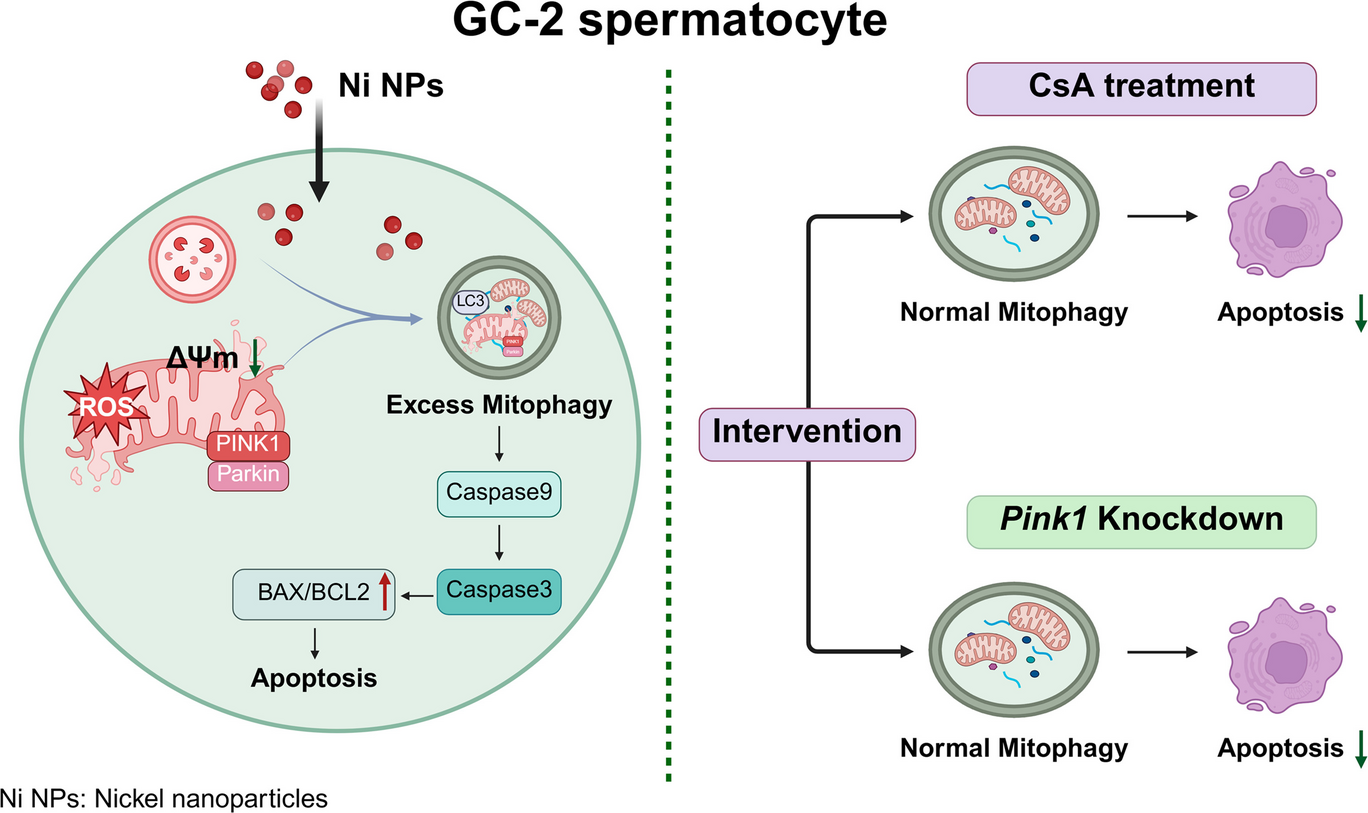
Kong L, Dong J, Wāng Y. Mitochondrial homeostasis via Pink1 control alleviates nickel nanoparticle-induced reproductive damage in mouse spermatocyte GC-2 cells. Environ Int. 2025;206:109910.
Google Scholar
Kubli DA, Gustafsson ÅB. Mitochondria and mitophagy: the yin and yang of cell death control. Circ Res. 2012;111:1208–21.
Google Scholar
Kumar S. Occupational exposure associated with reproductive dysfunction. J Occup Health. 2004;46:1–19.
Google Scholar
Levine H, Jørgensen N, Martino-Andrade A, Mendiola J, Weksler-Derri D, Jolles M, et al. Temporal trends in sperm count: a systematic review and meta-regression analysis of samples collected globally in the 20th and 21st centuries. Hum Reprod Update. 2023;29:157–76.
Google Scholar
Liu L, Kong L. Research progress on the carcinogenicity of metal nanomaterials. J Appl Toxicol. 2021;41:1334–44.
Google Scholar
Liu N, Tang M. Toxic effects and involved molecular pathways of nanoparticles on cells and subcellular organelles. J Appl Toxicol. 2020;40:16–36.
Google Scholar
Liu L, Lu W, Dong J, Wu Y, Tang M, Liang G, et al. Study of the mechanism of mitochondrial division and mitochondrial autophagy in the male reproductive toxicity induced by nickel nanoparticles. Nanoscale. 2022a;14:1868–84.
Google Scholar
Liu M, Wang B, Cui Y, Xiao B, Liu P, Gao J, et al. Pink1/Parkin-mediated mitophagy is activated to protect against testicular damage caused by aluminum. J Inorg Biochem. 2022b;232:111840.
Google Scholar
Mo Y, Jiang M, Zhang Y, Wan R, Li J, Zhong CJ, et al. Comparative mouse lung injury by nickel nanoparticles with differential surface modification. J Nanobiotechnol. 2019;17:2.
Google Scholar
Mo Y, Zhang Y, Zhang Y, Yuan J, Mo L, Zhang Q. Nickel nanoparticle-induced cell transformation: involvement of DNA damage and DNA repair defect through HIF-1α/miR-210/Rad52 pathway. J Nanobiotechnol. 2021;19:370.
Google Scholar
Mo Y, Zhang Y, Zhang Q. The pulmonary effects of nickel-containing nanoparticles: cytotoxicity, genotoxicity, carcinogenicity, and their underlying mechanisms. Environ Sci Nano. 2024;11:1817–46.
Google Scholar
More SL, Kovochich M, Lyons-Darden T, Taylor M, Schulte AM, Madl AK. Review and evaluation of the potential health effects of oxidic nickel nanoparticles. Nanomaterials. 2021;11:642.
Google Scholar
Nguyen TN, Padman BS, Lazarou M. Deciphering the molecular signals of PINK1/Parkin mitophagy. Trends Cell Biol. 2016;26:733–44.
Google Scholar
Panchal H, Bhardwaj JK. Quercetin supplementation alleviates cadmium induced genotoxicity-mediated apoptosis in caprine testicular cells. Biol Trace Elem Res. 2024;202:1–14.
Google Scholar
Phillips JI, Green FY, Davies JC, Murray J. Pulmonary and systemic toxicity following exposure to nickel nanoparticles. Am J Ind Med. 2010;53:763–7.
Google Scholar
Rambold AS, Lippincott-Schwartz J. Mechanisms of mitochondria and autophagy crosstalk. Cell Cycle. 2011;10:4032–8.
Google Scholar
Roca-Agujetas V, de Dios C, Lestón L, Marí M, Morales A, Colell A. Recent insights into the mitochondrial role in autophagy and its regulation by oxidative stress. Oxid Med Cell Longev. 2019;2019:3809308.
Google Scholar
Roychoudhury S, Saha MR, Saha MM. Environmental toxicants and male reproductive toxicity: oxidation-reduction potential as a new marker of oxidative stress in infertile men. Netw Mutagens Environ Toxicol. 2019:99–115.
Sana SS, Singh RP, Sharma M, Srivastava AK, Manchanda G, Rai AR, et al. Biogenesis and application of nickel nanoparticles: a review. Curr Pharm Biotechnol. 2021;22:808–22.
Google Scholar
Santiago J, Santos M, Fardilha M, Silva J. Stress response pathways in the male germ cells and gametes. Mol Hum Reprod. 2020;26:1–13.
Google Scholar
Sinha K, Das J, Pal PB, Sil PC. Oxidative stress: the mitochondria-dependent and mitochondria-independent pathways of apoptosis. Arch Toxicol. 2013;87:1157–80.
Google Scholar
Springer W, Kahle PJ. Regulation of PINK1-Parkin-mediated mitophagy. Autophagy. 2011;7:266–78.
Google Scholar
Szabó A, Nyirády P, Kopa Z. Impact of lifestyle and environmental factors on fertility. Curr Opin Urol. 2025;35:685–90.
Google Scholar
Vassal M, Rebelo S, Pereira MdL. Metal oxide nanoparticles: evidence of adverse effects on the male reproductive system. Int J Mol Sci. 2021;22:8061.
Google Scholar
Wāng Y. Ambient fine particulate matter provokes multiple modalities of cell death via perturbation of subcellular structures. Environ Int. 2025a;195:109193.
Google Scholar
Wāng Y. Physicochemical properties and combined toxic effects of micro- and nanoplastics on gut and gut-organ axes. Trends Food Sci Technol. 2025b;165:105265.
Google Scholar
Wāng Y, Han Y, Xu DX. Developmental impacts and toxicological hallmarks of silver nanoparticles across diverse biological models. Environ Sci Ecotechnol. 2024;19:100325.
Google Scholar
Wāng Y, Han Y, Xu DX. Mitochondrial metabolism reprogramming-mediated cardiomyocyte senescence involved in arsenic stress-evoked heart failure. Environ Int. 2025;202:109686.
Google Scholar
Wang J, Jiang Y, Wāng Y. Toxicity assessment of SiO(2) nanoparticles on developmental and reproductive traits in Drosophila melanogaster. Nanotoxicology. 2025;19:651–64.
Google Scholar
Wu Y, Kong L. Advance on toxicity of metal nickel nanoparticles. Environ Geochem Health. 2020;42(7):2277–86.
Google Scholar
Wu Y, Ma J, Sun Y, Tang M, Kong L. Effect and mechanism of PI3K/AKT/mTOR signaling pathway in the apoptosis of GC-1 cells induced by nickel nanoparticles. Chemosphere. 2020;255:126913.
Google Scholar
Xu J, Wang L, Zhang L, Zheng F, Wang F, Leng J, et al. Mono-2-ethylhexyl phthalate drives progression of PINK1-parkin-mediated mitophagy via increasing mitochondrial ROS to exacerbate cytotoxicity. Redox Biol. 2021;38:101776.
Google Scholar
Yi L, Shang XJ, Lv L, Wang Y, Zhang J, Quan C, et al. Cadmium-induced apoptosis of Leydig cells is mediated by excessive mitochondrial fission and inhibition of mitophagy. Cell Death Dis. 2022;13:928.
Google Scholar
Yuan J, Zhang Y, Zhang Y, Mo Y, Zhang Q. Effects of metal nanoparticles on tight junction-associated proteins via HIF-1α/miR-29b/MMPs pathway in human epidermal keratinocytes. Part Fibre Toxicol. 2021;18:13.
Google Scholar
Yuan J, Mo Y, Zhang Y, Zhang Y, Zhang Q. Nickel nanoparticles induce epithelial-mesenchymal transition in human bronchial epithelial cells via the HIF-1α/HDAC3 pathway. Nanotoxicology. 2022;16:695–712.
Google Scholar
Yuan J, Mo Y, Zhang Y, Zhang Y, Zhang Q. Nickel nanoparticles induce autophagy and apoptosis via HIF-1α/mTOR signaling in human bronchial epithelial cells. Environ Pollut. 2023;329:121670.
Google Scholar
Zheng H, Liang G, Guan C, Liu L, Dong J, Zhao J, et al. Mitochondrial fission in nickel nanoparticle-induced reproductive toxicity: an in vitro GC-1 cell study. Nanomaterials. 2024;14:689.
Google Scholar
Zhou X, Liao J, Lei Z, Yao H, Zhao L, Yang C, et al. Nickel-based nanomaterials: a comprehensive analysis of risk assessment, toxicity mechanisms, and future strategies for health risk prevention. J Nanobiotechnology. 2025;23:211.
Google Scholar

Comments (0)