This is the first study to evaluate the effects of a spray-dried Vistula TC extract on indices of recovery following a marathon. The marathon caused changes in indices of muscle damage and hs-CRP in both groups. Despite there being no evidence of functional or perceptual differences between the groups, the TC group did experience significantly lower levels of hs-CRP following the marathon, compared to the placebo control group.
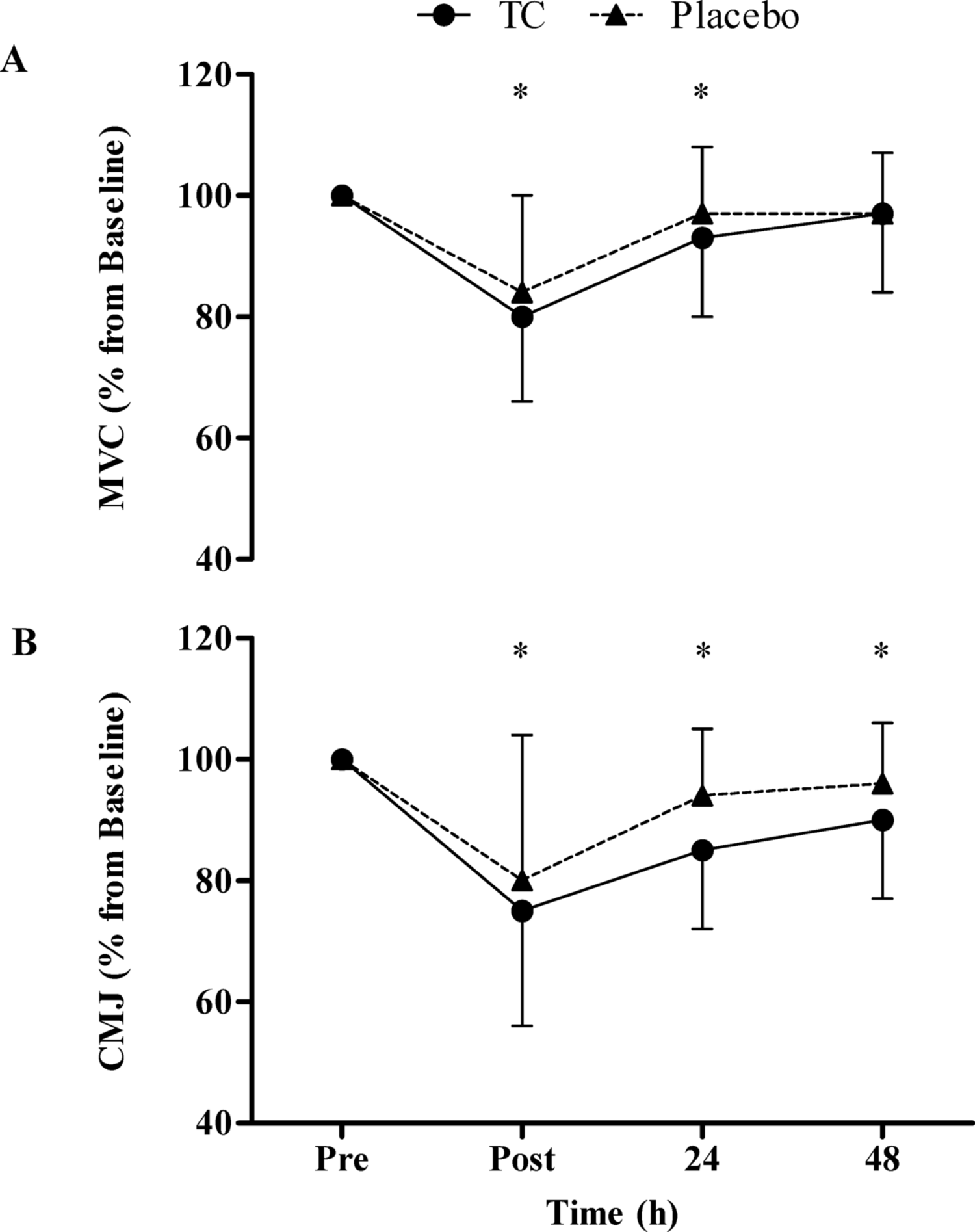
In the present study, no differences were observed between the TC and placebo groups for either functional measure, MVC and CMJ, after a marathon. There has only been one other study which measured MVC after long-distance running [6], and showed an attenuation in strength loss in the TC group, compared to the placebo. Additionally, after a 109 min cycling trial [14] and adapted version of the Loughborough Intermittent Shuttle Test (LIST ADAPT) completing 6 × 15 min sections [15], similar results were seen, in that Montmorency TC consumption improved the post exercise recovery of MVC. It is feasible that the extent of the damage impacts TC effectiveness. In the present study, immediately post marathon MVC were 80 and 84% of baseline for the TC and placebo groups, respectively. However, Howatson, McHugh [6] reported MVC immediately post marathon as ~ 70% of baseline for both groups, with a ~ 10% greater reduction in force generating capacity compared to the present study. Despite the study being adequately powered (according to our calculations) it is conceivable that the study sample size was still insufficient to detect a group difference. Although, previous work has shown a benefit with very modest changes in strength [14], although in that study cycling was the mode of exercise. A potential explanation could be the training history of the participants, which could influence the extent of muscle damage [33, 34]. In the present study there was an average of 7 ± 25 previous marathons completed, with 11 completing this as their first marathon. This is a far greater range of training status in comparison to the previous study [6], of which the participants had completed 5 ± 7 previous marathons, and only 5 completed it as their first.
This study is the first to investigate the Vistula variety of TC, which is spray-dried and consumed in capsule form. Howatson, McHugh [6] provided the Montmorency variety in a juice blend, which was a mixture of freshly prepared TC juice with commercially available apple juice in a proprietary ratio. Although the anthocyanin content (according to the manufacturer) was greater than previous studies, caution should be taken when interpreting the content of the product. Analytical chemistry methodologies can differ between studies and some previous studies reported the phytochemical content that was derived from previously published studies, not from the batch that was used. Environmental factors can markedly influence the concentrations of phytochemicals in batches of TC [19], ranging from 500 to 2300 mg/L of cyanidin-3-glucoside equivalents in TC juice [35]. Thus, even among TC products of the same cultivar, there will be differences in the concentration of polyphenols and anthocyanins. Hence it is difficult to draw definitive conclusions when comparisons cannot easily be made between studies. When exploring other exercise studies, with different methodologies that used a powdered Montmorency TC product, only one has shown any positive effects [22]; all others reporting no effect with a powdered TC product, compared to the placebo group [11, 12, 36]. However, Hooper, Orange [22] report TC to attenuate strength following EIMD, yet hand-grip strength increased over baseline values, suggesting poor familiarisation with the task. Moreover, given the damage protocol consisted of 60 repetitions of barbell back squats (80% of the participants 1RM), assessing hand-grip strength is not an appropriate measure to assess recovery. Vertical jump performance was also assessed, a more appropriate measure following the damage protocol, although there were no differences between the groups, nor were their performance decrements at any timepoints for that measure. Moreover, there the study was a cross-over design, and a contralateral repeated bout effect (adaptation to the non-exercising limb) might have influenced the extent of damage in the limb tested second bout [37, 38], rendering it difficult to draw conclusions from.
The CMJ data, similarly to the MVC data, contrasted with previous research. Bell, Stevenson [15], Brown, Stevenson and Howatson [39] and Quinlan and Hill [40] demonstrated that TC attenuated the loss in jump height following a damaging bout of exercise. Although the exercise employed is different to the present study, the LIST ADAPT and repeated sprints will likely have induced a combination of mechanical and metabolic stress, in a similar way to marathon running. Despite the observation of jump height improvements in the TC group, there were no differences in MVC recovery between groups [39]. Moreover, eccentric damage to the lower limbs resulted in no differences in the recovery of jump height between the groups [9], yet there were differences between the groups for MVC. There are inconsistent results in previous studies between functional recovery measures; in this case jump height and MVC performance. In the present study, both measures of functional recovery declined following the marathon and the TC group did not experience an accelerated recovery.
Muscle soreness has been proposed to occur via a combination of structural damage to the muscle, disrupted calcium homeostasis, and sensitisation of type III and IV afferent nerve endings from inflammatory cell infiltration [41, 42], although the exact mechanisms remain unclear. In the present study, soreness increased over time, suggesting the marathon was successful in inducing muscle damage. However, the lack of effect Vistula TC had on functional variables, was mirrored in soreness. This concurs with previous research [6, 11, 14] with the exception of one study [13], that showed TC to be effective in reducing DOMS. Kuehl, Perrier [13] only assessed the participants perceptions of pain at baseline, before and after a running race that consisted of distances ranging from 5.6 to 12.4 km. The large range in distance covered suggests that participants are likely to experience a range of muscle damage symptoms. When coupled with the fact that soreness was only assessed immediately after the race, drawing meaningful inference to TC being of real benefit is limited. Despite the criticism of CK as a biomarker of EIMD, it can still be useful to serve as a marker that tissue damage has occurred and the sarcolemma has disruption, but is less useful to determine the magnitude of EIMD [43, 44], unless it is extremely elevated to the point of exertional rhabdomyolysis [45]. In the present study, participants experienced muscle damage as increases in DOMS and CK. Hence, the data concur the consensus of the literature, and it is plausible to conclude that TC products do not attenuate pain (or at least have minimal benefit) following long-distance running.
Soreness (passive), fatigue, energy and readiness to train showed differences over time, but no differences between the groups were observed. Despite the differences between the groups in inflammation, this did not translate to perceptual feelings. This is unsurprising as DOMS was not affected by the consumption of TC, so it seems reasonable to assume other perceptual feelings are not affected. Sleepiness showed no differences over time, nor differences between the groups. Although not significant, 48 h post marathon, there is a 30% difference between the groups in reported perceptions of sleepiness (average for the TC group 55 ± 36 vs. placebo group 76 ± 45 mm). Previous research [46, 47], has suggested sleep quality could be influenced by Montmorency TC consumption. Sleep is an important contributing factor to the recovery process [Howatson et al. in press], therefore it seems reasonable to suggest Vistula TC might also improve sleep parameters. Although no differences were observed using a questionnaire, future work could consider using sleep monitoring technology, such as actigraphy.
In agreement with previous studies that observed lower levels of inflammation following endurance exercise with Montmorency TC [6, 11, 14, 16], the present study provided additional evidence that spray-dried Vistula cultivar of TC also attenuated inflammation (hs-CRP) following a marathon. There was a marked reduction in hs-CRP 24 and 48 h post in the TC group, suggesting that the inflammatory response was attenuated. This finding supports the notion that TC supplementation might be more suited to facilitate recovery from exercise that has caused metabolic stress, but little or no effect from mechanically strenuous exercise [21]. One potential explanation for the diminished inflammatory response is that the phytochemicals in TC could reduce the activity of nicotinamide adenine dinucleotide phosphate oxidase, COX, and lipoxygenase, which in turn reduce the formation of ROS [48]. Jung, Kwak and Hwang [49] previously demonstrated that anthocyanins inhibited the COX-1 and COX-2 expression. Another potential explanation could be that TC resulted in a reduction in proteolytic and lipolytic cascades via the COX, prostaglandin, and IL-6 pathways [50, 51]. Prolonged endurance activities, like marathon running, might trigger a systemic inflammatory response, and increased oxidative stress [14]; hence it is plausible the exercise modality and extent of oxidative stress, might amplify TC capacity to alleviate secondary muscle damage. Seemingly, TC supplementation reduced elements of inflammation (as indicated by hs-CRP) but did not allow for greater restoration of muscular performance in the recovery period, which other studies have observed [6, 14, 15].
Potential limitations and weakness of the current study should also be considered. Differences in training status beyond the study inclusion/exclusion criteria could also have been a source of variability in study cohort recruitment. There were no dietary controls in place, which some previous studies have enforced because it allows insight to the potential of polyphenolic compounds. However, this might lead to an overestimation of the intervention effects, and in this case, being a field-based study, no restrictions were in place to increase ecological validity. Lastly, hs-CRP is an immune system protein produced by the liver in response to injury, infection or other inflammatory events [52], hence it is widely accepted as a marker of acute and chronic inflammation. As a result, this measure could be influenced by many factors, and not solely inflammation induced by the marathon. Nevertheless, the major overriding strength of the current study is that this is the first study to be conducted utilising a spray-dried Vistula TC powder.

Comments (0)