Study Design - Qualitative Analysis of Journal Responses
Our study employed a descriptive, qualitative design approach that utilized inductive principles based on grounded theory methodology. Centered on simultaneously analyzing interview observations and identifying emerging concepts and theories, this open-ended approach allowed for the comprehensive capture of themes, events, and emotional responses underlying participants’ global health experiences [11]. By prioritizing participants’ own language and perspectives, we sought to contextualize their reflections within the social and cultural frameworks of their specific host environments. Written narratives were examined with a priority to identify meaningful patterns related to intercultural uncertainty, adaptation, and personal growth throughout the duration of each trip.
This study was not designed to compare sites as discrete analytic units. Instead, sites were treated as contextual conditions informing students’ experiences. While site-specific differences may influence how cultural uncertainty is encountered, the analytic focus was on shared processes across settings rather than comparative site analysis.
Participants
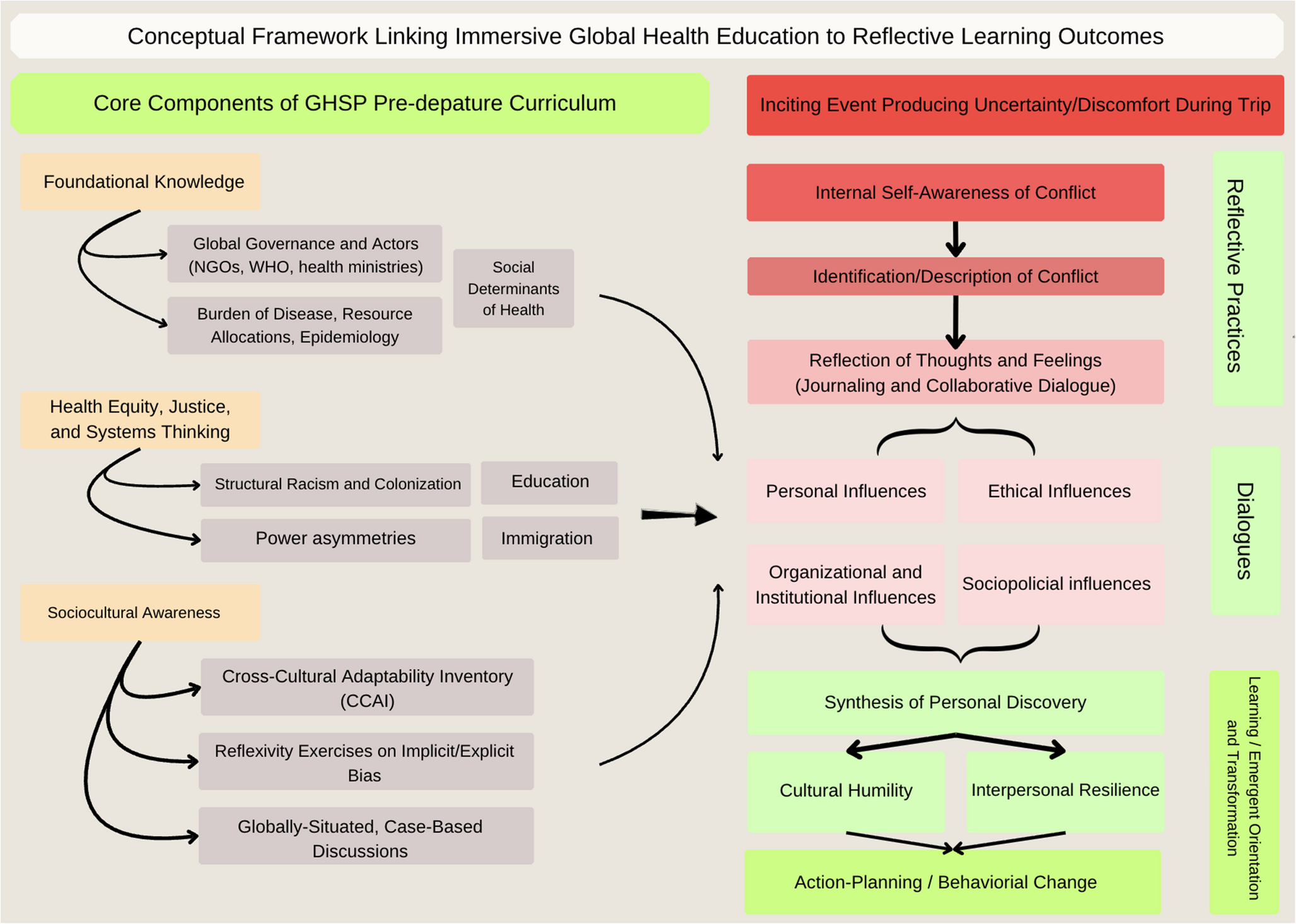
A total of 52 1st year medical students from Penn State College of Medicine participated in the Global Health Scholars Pathway (GHSP), a longitudinal program throughout all four years with integrated immersive international, month-long host-site trips designed to promote experiential learning and cultural competency. Students’ global health experiences ranged across many diverse international sites, including Ghana, Brazil, Ecuador, Australia, Nepal, Vietnam, and Zambia. Each participant was involved to some varying degree in community health initiatives and clinical care within their respective host sites and had established longitudinal relationships with their host environments aimed at enriching their intrinsic schema of global health measures and disparities.
All students participating in GHSP were required to report evolving values, conflicts, and perceptions through journal assessments and entries. Journal entries prompted students to consider three different themes when answering: their experiences with intercultural uncertainty and connections, their experiences with foreign novelty, and their identification of value incongruity. Questions were presented to students under two different subject titles: (1) Intercultural Uncertainty and (2) Feeling Foreign - Being The Other. Trips consisted of one month-long period during the summer with journals collected at the conclusion. Three independent screeners reviewed all journal submissions, and responses that were illegible, incomplete, or empty were excluded. This resulted in 50 viable entries for the “Intercultural Uncertainty” subject title and 52 for “Feeling Foreign—Being the Other” subject title.
Representation of responses reflects multiple individualized backgrounds, including extensive geographic diversity and baseline interactions with international countries prior to initiation of GHSP; this accounts, in part, for the potentially variable situational differences experienced by students within their respective journal entries.
Data Collection
Medical students at Penn State College of Medicine completed a series of structured reflective journal prompts designed to explore their perceptions of their individual GHSP experiences and their impressions of their host community’s cultural values. Each prompt aimed to elicit reflections on moments of uncertainty, ambiguity, and value conflict encountered during their time abroad, along with self-evaluation on how each student responded to discrepancies between their beliefs, emotions, and values with those of their site. Students were tasked with compiling responses during their GHSP trip, conducting weekly retrospection on the events they experienced at their site and annotating their responses.
Journal prompts were arranged into two respective subjects, and response data were collected based on multiple assigned survey questions listed below in Table 1. These prompts were intentionally open-ended and experiential rather than psychometrically validated, consistent with grounded theory’s emphasis on eliciting participant-generated meaning rather than measuring predefined constructs. Prompts were designed to function as sensitizing devices, encouraging reflection on uncertainty, foreignness, and value incongruity without constraining students’ responses to predetermined categories.
We acknowledge that these journal prompts have not undergone formal validation. As such, responses may reflect variability in interpretive depth and writing style. However, this variability was considered analytically valuable, allowing unanticipated processes and perspectives to emerge inductively from the data.
Table 1 Journal prompts for global health studentsQualitative Data Analysis
We employed a constructivist grounded theory approach to explore how medical students make meaning of global health engagements. Consistent with grounded theory principles, data collection and analysis occurred iteratively, allowing analytic insights to inform ongoing coding decisions and theoretical development. Grounded theory principles were operationalized through concurrent data familiarization and coding, constant comparison within and across journal entries, iterative refinement of codes through multiple analytic cycles, and theoretical integration of codes into higher-order conceptual categories, Rather than treating themes as discrete endpoints, analysis emphasized relationships among codes to generate an explanatory framework describing how students experienced and responded to cultural uncertainty during global health engagement.
Two primary coders independently conducted initial line-by-line and incident-by-incident coding of all journal entries. Codes were inductively generated, remained close to the participant’s language, and were framed as actions or processes where possible (e.g., navigating language discordance, questioning assumptions, observing cultural norms). During this phase, an open coding framework was applied, where categories emerged directly from the data instead of pre-set codes of theories. This produced an initial, tentative set of descriptive and process-oriented codes, generated from emerging themes from the journal data and condensed into a preliminary “codebook” that highlighted commonalities between students’ GHSP experiences. This codebook acted as a template on which subsequent review cycles were performed.
Through focused coding, the coders identified the most salient and frequently occurring codes. Using constant comparative methods, codes were compared across participants, across journal prompts, and across international sites. Each reviewer provided supportive quotes to introduce context and evidence for the application of each code within the data. Analytic memos documented evolving code definitions, relationships among codes, and emerging conceptual patterns. These memos informed iterative refinement of the codebook, including consolidation, modification, or elimination of codes across successive analytic cycles. Coding disagreements were resolved through structured discussion and consensus rather than calculation of statistical interrater reliability, consistent with constructionist grounded theory methodology. When discrepancies arose, coders reviewed the relevant excerpts jointly, revised coding definitions, and refined the codebook accordingly. This process prioritized conceptual clarity and theoretical coherence over numerical agreement.
Multiple iterative review cycles of all journal entries were conducted on the journal’s two subjects to ensure the efficacy, accuracy, and reliability of our themes. Review cycles continued over four months, with the last iterative review leading to a reduced, yet more accurate final codebook that included a set of nine robust “codes” with strong thematic evidence and encompassed all significant themes generated from both journal subjects. These codes serve as conceptual anchors representing interrelated dimensions of students’ experiences. Table 2 outlines our finalized code set with examples from our journal analysis.
Codes were considered “robust” when they met three criteria: presence across a substantial proportion of participants (≥ 5 entries, or approximately 10% of journal entries), recurrence across multiple international sites, and conceptual richness, defined by multiple properties and variations identified through constant comparison. Frequency alone was not used as a determinant of analytic importance.
Table 2 Final codebook with journal examplesAdditionally, we sought to ensure accurate consensus and replicability of the finalized codebook. An independent review of three randomized response sets of ten journal participants was conducted. Application of each “code” was conducted on each journal response, with lab members discussing their choice and achieving consensus when each party obtained the same, validated response. Continued revisions were made when applicable in events of coding disagreements, and this process persisted in randomized order until adequate interrater reliability was achieved.
The research team consisted of medical trainees and faculty with prior experience in global health education. The team’s positionality, including shared professional identity with participants and varying degrees of prior international exposure, was explicitly acknowledged throughout the analysis. Reflexive discussions were incorporated into coding meetings to examine how researchers’ assumptions about culture, medicine, and professional growth might shape interpretation of the data. Analytic memos documented these reflections and were revisited during theory development to minimize unexamined bias and enhance interpretive transparency.

Comments (0)