This study demonstrates the feasibility and value of a Shark Tank-inspired, game-based workshop designed to intentionally cultivate persuasive communication, advocacy, and interprofessional collaboration, competencies often underemphasized in traditional curricula. Implemented across five cohorts over five years, EquityRx Tank engaged learners spanning various backgrounds, fostering collaboration from the outset of training. By embedding these competencies in an interactive, theory-driven format, the workshop offered learners an authentic experience to practice persuasive communication and teamwork in addressing real-world health priorities.
While Shark Tank-inspired models have previously been applied to content mastery and curricular innovation, this study extends the literature by intentionally focusing on competency enrichment rather than content reinforcement. In doing so, EquityRx Tank addresses a recognized gap in professionalism and communication training, responding to calls for structured, reproducible approaches to competency development. Notably, this model provides structured practice in advocacy-related communication (i.e., framing a problem, proposing an action-oriented solution, and tailoring a message to decision makers), which aligns with interprofessional communication expectations across health professions training [11].
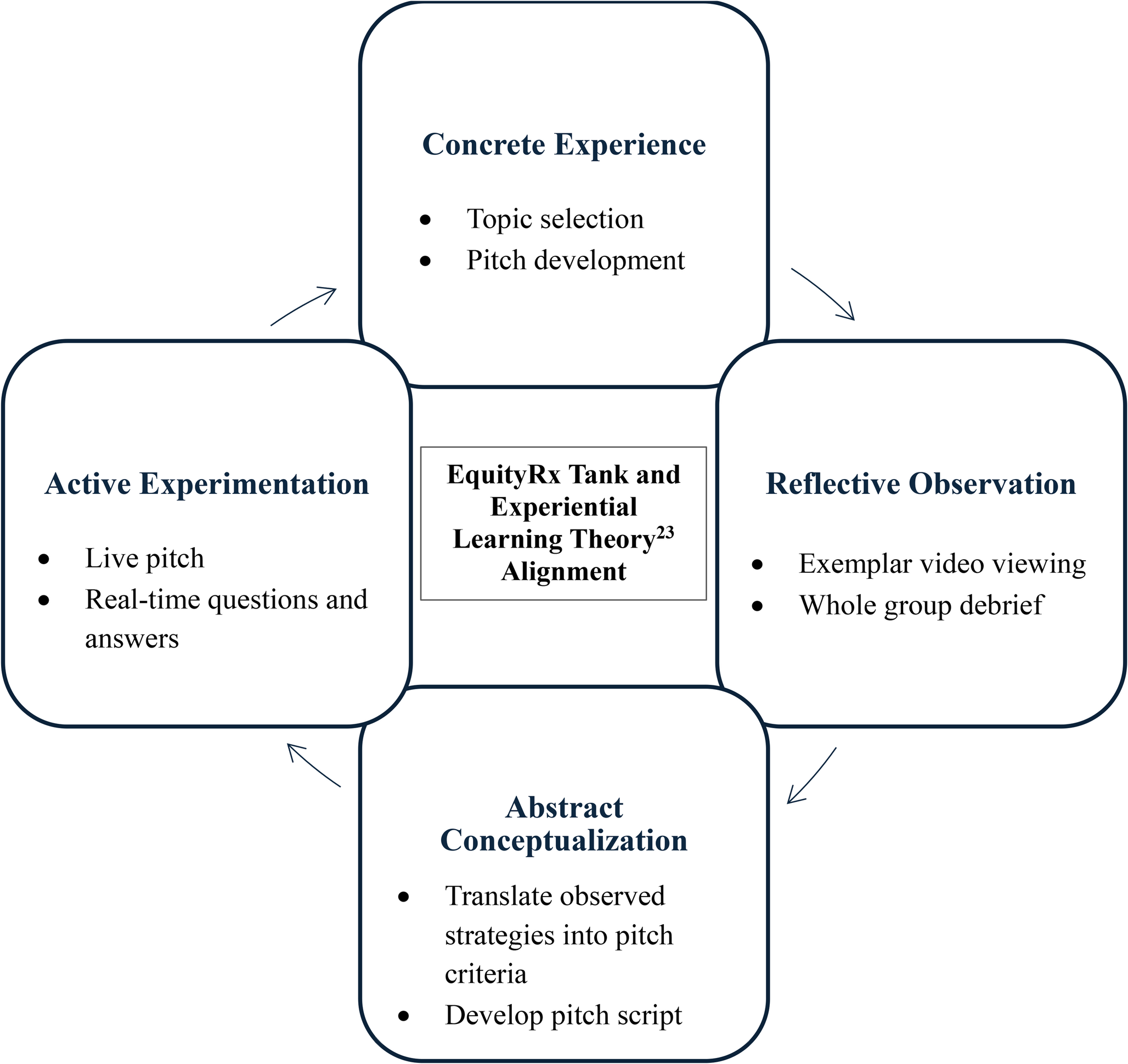
Several features distinguish this instructional design. First, the workshop was explicitly theory-driven, grounded in UbD and Experiential Learning Theory, ensuring alignment between instructional goals, activities, and assessment [22, 23]. Making the experiential learning cycle explicit (exemplar reflection, structured pitch development, live practice, and feedback), may help other educators replicate the logic of this design. Second, it was delivered across multiple years and formats, demonstrating adaptability. Third, it intentionally emphasized competency development rather than solely reinforcing content mastery, directly addressing gaps identified in health professions education [7]. Finally, EquityRx Tank extended prior Shark Tank-based innovations by focusing on communication and advocacy skills, engaging undergraduate and interprofessional learners.
While EquityRx Tank demonstrated feasibility and strong learner reception, limitations inform interpretation and opportunities for future development and exploration. The primary limitation relates to the evaluation approach. First, evaluation relied primarily on post-session learner self-report, which may be influenced by response bias, including social desirability and perceived expectations. This limits inferences about skill change because we did not assess baseline public-speaking competencies, prior advocacy/communication training, or learner motivation/engagement, and we did not include objective pre-/post-measures. Future implementations could add brief pre-/post self-efficacy items and a short performance checklist aligned to the rubric. As participation was required within the SEP, we cannot rule out differential engagement related to interest or motivation; we interpret findings as learner reaction and perceived value rather than causal evidence of competency gains.
Additionally, the session utilized exemplar videos on persuasive communication; however, the exemplars were selected for instructional fit and feasibility and were not formally validated by subject-matter experts. Future implementations may strengthen this component through expert review of exemplars or development of context-specific standardized materials. Finally, while iterative refinements were made based on feedback, formal comparisons were not systematically evaluated, and the single-session exposure limits causal claims about sustained impact.
Future work should examine measurable competency gains using feasible objective measures aligned with session objectives and explore longitudinal outcomes related to learners’ ability to advocate, collaborate, and communicate across academic and professional settings. Expansion to additional health professions programs, including medical school clerkships, graduate health programs, and faculty development may broaden its reach and impact. Given its resource-light design and reproducible instructional materials, EquityRx Tank offers a practical model for broader integration.

Comments (0)