
Remember me
A total of 31 out of 64 students of the medical school completed the eSurvey, giving a response rate of 48%. Three students started the survey but did not complete it and were excluded from analysis. Among respondents, 48% (n = 15) were male and 52% (n = 16) were female; 81% (n = 25) were aged 21–24 years, 16% (n = 5) aged 25–29 years, and 3% (n = 1) above 30 years old. The highest level of study for 48% (n = 15) of participants was A-level, followed by 35% (n = 11) who have BSc/BA degrees, 3% (n = 1) with a master’s degree, 3% (n = 1) with a PhD and 11% (n = 3) with “Other” qualifications (e.g., international qualifications). Only one student was a registered health professional.
Ranking of Resources Students Used To Prepare for the UKMLA-AKTThe 49 resources were rank ordered, as used by students to prepare for the UKMLA-AKT (Table 3), with the question bank resource PassMedicine achieving the highest weighted score of 121. All students used this resource, with 90% (n = 28) using it “All the Time” and 10% (n = 3) using it “Often”. Passmedicine far outweighed Geeky Medics-Question Bank, Self-Curated Personal Study Notes and Zero to Finals-Learning Platform, which scored 85, 83 and 83 respectively. It should be noted that this study did not look at combinations of resources and therefore which resource may better complement another.
Table 3 Ranking of resources used for UKMLA - AKT Preparation by weighted scoreOf the total number of resources used by students (n = 49), 45% (n = 22) were purchased/provided by the medical school and its libraries. 55% (n = 27) were either free resources or purchased by the students. The mean weighted score for purchased/provided resources was 47, compared to 53 for those resources which were not currently purchased/provided by the medical school or its libraries.
BooksStudents were asked about their use of traditional textbooks such as Kumar and Clark’s Clinical Medicine or the Oxford Handbooks series, and about high yield review books (some of which focussed their newest editions on UKMLA preparation) such as the Crash Course series. All of the books listed in the survey were core titles from the Y5 reading lists. The average weighted score for books was 46. Pass the PSA, a title preparing students for the mandatory Prescribing Safety Assessment scored highest (Table 4).
Table 4 Frequency and ranking of books students used for UKMLA - AKT PreparationIn the open answer field of the MCQ-LS questions, students were asked about additional books used for preparation, which were not listed. The following titles were mentioned: Essential Surgery [29] Grant’s Atlas of Anatomy [30] ,Mind Maps for Medicine [31], The Geeky Medics OSCE Revision Guide [32] and The Zero to Finals textbooks series [33]. Two students explicitly stated that they did not use any books for their UKMLA preparation.
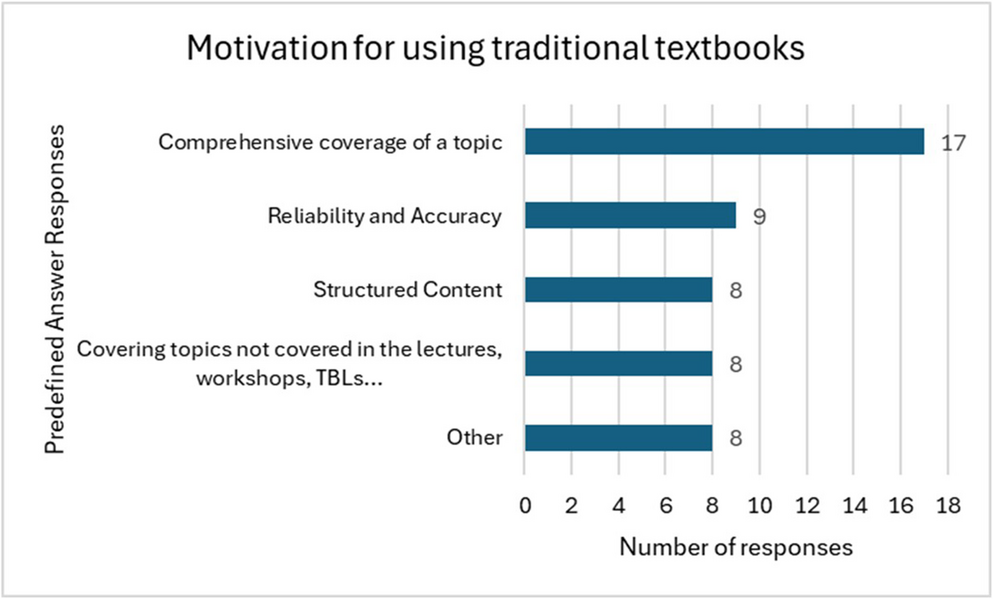
Specifically asked in the MCQ-PAR question about their reasons for using traditional textbooks rather than exam preparation books, 55% (n = 17) students selected “comprehensive coverage of a topic”, followed by “reliability and accuracy” 29% (n = 9) (Fig. 1).
Fig. 1
Motivation for using traditional textbooks
In the open answer question (“Other”), one student explained that a textbook “gives an understanding of a topic from start to finish instead of random bullet points. If you’ve read it, you know the topic.” However, 13% (n = 4) students stated that they either did not use textbooks or found them unhelpful.
Question BanksPassmedicine was the highest ranked and most frequently used resource for UKMLA-AKT preparation, followed by Geeky Medics (Table 5). No other question banks other than the ones already listed were mentioned by students.
Table 5 Frequency and ranking of question banks students used for UKMLA - AKT PreparationIn the MCQ-PAR question, familiarising themselves with MLA question types, identifying gaps in knowledge and memory retention were the main reasons why Question Banks were used (Fig. 2).
Fig. 2
Motivation for using question banks
FlashcardsThe most frequently used flashcards were Anki, closely followed by Zero to Finals and Geeky Medics (Table 6).
Table 6 Frequency and ranking of flashcards students used for UKMLA - AKT PreparationThe main motivation for using flashcards was help with recall and memorisation (Fig. 3). In the open answer question, one student highlighted the importance of spaces repetition by stating that “Spaced repetition is the most effective and proven method. I made my own cards which took time, but Anki is pretty much all I did, and I just did a little each day, and it served me much better than when I’ve ever taken notes.’’.
Fig. 3
Motivation for using flashcards
Learning PlatformsThird-party resources, not provided by the medical school, such as Geeky Medics and Zero to Finals were the most frequently used by students (Table 7).
Table 7 Frequency and ranking of learning platforms students used for UKMLA - AKT PreparationThe MCQ-PAR questions showed that students mainly used resources such as Osmosis or RX Bricks to revise pre-clinical curriculum content Reasons students used learning platforms were:
Good structure easy to understand and reinforce content.
Learning content not covered/covered poorly during lectures.
Concise explanations and breakdown of conditions.
Good substitute for big textbooks.
Clinical Decision Support ToolsClinical Decision Support Tools such as BMJ Best Practice, Up-to-Date and Dynamed are provided to KMMS students whilst they are on longitudinal placement in NHS Trusts (Table 8). When asked about their motivation for using these tools, an equal proportion of students mentioned that they were either not helpful at all (42%, n = 13), or, that they helped them to better understand disease mechanisms, treatment options, and potential side effects (45%, n = 13) (Fig. 4).
Fig. 4
Motivation for using Clinical Decision Support Tools
Table 8 Frequency and ranking of clinical decision support tools students used for UKMLA - AKT PreparationGenerative AI ToolsChatGPT was the most frequently used GenAI tool, used by 68% (n = 21) of students. Gemini and CoPilot were scarcely used, and ScopusAI (a tool provided by the medical school) and Apple Intelligence were not used at all (Table 9). Students who did use GenAI, mainly used it to explain medical concepts and conditions (Table 10).
Table 9 Frequency and ranking of generative AI tools students used for UKMLA - AKT PreparationTable 10 Motivation for using generative AI toolsIn the open answer question, one student, who also stated that they use ChatGPT all the time, provided insight on how they use ChatGPT: “I would put questions I got wrong from Passmed on ChatGPT and get it to explain to me why the answer was this or if I wanted more detail of an explanation from the passed questions I would ask ChatGPT to teach me this for the standard of a UK final year med student.”
Other ResourcesAmongst “Other Resources” (Table 11), self-curated study notes and Medical School Council (MSC) practice papers ranked most highly.
Table 11 Frequency and ranking of “Other Resources” students used for UKMLA - AKT PreparationIn the open answer question, students provided feedback on their motivation for using personal study notes and internet resources only:
Self-Curated Personal Study NotesThe ability to easily share these with peers or to structure notes in a students’ own way were mentioned by four students. One student highlighted their personal study style in more detail:
“I have made my own written notes since year 3, this is colour coded with pictures which helps me visually recognise conditions and helps me easily picture my notes when doing an exam question, almost like spatial recognition. My notes would be a collation of kmms lecture notes, passmed high yield textbook, zero to finals notes and osmosis”’.
YouTube and Internet Video ResourcesEight students provided some comments on this learning resource:
YouTube lectures are engaging.
Learning with videos is easier for them than to read lots of pages in textbooks.
YouTube videos and podcasts helped to better understand concepts.
Overall, some generalised feedback included:
“The Zero to Finals book literally had everything in one place, alongside Passmedicine to supplement knowledge of guidelines and then the MLA created mocks just to understand the writing style of the MLA writers and what they mean when they’re asking a question”.
“Passmedicine, Anki personal notes and Zero to Finals all helped to organise and consolidate medical knowledge”.
“Passmedicine was most important for question practice”.
“Lots of MLA AKT questions based on NICE guidelines so useful to understand some of the guidelines e.g. asthma management in more details”.
“AI was useful as it’s basically like having your own tutor”.
Ranking of Resources Students Used for UKMLA - CPSA PreparationResources used by students to prepare for the UKMLA-CPSA were also weighted and rank ordered, with the resources Clinical Skills Net and Clinical Skills Resources on the medical school Virtual Learning Environment (VLE) achieving the highest weighted scores of 64 (Table 12). Out of the 6 resources listed, 66% (n = 4) (were provided by the medical school and 24% (n = 2) were not provided.
Table 12 Resources for UKMLA clinical and professional skill assessment (CPSA) PreparationIn the open answer question, Geeky Medics was frequently mentioned as an important resource for OSCE preparation. Many students highlighted its usefulness for practicing scenarios, accessing mark schemes, and providing a wealth of OSCE stations. Some students also noted the availability of a subscription for more practice.
Students mentioned that they use Clinical Skills.net for its comprehensive mark schemes and as an alternative to the KMMS checklists, which some found less effective.
KMMS-specific resources, such as examination notes and checklists are also heavily used. Students appreciate that these materials are tailored to KMMS assessment practices, helping them ensure they perform steps correctly and are less likely to be penalised for their examination style or procedure. The relevance of these resources to KMMS-style OSCEs and their provision of patient scenarios similar to assessments were also cited as beneficial.
Overall, students leverage these tools to understand potential exam topics, practice their clinical skills and to prepare for specific scenarios.
KMMS in-house Resources vs. External ResourcesOverall, students estimated that they spent 20% of their time engaging with KMMS in-house resources compared to 80% engagement with external resources, for both the AKT and the CPSA part of the UKMLA. Only 13% (n = 4) students used KMMS in-house resources the same or more than external resources. The 20% engagement with in-house resources is likely attributable to time spent on CPSA exam preparation only, given that KMMS in-house resources on the VLE were ranked equally with Clinical Skills Net, yet no in-house resources were ranked for the AKT preparation.
Correlations between Frequency of Use and DemographicsThere were significant correlations between gender, age and level of education, with frequency of use of resources. Only one book, Essential Primary Care (Blythe, 2017), showed significant associations with “Age group” (p=.016) and “Level of study” (p = .010); 96% (n = 24) from the 21–24 age group versus 60% (n = 3) from the 25–29 age group, never used the book, implying that the older age group used it more often. However, overall usage was low with 40% (n = 2) from the 25–29 age group and a single student from each of the 21–24 and the 30 + age groups, using it at least “sometimes”. The more frequent use by the 25–29 age group correlates with “Level of study”, where 4 students with a degree used it at least “sometimes” compared to none of the A-Level students.
Question bank, Pastest, was significantly associated with “Level of Study” where 31% (n = 5) post grad students used it “sometimes” compared to only 8% (n = 1) students with A-Level education. The Brainscape and Geeky Medics Flashcards were significantly associated with “Age Group” (p=.032; p=.041 respectively). Brainscape was used “sometimes” by 8% (n = 2) students from the 21–24 age group, and “often” by a single student in the 30 + age group. In contrast, Geeky Medics was used “often” by one student from each of the higher age groups (25–29 and 30+), yet “sometimes” by 40% (n = 10) or “often” by 16% (n = 4) of the A-Level 21–24 year olds (p=.025).
YouTube and Internet Videos showed a significant correlation with gender; 100% (n = 16) of female students used it either “often” or “sometimes” compared to 64% (n = 9) of male students, with 29% (n = 4) males never using it and one using it “All the time” (p=.043). Lastly, for the CPSA, 33% (n = 5) of A-Level students used Macleod’s Clinical Examination (Dover, 2024) “sometimes” compared to 53% (n = 7) of BSc/BA, MSc/MA and PhD students, who used it either “sometimes” or “often” (p=.047).
Comments (0)