The transition from pre-clinical to clinical training remains a recognized challenge, particularly in multi-campus medical schools where students must adapt not only to new clinical responsibilities but also to unfamiliar environments. Clerkship directors have frequently reported that incoming third-year students lack readiness in core areas such as communication, physical examination, clinical reasoning, professionalism, and understanding of life cycle stages [22]. Students themselves echo these concerns, reporting feeling underprepared, which undermines their confidence and early performance [23]. Similar findings have been reported internationally. A survey of fourth-year students at Maastricht Medical School highlighted persistent challenges, including uncertainty about expectations, difficulty applying theoretical knowledge to patient care, increased workload, and limited study time. While students reported moderate preparedness in knowledge and physical examination skills, many lacked the practical experience necessary for clinical settings [24]. These consistent gaps highlight the need for structured, targeted interventions to bridge classroom learning and clinical practice during this critical transition.
To address these challenges, many medical schools have implemented transition courses, orientations or preparatory sessions immediately prior to clerkships. These initiatives aim to reinforce clinically relevant knowledge, provide opportunities to practice key skills with feedback, and offer structured support to ease the transition into clinical environments. Two national surveys illustrate the evolution of such efforts. In 2003, a survey of 56 medical schools (56% response rate) identified 30 transition courses, most (83%) lasting 1 week or less. These courses emphasized introducing new clinical skills, reinforcing preclinical knowledge, and promoting student well-being, with topics such as technical skills, safety protocols, orientation to clinical settings, and stress management frequently addressed. Over half these courses (12) facilitated peer interaction with students who had completed clerkships. By 2010, 88% of responding U.S. (78/126) and Canadian (5/16) medical schools reported having implemented transition courses [16]. While participation was often mandatory, only 35% of programs awarded grades, and 41% formally evaluated student performance. The core objectives consistently emphasized clinical skill development, application of preclinical knowledge, and student well-being. Course content also included clinical tasks (41%), workplace culture (37%), and interpersonal skills (17%). Didactic sessions were nearly universal (98%), and 74% incorporated hands-on practice, though only 21% included experiences in clinical settings. Senior medical students participated in 82% of these courses, and over half engaged multiple clerkship departments [8]. Despite their widespread use, many transition courses required at least 1 week and often longer to achieve meaningful outcomes [9, 10, 11, 12, 25, 26, 27]. Such time frames are increasingly impractical given condensed curricula, time constraints, and limited resources. In response to these constraints, most recent literature has shifted towards shorter, specialty-specific bootcamps. For example, otolaryngology bootcamps for first- and second-year medical students have employed a brief, 3-hour format that combined didactics with supervised skills practice [28]. Similarly, neurosurgical and OBGYN bootcamps have focused on preparing learners for specialty-specific sub-internships through 1-day interventions that included lectures and cadaver-based or procedural skills training [29, 30]. While effective, these programs targeted narrow learner populations and specialty-defined outcomes rather than global readiness for core clerkships. While bootcamps have been widely described as a strategy to bridge the transition from UME to residency, with positive outcomes in areas such as technical skill acquisition and confidence building [18], few programs have systematically applied this model to support the transition from pre-clinical and core-clerkship training, particularly within multi-campus institutions.
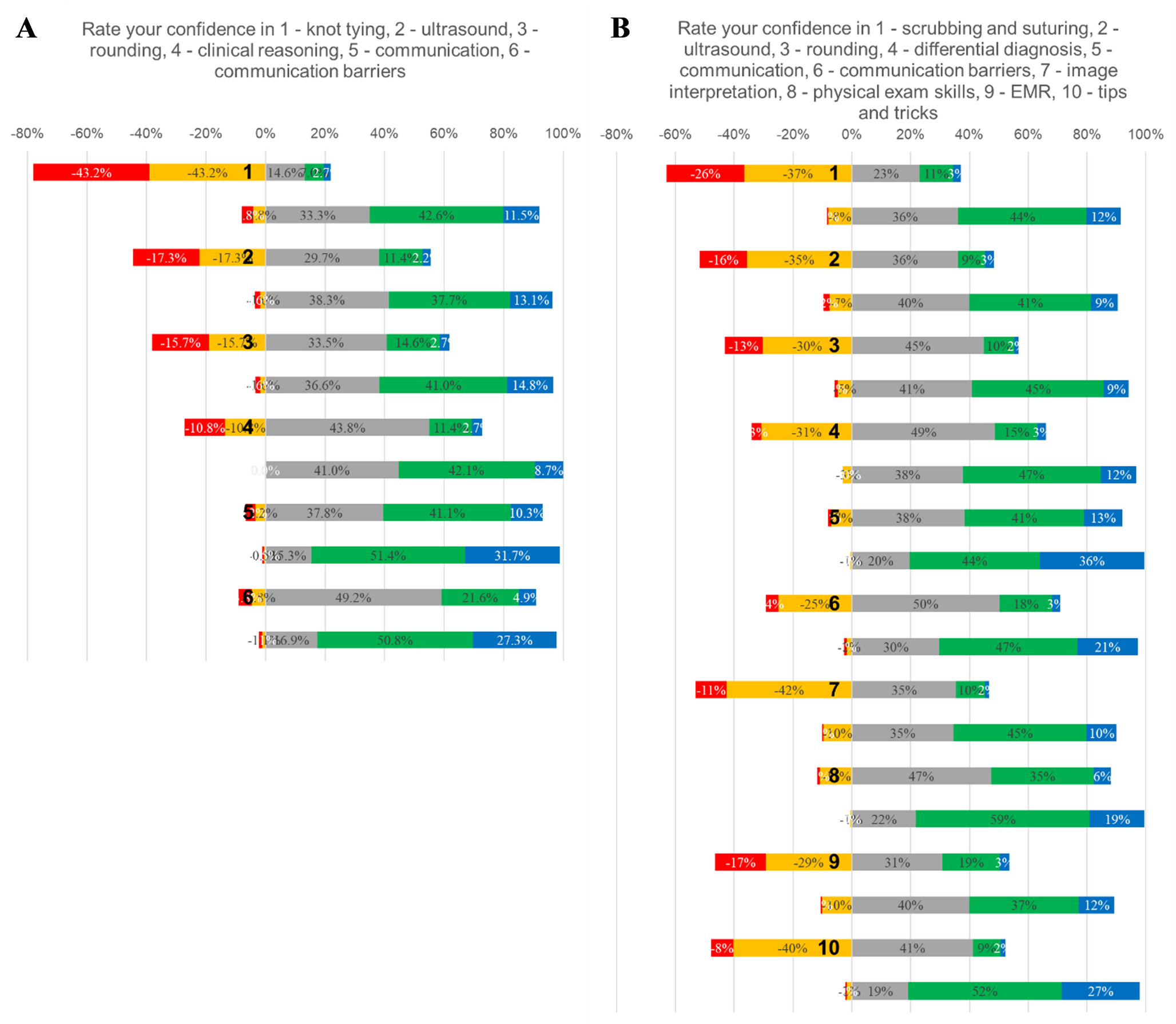
In this study, we describe the successful implementation of a standardized, collaborative bootcamp to ease the transition to core clerkships within a multi-campus medical school. Our findings help address an under-studied aspect of clerkship transitions in multi-campus programs, where site-to-site differences in personnel and clinical environments may affect early learner experience and performance. The bootcamp reinforced essential pre-clerkship skills, such as history taking and physical examination, while introducing new, clerkship-relevant competencies, including patient presentations, suturing, image interpretation, and navigation of campus-specific electronic medical records. O’Brien et al. proposed that grouping students by their first clerkship site may enhance practical skills training [8]. Following this framework, our bootcamp divided students into groups paired by their initial clerkship site. O’Brien et al. also reported that learning from senior medical students represented the most effective element of transition courses (40% of 60 courses with responses) [8]. Similarly, Ramakrishnan et al. implemented a near-peer (sideways) mentorship model during a 1-hour internal medicine clerkship orientation bootcamp [31]. Using pre- and post- bootcamp surveys, the authors demonstrated a significant increase in student confidence across all 10-core internal medicine clerkship domains, supporting the effectiveness of a structured student-led bootcamp in improving clerkship preparation. At our institution, senior medical students facilitated skills stations alongside faculty and provided informal mentorship on adjusting to clerkships. Our findings demonstrate that the bootcamp successfully achieved its primary objective of increasing student confidence and perceived readiness for core-clerkships. The conclusion was supported not only by student self-assessments but also by faculty and resident observations, which indicated noticeable improvements in students’ clinical performance and readiness. Together, these findings highlight the bootcamp’s effectiveness in preparing students for the demands of Phase 2 clinical education.
A common limitation of the transition courses is the reliance on variable assessments, such as attendance or self-perception surveys, rather than objective measures of clinical competence. To truly support workplace readiness, evaluation should focus on students’ ability to engage in key clinical activities early in clerkships. A recently published study addressing this gap introduced a 2-week transition course and demonstrated measurable improvements in student performance [28]. Students who participated in the transition course and simulation showed statistically significant improvements in summative performance across clerkships compared to that of the standard group, with the most pronounced impact observed during the early clerkships of the academic year. Our findings align with these results and further demonstrate the value of structured transition initiatives. Instructors’ narrative feedback complemented student self-assessments and suggested improved early clerkship readiness following the bootcamp, while also identifying targeted areas for iterative improvement. There was strong consensus in support of making the bootcamp a recurring component of the curriculum.
Several limitations should be acknowledged. The instructor survey in 2025 had a response rate of 11% and was likely also low in 2024, even though we do not know the number of recipients for that year due to its decentralized distribution. Interpretation of the 2025 instructor survey item comparing student performance during the first clerkship period with prior years is limited by an ambiguous reference group. Because the comparison necessarily included students who had participated in the 2024 bootcamp, it is unclear whether instructors anchored their responses to cohorts from the pre–bootcamp era or to students trained under the 2024 iteration rather than the 2025 model. Concurrent updates to the longitudinal ICM curriculum for the classes of 2025 and 2026 may have contributed to students’ overall preparedness, making it difficult to isolate the specific impact of the bootcamp. However, the time gap between the end of the ICM course and the commencement of Phase 2, contributed to students forgetting the material, according to students during the authors’ on-campus visits with clerkship students. The low response rate for the post-first-clerkship faculty survey during the first implementation year may have introduced response bias, limiting generalizability of those findings. Additionally, variations in resources and logistics across the four participating sites posed challenges to ensuring uniform delivery of the bootcamp experience, which may have affected outcomes.
Despite these limitations, implementing the bootcamp across multiple campuses underscored the value of collaborative efforts in distributed medical education. Shared development of curriculum resources such as standardized case studies and simulation exercises helped ensure a consistent educational experience, irrespective of site-specific constraints. Moreover, the process fostered stronger inter-campus faculty relationships and promoted a more unified approach to clinical skills training. These collaborative practices offer a promising model for other distributed medical education programs seeking to enhance student preparation while leveraging collective institutional strengths. Future efforts should focus on improving data collection strategies, particularly for post-clerkship faculty evaluations, to ensure more comprehensive and representative outcome assessments. Longitudinal studies are also needed to assess the sustained impact of the bootcamp on students’ clinical performance and confidence as they progress through medical training. These future directions will be essential for refining the bootcamp model and ensuring its continued relevance and effectiveness in supporting student success.

Comments (0)