Principal Findings
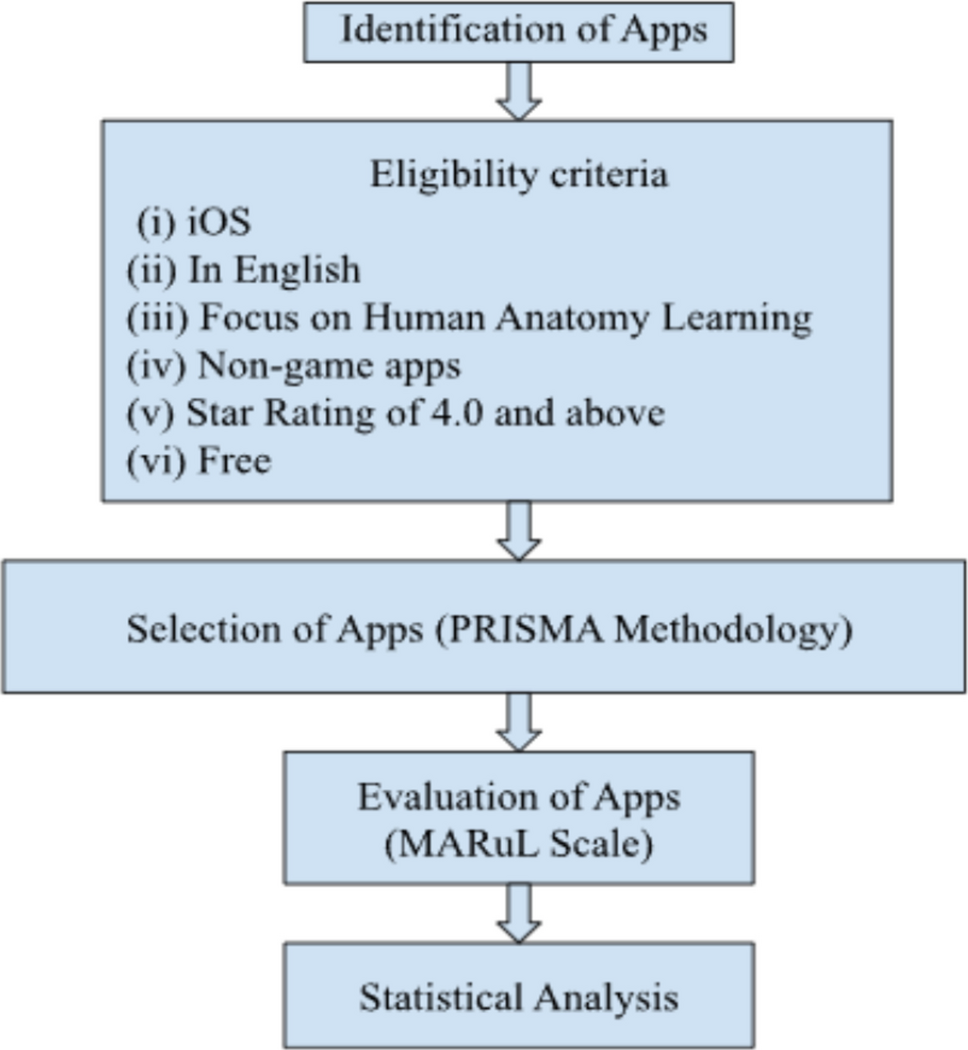
Mobile apps for teaching and learning human anatomy are widely used among medical and health sciences students [4]. In this study, a systematic search of the iOS App Store for anatomy mobile apps for undergraduate learning identified 20 relevant apps. Subsequent verification revealed that 19 out of 20 selected apps (except app no. 11: Anki Pro) are also available on the Google Play Store, making them widely accessible to students on either the Android or Apple platforms. The quality of these apps was evaluated using the MARuL scale, which was selected because it offers a more comprehensive and objective assessment compared to general app evaluation methods [24].
Two trained raters assessed app quality using the MARuL scale, with final scores based on their average ratings. This dual-rater methodology has been documented in other studies [20, 25]. The reliability measures from the two raters on the average total MARuL score and three (Part A, B and C) sections revealed a good ICC value, which could be attributed to the complementary expertise and similar health background of the raters. Nevertheless, the Usability (Part D) section yielded a low ICC score, indicating poor reliability. This could be due to the highly subjective nature of the items within this domain. Aspects such as aesthetics and ease of use are dependent on individual preferences, which, as noted by Zamli et al., can vary significantly even between raters from a similar discipline [26]. Consequently, this inherent subjectivity reduces the consistency of evaluations, leading to a lower level of measurement reliability for this section. Additionally, the two raters used different Apple devices (iPhone and iPad), which may have influenced user experience and usability ratings. However, the acceptable total inter-rater reliability score indicates that app quality, rather than device type, primarily influenced the ratings. Evaluating apps across different device types reflects real-world usage patterns and may enhance the generalisability of the findings.
Among the 20 apps evaluated, only three achieved high scores and were classified as ‘probably valuable’ according to MARuL scale: BioDigital Human 3D Anatomy, TeachMeAnatomy, and Anatomyka Atlas. Although these top three apps differ from those of Garcia et al., probably due to distinct evaluation frameworks, these apps were arguably high-performing in both studies, reinforcing their overall quality [11]. In this study, the three apps scored highly across all four sections and excelled in features that are effectively engaging students, consistently providing educational value and enhancing user experience.
For instance, the Anatomyka Atlas offers high-quality images of human bones and includes an interactive instructional guide to help users navigate its features. In contrast, the three apps with the lowest overall scores are Augmented Anatomy, Brain and Nerves, and Circulatory System and were classified as ‘not valuable at all’. This suggests that these apps possessed inadequate essential content or substandard image quality, making them ineffective for supporting undergraduate students' learning of human anatomy.
Table 4 presents the average total MARuL scores of the 20 apps for each item, with the average total score for each section subsequently. In the Teaching and Learning (Part A) section, TeachMeAnatomy obtained the highest score due to its established learning goals, which are relevant to anatomical pedagogy. Furthermore, the apps generate meaningful learning experiences, provide comprehensive information, and are robust enough to be used as a standalone study resource. A previous study demonstrates that an anatomy mobile app has a direct impact on academic success [27], which justifies the importance of this section in app evaluation. In contrast, the lowest-scoring app in this section was Complete Anatomy. This result may be attributed to the labelling of specific structures, for example, parts of a bone, being listed on the left side of the interface, rather than pointing directly to the anatomical structures. Additionally, the evaluation was limited to the app’s free version, which lacked interactive features such as quizzes.
For the User-centred (Part B) section, TeachMeAnatomy once again achieved the highest score. In addition to its excellent performance in the Teaching and Learning (Part A) section, the app is consistent with user needs effectively. The app provides an intuitive, engaging, and user-friendly experience, which suggests a high likelihood of continued student use. Conversely, the lowest-performing app was Augmented Anatomy. The app’s ability to optimise user experience and satisfaction is limited, primarily due to the layout design that could be more user-friendly. For instance, while the inclusion of augmented reality (AR) is a good strength, users may face difficulties due to the current layout and instructional guidance.
Subsequently, the top-rated app in the Professional (Part C) domain was Orthopaedic Limbs Anatomy. This app provided clear information on the involvement of qualified medical professionals and academics. In contrast, the lowest-rated app in this section was 3B Smart Anatomy, as it did not provide information on the qualifications of the developers and limited information on the references. Anatomyka Atlas achieved the highest score in the Usability (Part D) section. The app features high-quality images and an intuitive layout. For example, students can enlarge specific parts of a bone and select individual structures to assess detailed information. Besides working very well, this app provides comprehensive support and responds promptly to technical issues. In contrast, Brain and Nerves received the lowest score, reflecting opportunities for improvement in its layout. Users may find the labelling of brain structures difficult to interpret, while the interface constrained the efficiency of navigation when exploring the app's function.
Comparing the four sections in MARuL, this study found that the Usability (Part D) section scores the highest rated domain. In this domain, several apps scored high in functionality (Item 21), which analyses the app’s speed and performance. Compared with the MARS evaluation, this result is consistent with Gladman et al., who revealed that most apps scored the highest in the functionality category [20]. Conversely, the low score for Item 22 (app differentiation) in the Usability section could reflect the widespread lack of adaptability to individual learning needs in the current apps. Future developers could focus on enhancing app differentiation by incorporating customisable difficulty levels to better suit individual learning needs.
Meanwhile, the lowest-rated domain in the MARuL scale was Professionalism (Part C), probably due to developers often prioritising user experience and commercial viability over providing evidence-based content. This finding aligns with Garcia et al. [11], who reported high functional and aesthetic scores for anatomy apps, but significant deficiencies in information quality when evaluated via the MARS scale. App developers should prioritise pedagogical rigour to bridge the current gap between high usability and functionality with educational integrity.
Finally, the authors propose reclassifying items 6,7,8,18,19, 24, and 25 into a ‘fixed-score’ category. These items are based on factual and app-specific characteristics such as instructional features, assessment tools (e.g. quiz), credibility (references), technical specification (updates), and advertisement visibility. The evaluation of these items does not depend on the rater’s personal perspective; hence, scoring for these items in MARuL remain constants across raters. Additionally, Aldekhyyel & Almulhem highlighted the absence of open-ended questions, which could have potentially addressed the evaluator’s concern and feedback more effectively [24].
Limitations
This study has several limitations that should be acknowledged. First, some of the reviewed apps may have been updated since the MARuL evaluation, potentially altering their features and functionality and affecting future analysis. Additionally, this study excluded paid mobile apps, which may have limited the comprehensiveness of the evaluation, as they often offer more advanced features and have fewer usage restrictions. Consequently, the findings may not fully represent the entire spectrum of anatomy apps available in the market. Nevertheless, as the target users are undergraduates, free apps are more accessible to students with limited financial resources. Next, the search strategy relied on two primary keywords (‘anatomy’, ‘human anatomy’), which may not capture the available apps with other terminology, such as ‘clinical’ or ‘3D’ anatomy. Furthermore, the inclusion of only 20 free apps and a limited number of raters likely contributed to the relatively wide confidence intervals and limited precision of the interrater reliability estimates. Lastly, one item within the MARuL scale is specifically designed to evaluate clinical skills (Item 1), which may not be entirely applicable when assessing pre-clinical subjects such as human anatomy.
Suggestions for Future Research
This study identified several directions for future research, including evaluating both free and paid anatomy apps. Additionally, increasing the number of raters would ensure the precision of interrater reliability and strengthen evaluation robustness. Furthermore, the authors would like to suggest a modified MARuL tailored to assessing human anatomy education, as there are numerous anatomical apps available on the iOS and Play Store. Finally, it could be beneficial to test the three top-rated apps among undergraduate students to assess their effectiveness in student learning.

Comments (0)