
Remember me
Since 2012, the UofL-CEP has supported 343 trainees identified as: (1) 60% female; (2) 44% belonging to racial/ethnic groups historically underrepresented in biomedical research based on NIH definitions in effect during the reporting period; (3) 90% STEM majors; and (4) 73% having prior research experience before program entry. Over the years, UofL-CEP participants represented more than 50 U.S. colleges and universities, including historically Black colleges and universities (HBCUs), Ivy League and Ivy Plus institutions, rural Kentucky colleges, and research-intensive universities.
All participants presented their research at local, regional, national, or international scientific meetings, with 63 serving as first or co-authors on peer-reviewed publications.
Program alumni matriculated into MD, DMD, PharmD, MD/PhD, PhD, MPH, and other master’s programs, with many continuing in cancer research and oncology. Medical alumni pursued Distinction Tracks in Health Equity, Research, and Medical Justice, while undergraduates engaged in competitive summer research career pipeline programs, including the Summer Research Opportunity Program (SROP) and MD/PhD preparatory program. Institutional support facilitated participation in scientific conferences, with trainees receiving travel and presentation awards from organizations such as the American Association for Cancer Research. Some participants secured external funding, including NIH F31 and TriBeta research grants. Many alumni are now successful physicians, researchers, and oncologists, and recent cohorts (2021–2022) have overwhelmingly reported aspirations in medicine, oncology, and basic, clinical, and translational research. As these scholars advance into graduate and professional programs, we anticipate continued expansion of the cancer research workforce.
The UofL-CEP successfully supported underrepresented students, exemplified by Douglas Saforo and Afi H. Tagnedji. Douglas conducted a research project entitled “Candidate drugs binding the Anaphase Promoting Complex: A novel target for anti-cancer therapy” in Dr. Chris States’ laboratory. He was accepted into UofL’s MD/PhD program, focusing his dissertation on in vitro 3D modeling of the tumor microenvironment in non-small cell lung carcinoma, resulting in 1st authorship [4]. He later completed a Pediatric Residency at Emory University and is currently pursuing a pediatric oncology fellowship at the Children’s Hospital of Philadelphia.
Afi, originally from Todome, Togo, completed her cancer research in Dr. David Hein’s laboratory and 1st authored a publication on “Upregulation of cytidine deaminase in NAT1 knockout breast cancer cells” [5]. She received an AACR travel award to present this work. She graduated from UofL with a bachelor’s degree in biochemistry, earning honors as Martin Luther King, Porter, and Louis Stokes Scholar. Afi actively engages in educational equity through policy work and holds fellowships, including Goldwater, AACR, QUAD, and Knight-Hennessy. She is pursuing a PhD in cancer biology, specializing in computational and systems biology at Stanford University.
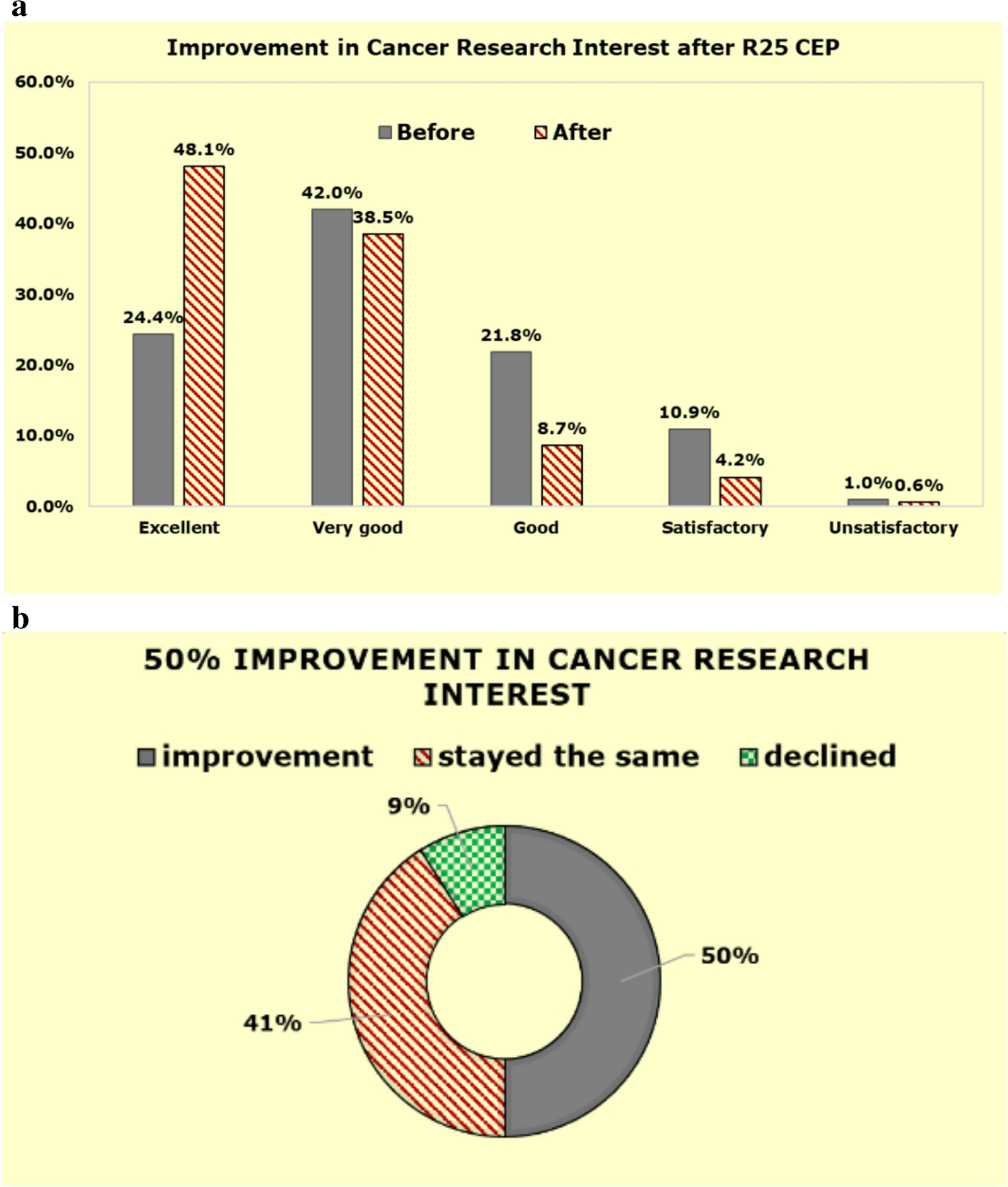
Improvements in Cancer Research Interest After the Cancer Education ExperienceFrom 2013 to 2022 (excluding 2020), 312 participants were surveyed on their interest in cancer research before and after completing the UofL-CEP. The program significantly increased interest in cancer research (P < 0.001) relative to baseline levels, with a two-fold increase in participants rating their experience as excellent (P = 0.0001) (Fig. 1a). Half of the trainees reported increased interest, whereas 41% maintained strong prior interest and 9% noted a decline (Fig. 1b).
Fig. 1
a (top) & b (bottom). Improvement in cancer research after the cancer education experience, 2013–2022 (n = 312)
Reflections from over 100 trainees (2012, 2014–2019, 2021–2022) revealed five drivers of increased interest in cancer research and clinical careers. First, participants cited mentorship and a supportive lab environment as key to building confidence and research skills. Second, exposure to clinical and translational research, including patient-centered projects and shadowing, emphasized the real-world impact of cancer research. Third, clinical seminars introduced participants to diverse research areas (e.g., psycho-oncology, immunotherapy, outcomes research), thereby demystifying cancer research and making it more accessible. Fourth, conducting independent research fostered ownership and changed perceptions of cancer science from intimidating to inspiring. Finally, many trainees reported personal connections with cancer that deepened their commitment to the field.
Multi-Level Mentoring ExperienceFaculty mentors often paired trainees with near-peer mentors to assist in laboratory experimental training. More than 95% of participants rated faculty and near-peer mentors positively, with no significant difference in perceived mentor quality between the two groups (P = 0.3681).
Research Dissemination SkillsFrom 2012 to 2015, faculty led seminars on abstract writing, poster design, and publishing. In later years, peer-based and flipped-classroom models were introduced in response to feedback to promote more active learning. Trainees independently reviewed educational materials, followed by small-group discussions and faculty-led wrap-ups. Between 2016 and 2022, satisfaction with dissemination sessions ranged from 84.4% to 94.0% (P = 0.0903).
EMOTE: Connecting with Your AudienceDeveloped by Dr. Luz Huntington-Moskos, EMOTE helped trainees present their research with clarity and emotion. Inspired by The Voice, the session included a group discussion, analysis of TED Talks, and interactive practice of presentation skills. Over 94% of participants rated the session as exceeding expectations. The seminar emphasized plain language communication and highlighted the societal relevance of research. Participants reported greater confidence, especially in reaching lay audiences.
Feedback revealed four key themes: (1) engagement and enthusiasm, (2) practical and applicable skills, (3) interactive and innovative teaching, and (4) the importance of audience connection. Although this session was widely viewed as a program highlight, participants recommended improvements, including allocating more time for group discussion and assigning the TED Talk as homework to deepen the discussion.
90-Second Elevator PitchIntroduced in 2016, the elevator pitch contest evolved into a structured competition emphasizing key communication skills. Participants summarized their projects in under two minutes, focusing on research significance, hypothesis, innovation, and relevance. Finalists were selected from each group and evaluated by faculty using a standardized scoring rubric. Winners received certificates and token gifts. Undergraduate and professional students were judged separately. Participants appreciated learning about their peers’ research and reported that the activity helped them prepare for poster presentations and abstracts. The exercise improved their ability to communicate clearly with diverse audiences. Based on suggestions from the 2016 cohort, scoring was standardized, and pre-session guidance was added in later years. Trainees recommended expanding peer interactions to learn about other summer projects.
Career Planning and ExplorationCareer development activities included workshops on individualized development plans, graduate school applications, personal statements, and fellowship competitiveness. Since 2016, the “Navigating Careers in Cancer Research” event used a speed-networking format to connect trainees with alumni, faculty, and professionals in academia, industry, and public health. Topics included women in science, work-life balance, dual roles as clinicians and researchers, and various cancer research career/training opportunities in academia. More than 93.7% of trainees rated the sessions as excellent or very good (Fig. 2). Ranked scores did not vary significantly among the various seminars and table discussions (P = 0.524).
Fig. 2
A majority of the medical/pre-medical students (93.7%) rated the career enhancement and professional development sessions as excellent or very good. There were no significant differences in the ranked scores across the various seminars and table discussions (P = 0.524)
Community OutreachTrainees attended sessions that included a seminar on the community outreach activities by the Kentucky African Americans Against Cancer (a local cancer support group under the Kentucky Cancer Program) and personal testimonials from cancer survivors. Survivor talks were significantly more impactful (P < 0.001) than the seminar (Fig. 3), with more than 99% of students reporting inspiration and emotional resonance. Four themes emerged from participant responses: (1) increased motivation to pursue research and clinical care, (2) humanizing the research process, (3) more profound empathy for patients, and (4) reaffirmation of the value of cancer research. Students described these stories as powerful reminders of research’s real-world impact, which enhanced their sense of purpose and professional direction.
Fig. 3
Trainees preferred cancer survivors’ testimonies enhanced trainees over a seminar about community outreach activities by cancer support group, 2018, 2019, 2021 (n = 108)
Improved Self-Efficacy in Cancer ResearchIn 2021–2022, trainees reported major gains in five areas: (1) confidence to serve as a future teacher or mentor, (2) belonging in a cancer research community, (3) understanding of the research process, (4) tolerance for setbacks, and (5) skill in interpreting data. More than 50% reported being prepared to publish or present research following the program.
Comments (0)