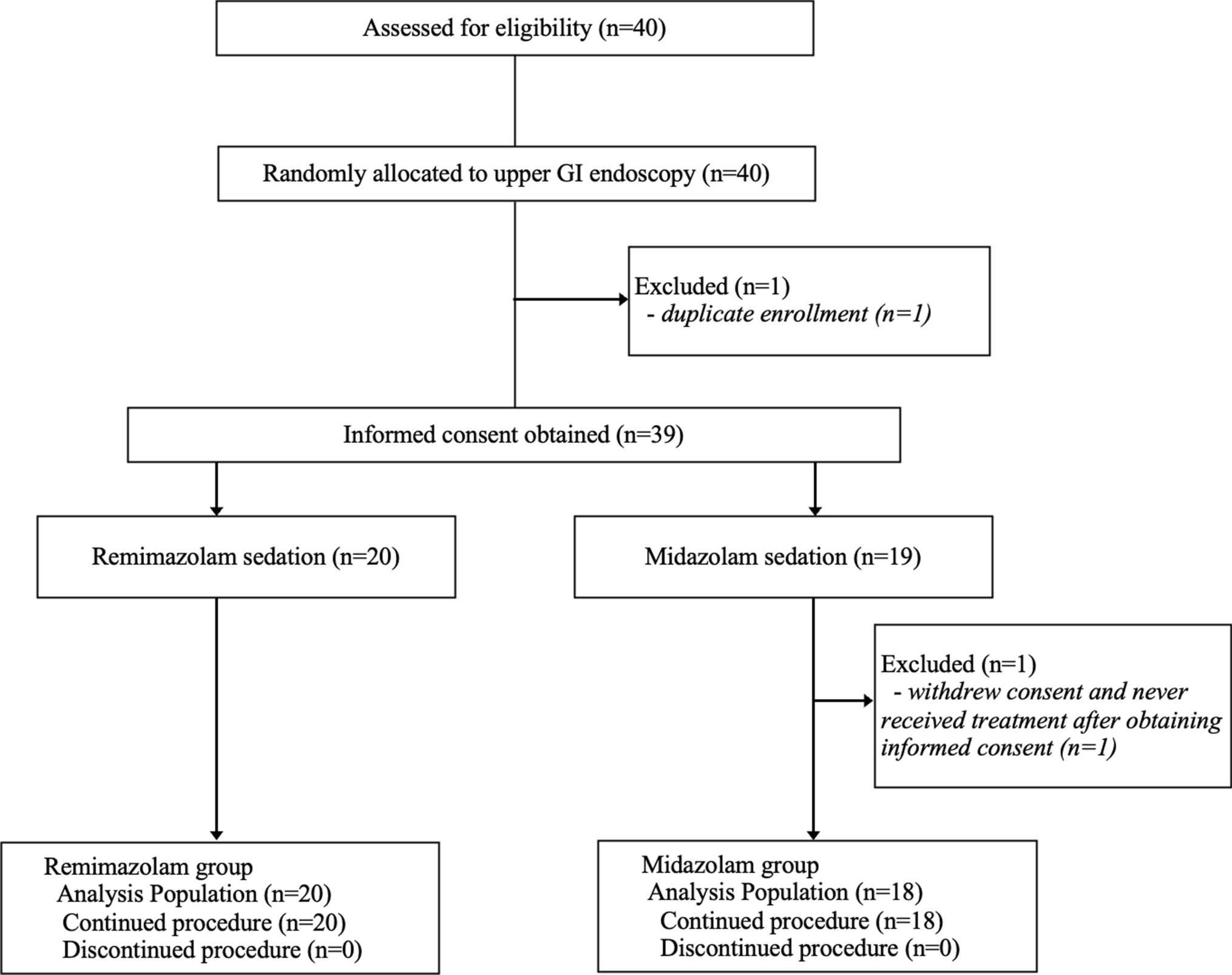
To our knowledge, this RECOVER study is the first randomized, multicenter comparison of remimazolam and midazolam for upper GI endoscopy in Japan. Previous comparative studies from Japan were retrospective and propensity-matched rather than randomized [26, 27], highlighting the incremental value of the present trial’s design and endpoints. Remimazolam was approved in Japan for sedation for gastrointestinal endoscopic procedures on 24 June 2025 and added to the National Health Insurance Drug Price List on 14 August 2025, thereby enabling its use under Japan’s public health insurance system. This approval made a direct, head-to-head comparison with the long-standing standard sedative, midazolam, of considerable clinical relevance.
We previously demonstrated the safety of remimazolam in Phase III trials [18]. In the present study, we aimed to assess the recovery efficacy of remimazolam compared to midazolam that could be assumed as the most remarkable advantage of this sedative. We thus set the primary endpoint as “ambulation after 5 min” to evaluate recovery efficacy following endoscopy as had been set in the previous study [18]. This endpoint is important because quick arousal after sedative endoscopy can improve safe and smooth management of the recovery room. We also assessed sedation success rates and the degree of recovery after endoscopy as well, that had not been assessed in the previous RCTs [13, 14, 23]. Furthermore, these endpoints were evaluated in patients without concomitant use of analgesics in the present study. Thus, the present study is considered the true comparative study of remimazolam and midazolam in sedative gastrointestinal endoscopy.
The primary endpoint, unassisted ambulation at 5 min, was met by 85% of patients receiving remimazolam versus 0% of those receiving midazolam. Most patients in the remimazolam group were able to walk within 5 min after endoscopy, which is consistent with the findings of our previous study [18]. The fact that no one in the midazolam group was able to walk 5 min after ending endoscopy clearly indicates that consciousness is regained more quickly with remimazolam. Remimazolam promotes rapid recovery of consciousness following upper gastrointestinal endoscopy and reduces the time to ambulation, conferring a clinical advantage.
The rate of successfully achieving pre-endoscopy sedation (MOAA/S score ≤ 4) was 100% in both groups. These results are consistent with those of overseas trials comparing remimazolam and midazolam, demonstrating a high success rate [13,14,15]. In the present study, indicators of recovery favored remimazolam: while the time required to achieve sedation before endoscopy did not differ significantly between the groups, the times from endoscope removal to MOAA/S score = 5 and from ending endoscopy to ambulation were significantly shorter in the remimazolam group. Notably, the average time to ambulation after endoscopy was 35.56 min in the midazolam group but only 4.25 min in the remimazolam group. Demand for sedation for upper GI endoscopy continues to grow because it reduces patient discomfort and improves endoscopist satisfaction; however, the use of sedation requires more recovery space and additional monitoring staff [2, 29]. Using remimazolam could ease these operational burdens. Accordingly, it is expected that remimazolam will increasingly be used for sedated endoscopy, including in outpatient settings.
Although the total dose of sedative was higher in the remimazolam group, this difference was attributable to having used the initial doses specified in a previous study [18], which were 3 mg for remimazolam and 2 mg for midazolam. The absence of differences in additional doses during endoscopy between the two groups indicates that it is feasible to use the same method for additional administration of remimazolam as has been used for midazolam. However, since remimazolam is a newly approved drug, higher cost is a main disadvantage. The average cost per patient was calculated to be JPY 331.1 for remimazolam and JPY 17.9 for midazolam in this study setting.
Our findings related to safety were generally reassuring. Remimazolam was associated with a lower frequency of supplemental oxygen and no patients required flumazenil or bag-valve mask ventilation, while pre-endoscopy, during endoscopy and total dosages corrected by molar mass were equivalent between the two groups (Supplementary Table 1). This result might be caused by the shorter duration of activity of remimazolam, probably caused by the difference in metabolic pathway, mode and affinity to benzodiazepine receptors compared to midazolam. Such a milder respiratory suppression of remimazolam could bring secure use for endoscopic staff. In addition, all patients in the remimazolam group could leave the endoscopy room 30 min after the endoscopy in this study. Although further investigation with a larger sample size is necessary to generalize this finding into all cases, the quick recovery effect of remimazolam could contribute to the safety issue of sedative endoscopy.
Patients’ satisfaction was high in both groups. The greater endoscopists’ satisfaction in the remimazolam group likely reflects the high success of endoscopic sedation, a smooth endoscopy workflow, and a low incidence of adverse events. Combined with the significant reduction in recovery time observed in this study, these factors could lead to shorter procedure and recovery room occupancy times, a reduction of staff burden, and more reliable improvement in endoscopy suite turnover rates in an outpatient setting. Furthermore, favorable patient evaluations suggest that sedation-assisted endoscopy can reduce patient anxiety and improve compliance with endoscopy procedures. Remimazolam is therefore expected to become the standard sedative for upper gastrointestinal endoscopy in outpatients in the future.
This study had several limitations. First, because the sample size was small, rare adverse events may have been undetected or not occurred. Furthermore, the small sample size may somewhat limit the strength of the results. Second, although patients were blinded, endoscopists were not; such a single-blind design might have caused bias for the decision of additional sedation by the endoscopists to some extent. However, since it was a multicenter study conducted in real-world clinical settings, we considered that blinding of endoscopists was not feasible to ensure safe sedative administration and appropriate intra-procedural management. Third, because the trial focused on upper GI endoscopy, the findings may not be generalizable to longer therapeutic procedures or higher-risk cohorts (e.g., ASA-PS score ≥ III, older adults).
In conclusion, this randomized, multicenter, head-to-head trial demonstrated that remimazolam yielded substantially faster recovery and less frequent need for supplemental oxygen than midazolam, while maintaining comparable initial sedation success. These findings support the use of remimazolam as an effective and operationally advantageous benzodiazepine for sedated upper gastrointestinal endoscopy in Japan.

Comments (0)