Kolb, H. C., Finn, M. G. & Sharpless, K. B. Click chemistry: diverse chemical function from a few good reactions. Angew. Chem. Int. Ed. 40, 2004–2021 (2001).
Article
CAS
Google Scholar
Rostovtsev, V. V., Green, L. G., Fokin, V. V. & Sharpless, K. B. A stepwise Huisgen cycloaddition process: copper(I)-catalyzed regioselective ‘ligation’ of azides and terminal alkynes. Angew. Chem. Int. Ed. 41, 2596–2599 (2002).
Article
CAS
Google Scholar
Dong, J., Krasnova, L., Finn, M. G. & Sharpless, K. B. Sulfur(VI) fluoride exchange (SuFEx): another good reaction for click chemistry. Angew. Chem. Int. Ed. 53, 9430–9448 (2014).
Article
CAS
Google Scholar
Tornøe, C. W., Christensen, C. & Meldal, M. Peptidotriazoles on solid phase: [1,2,3]-triazoles by regiospecific copper(I)-catalyzed 1,3-dipolar cycloadditions of terminal alkynes to azides. J. Org. Chem. 67, 3057–3064 (2002).
Article
PubMed
Google Scholar
Paioti, P. H. S. et al. Click processes orthogonal to CuAAC and SuFEx forge selectively modifiable fluorescent linkers. Nat. Chem. 16, 426–436 (2024).
Article
CAS
PubMed
Google Scholar
Homer, J. A. et al. Sulfur fluoride exchange. Nat. Rev. Methods Primers 3, 58 (2023).
Article
CAS
PubMed
PubMed Central
Google Scholar
Békés, M., Langley, D. R. & Crews, C. M. PROTAC targeted protein degraders: the past is prologue. Nat. Rev. Drug Discov. 21, 181–200 (2022).
Article
PubMed
PubMed Central
Google Scholar
Liu, J. et al. Cancer selective target degradation by folate-caged PROTACs. J. Am. Chem. Soc. 143, 7380–7387 (2021).
Article
CAS
PubMed
PubMed Central
Google Scholar
Chen, Y. et al. Proteolysis-targeting chimera (PROTAC) delivery system: advancing protein degraders towards clinical translation. Chem. Soc. Rev. 51, 5330–5350 (2022).
Article
CAS
PubMed
PubMed Central
Google Scholar
Imaide, S. et al. Trivalent PROTACs enhance protein degradation via combined avidity and cooperativity. Nat. Chem. Biol. 17, 1157–1167 (2021).
Article
CAS
PubMed
PubMed Central
Google Scholar
Li, K. L. & Crews, C. M. PROTACs: past, present and future. Chem. Soc. Rev. 51, 5214–5236 (2022).
Article
CAS
PubMed
PubMed Central
Google Scholar
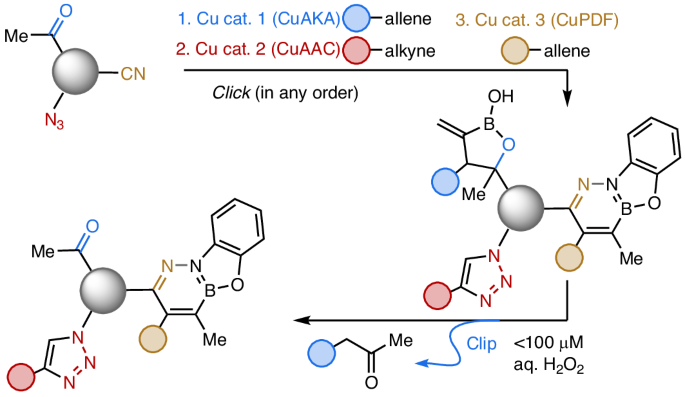
Zhao, J. et al. Radical-mediated click-clip reactions. Science 385, 1354–1359 (2024).
Article
CAS
PubMed
Google Scholar
Yamazaki, C. M. et al. Antibody-drug conjugates with dual payloads for combating breast tumor heterogeneity and drug resistance. Nat. Commun. 12, 3528 (2021).
Article
CAS
PubMed
PubMed Central
Google Scholar
Fu, Q. et al. Bioorthogonal chemistry for prodrug activation in vivo. Chem. Soc. Rev. 52, 7737–7772 (2023).
Article
CAS
PubMed
Google Scholar
Min, Q. & Ji, X. Bioorthogonal bond cleavage chemistry for on-demand prodrug activation: opportunities and challenges. J. Med. Chem. 66, 16546–16567 (2023).
Article
CAS
PubMed
Google Scholar
Kondengadan, S. M. et al. Click chemistry and drug delivery: a bird’s-eye view. Acta Pharma. Sin. B 13, 1990–2016 (2023).
Article
CAS
Google Scholar
Lei, K. et al. Research progress in the application of bile acid-drug conjugates: a ‘trojan horse’ strategy. Steroids 173, 108879 (2021).
Article
CAS
PubMed
Google Scholar
Dean, T. T., Jelú-Reyes, J., Allen, A. & Moore, T. W. Peptide-drug conjugates: an emerging direction for the next generation of peptide therapeutics. J. Med. Chem. 67, 1641–1661 (2024).
Article
CAS
PubMed
PubMed Central
Google Scholar
Askari Rizvi, S. F., Zhang, L., Zhang, H. & Fang, Q. Peptide-drug conjugates: design, chemistry, and drug delivery system as a novel cancer theranostic. ACS Pharmacol. Transl. Sci. 7, 309–334 (2024).
Article
Google Scholar
Meng, F., Jang, H., Jung, B. & Hoveyda, A. H. Cu-catalyzed chemoselective preparation of 2-(pinacolato)boron-substituted allylcopper complexes and their in situ site-, diastereo-, and enantioselective additions to aldehydes and ketones. Angew. Chem. Int. Ed. 52, 5046–5051 (2013).
Article
CAS
Google Scholar
Sies, H. & Jones, D. P. Reactive oxygen species (ROS) as pleiotropic physiological signalling agents. Nat. Rev. Mol. Cell Bio. 21, 363–383 (2020).
Article
CAS
Google Scholar
Sies, H. et al. Defining roles of specific reactive oxygen species (ROS) in cell biology and physiology. Nat. Rev. Mol. Cell Bio. 23, 499–515 (2022).
Article
CAS
Google Scholar
Pelicano, H., Carney, D. & Huang, P. ROS stress in cancer cells and therapeutic implications. Drug Resist. Updates 7, 97–110 (2004).
Article
CAS
Google Scholar
Paravicini, T. M. & Touyz, R. M. Redox signaling in hypertension. Cardiovasc. Res. 71, 247–258 (2006).
Article
CAS
PubMed
Google Scholar
Sies, H. Role of metabolic H2O2 generation: redox signaling and oxidative stress. J. Biol. Chem. 289, 8733–8741 (2014).
Article
Google Scholar
Wu, Y. et al. An inorganic prodrug, tellurium nanowires with enhanced ROS generation and GSH depletion for selective cancer therapy. Chem. Sci. 10, 7068–7075 (2019).
Article
CAS
PubMed
PubMed Central
Google Scholar
Ashman, N. et al. Peroxide-cleavable linkers for antibody–drug conjugates. Chem. Commun. 59, 1841–1844 (2023).
Article
CAS
Google Scholar
Hull, M. A., Gardner, S. H. & Hawcroft, G. Activity of the non-steroidal anti-inflammatory drug indomethacin against colorectal cancer. Cancer Treat. Rev. 29, 309–320 (2003).
Article
CAS
PubMed
Google Scholar
Shagufta & Ahmad, I. Tamoxifen a pioneering drug: an update on the therapeutic potential of tamoxifen derivatives. Eur. J. Med. Chem. 143, 515–531 (2018).
Article
CAS
PubMed
Google Scholar
Kolate, A. et al. PEG—a versatile conjugating ligand for drugs and drug delivery systems. J. Control. Release 192, 67–81 (2014).
Article
CAS
PubMed
Google Scholar
Sun, S. et al. Phosphorus fluoride exchange: multidimensional catalytic click chemistry from phosphorus connective hubs. Chem 9, 2128–2143 (2023).
Article
CAS
PubMed
PubMed Central
Google Scholar
Hao, G., Xu, Z. P. & Li, L. Manipulating extracellular tumour pH: an effective target for cancer therapy. RSC Adv. 8, 22182–22192 (2018).
Article
CAS
PubMed
PubMed Central
Google Scholar
Michl, J. et al. Acid-adapted cancer cells alkalinize their cytoplasm by degrading the acid-loading membrane transporter anion exchanger 2, SLC4A2. Cell Rep. 42, 112601 (2023).
Article

Comments (0)