
Remember me
Cell culture reagents including Dulbecco’s modified Eagle medium (DMEM), penicillin–streptomycin (Pen/Strep) and Dulbecco’s phosphate-buffered saline were purchased from Fisher Scientific. Fetal bovine serum (FBS) was purchased from Avantor Seradigm (lot #214B17). All cell lines were obtained from ATCC and were maintained at a low passage number (<15 passages). K562 and KCL22 cells were cultured in RPMI supplemented with 10% FBS and 1% antibiotics (Pen/Strep, 100 U ml−1). HEK293T cells were maintained in DMEM supplemented with 10% FBS, 1% antibiotics (Pen/Strep, 100 U ml−1). All media were filtered (0.22 μm) before use. Cells were maintained in a humidified incubator at 37 °C with 5 % CO2. Cell lines were tested monthly for mycoplasma using the Mycoplasma Detection Kit (InvivoGen).
Cloning of plasmidsList of plasmids with detailed information used in this study can be found in Supplementary Table 11. pDONR223 vector containing sequence for COX5A (plasmid #HsCD00042518) and pDONR221 vector containing sequence for STARD7 (plasmid #HsCD00719027) were obtained from DNASU and subcloned using GateWay cloning into C-terminal FLAG destination vector, pRK5-C-FLAG, which was a kind gift from T. Wucherpfennig. The Myc-DDK-tagged open reading frame clone of Homo sapiens reticulon 4 (RTN4), transcript variant 3, was obtained from Origene (RC221080) and also subcloned into pRK5-C-FLAG via GateWay cloning according to the manufacturer’s protocol.
Generation of HEK293T and HeLa stable cell linesFor preparation of lentiviruses to generate HEK293T and HeLa cell lines stably expressing GFP, wild-type COX5A-HA and Y80W-COX5A-HA. HEK293T cells in 10-cm plates were transfected at ~80–90% confluency with lentiviral vector pTwist Lenti SFFV Puro containing wild-type COX5A-HA or mutant Y80W-COX5A HA (10 μg; Twist Biosciences) or FUGW containing GFP (10 μg; a kind gift from the Mikkola lab) with the lentiviral packaging plasmids pCMV-VSV-G (4 μg; Addgene #8454) and Δ8.9 (8 μg; a kind gift from the Divakaruni lab) and 66 μl of LipoFexin (Lamda Biotech, TS310) in Opti-MEM (Gibco) media for 48 h for lentiviral production according to the manufacturer’s protocol. For preparation of retroviruses to generate HEK293T and HeLa cell lines stably expressing GFP-His and RTNR-His, HEK-G3P cells in 10-cm plates were transfected at ~75% confluency with retroviral vector pCLHCX containing GFP-FLAG-His or RTNR-FLAG-His (1.5 μg) with the retroviral plasmid pVSVG (1.5 μg) and 20 μl of FUGENE HD transfection reagent (Promega, PRE2311) in Opti-MEM (500 μl; Gibco). After 24 h, the medium containing transfection reagent was replaced with antibiotic-free DMEM for another 24 h for retroviral production. The virus-containing medium was collected, and 3 ml of virus-containing medium with 8 μg ml−1 of polybrene was added to HEK293T and HeLat cells at ~40–50% confluency for overnight infection. After 24-h infection, the retrovirus was removed, and cells were incubated with new antibiotic-free media. Hygromycin at 400 μg ml−1 for HEK293T cells or at 200 μg ml−1 for HeLa cells was added for selection of transduced cells. Selection media was replaced every 24–48 h until the appearance of visible colonies of transduced cells. Cells were expanded to larger plates and cryogenically frozen in FBS containing 10% dimethyl sulfoxide (DMSO) for future use.
MutagenesisPoint mutations (C1101S RTN4-FLAG, C1101W AP-Nogo66-His and T79G-, T79W-, Y80F-, Y80W-, D81W- and D81N-COX5A) were created by PCR-based site-directed mutagenesis. All primers used to generate mutant constructs can be found in Supplementary Table 11. Mutant plasmids were then transformed into competent TOP10 cells. Colonies were selected and grown in SOC medium at 37 °C for 2–3 h. Successful mutagenesis was confirmed by sequencing.
Transient transfectionsHEK293T cells were plated into six-well or 10-cm plates 24-h before transfection and were transiently transfected at 70–80% confluency with the relevant plasmids. For transfection done in a six-well plate, plasmid (1.5 μg) and PEI MAX-Transfection Grade Linear Polyethylenimine Hydrochloride (MW 40,000) (Polysciences, 24765-1, 7.5 μl) were each diluted with OptiMEM (75 μl). After 5-min equilibration at room temperature, the two diluted mixtures were mixed gently and incubated for another 20 min at room temperature. The transfection cocktail was then added dropwise to the cells and incubated for 24 h using RTN4 plasmids or 48 h using COX5A and STARD7 plasmids. Transfection done in a 10-cm plate (from FLAG-immunoprecipitation experiments) followed the same transfection protocol using 5 μg of plasmid, 35 μl of PEI reagent and 300 μl of OptiMEM.
Drug and/or probe treatment and UV irradiation for in situ PALAll probes and drugs were made up as 1,000× stock solutions in DMSO. Adherent cells at 90–100% confluency (HEK293T cells) or 5.0 × 10⁶ suspension cells (K562/KCL-22 cells) were treated with various probes at the tested concentrations for 1 h for photoaffinity experiments with probe-treated samples only or pretreated with asciminib or dasatinib at the tested concentrations for 30 min followed by 30-min or 1-h probe treatment at detailed separately for competitive PAL experiments. Treatment was done in serum-free and antibiotic-free DMEM (for adherent cells) or RPMI (for suspension cells) media at 37 °C with 5 % CO2 for the indicated time. For vehicle/mock samples, pure DMSO was used for the treatment instead. Treated cells were subjected to UV irradiation on ice (plates with no lids) at 350 nm for 20 min.
Cell collection, cell pellet storage, cell lysis and determination of protein concentrationCells were washed with cold 1× phosphate-buffered saline (PBS), gently transferred into cold PBS and collected by centrifugation at 1,000g for 5 min. Cell pellets were then washed twice with cold PBS and lysed as detailed next or snap-frozen with liquid nitrogen, followed by −80 °C storage until usage.
For lysis method 1 (used in all gel-based AfBPP analyses with RTN4- and STING-overexpressing cells, protein-level and peptide-level SEE-CITE proteomics experiments excluding AP-MS, and FLAG immunoprecipitation excluding ubiquitin assay), cells were lysed in 0.3% CHAPS (3-[(3-cholamidopropyl) dimethylammonio]-1-propanesulfonate) in 1× PBS (pH 7.4) and incubated on ice for 30 min.
For lysis method 2 (used in AP-MS experiments), cells were lysed in 0.3% CHAPS in 20 mM HEPES (4-(2-hydroxyethyl)-1-piperazineethanesulfonic acid) on ice for 30 min.
For lysis method 3 (used in all gel-based experiments with COX5A-overexpressing cells), cells were lysed in 8 M urea in 1× PBS (pH 7.4) with four cycles of freeze–thaw using liquid nitrogen. For one co-immunoprecipitation experiment with HEK293T cells overexpressing both COX5A–HA (stable) and COX5A–FLAG (transient), the insoluble fractions were resolubilized with 8 M urea in 1× PBS (pH 7.4)
For lysis method 4 (used in competitive in-gel fluorescence for RTN4-overexpressing cells and gel-based AfBPP for STARD7-overexpressing cells), cells were lysed in 0.3% CHAPS in 1× PBS (pH 7.4) with four cycles of freeze–thaw using liquid nitrogen.
For lysis method 5 used in FLAG-immunoprecipitation ubiquitin assay, cells were lysed in 1× RIPA buffer for 30 min on ice.
All lysis buffers except 8 M urea included 5 mg ml−1 ethylenediaminetetraacetic acid (EDTA)-free protease inhibitor cocktail (Roche #11836170001). After lysis, cellular debris was clarified by centrifugation at 3,000g for 5–10 min, and the soluble fractions were transferred to fresh microcentrifuge tubes. Protein concentrations were determined using a Bio-Rad detergent-compatible protein assay kit (Bio-Rad Life Science #5000113 and #5000114) for lysis methods 1–4 and using Pierce BCA protein assay kit (Thermo Scientific #23225) for lysis method 5. Normalized samples were prepared at different concentrations for different experiments using either 1× PBS (pH 7.4) or the same lysis buffer.
Click chemistryBefore click chemistry, a premixed copper-catalysed azide-alkyne cycloaddition (CuAAC) cocktail was freshly prepared at a 3:1:1:1 (v/v/v/v) ratio of 1.75 mM of tris[(1-benzyl-1H-1,2,3-triazol-4-yl)methyl]amine (TBTA) in tBuOH/DMSO 4/1 per sample, 50 mM of CuSO4 in molecular biology (MB) water, 50 mM of tris-(2-carboxyethyl)phosphine hydrochloride (TCEP) in MB water to 1.25 mM of 5-TAMRA-azide (Vector Laboratories #CCT-AZ109-5) in DMSO or to 5 mM of a biotin-azide reagent in DMSO.
For gel-based AfBPP, normalized lysates (25 μl, 1 mg ml−1) were prepared with 1× PBS and mixed with 3 μl of a premixed CuAAC cocktail prepared with 5-TAMRA-azide. For protein-directed AfBPP proteomics (label-free quantification, LFQ) or peptide-directed SEE-CITE proteomics involving SP3 clean-up, normalized samples (200 μl, 1 mg ml−1 or 200 μl, 2 mg ml−1, respectively) were prepared in 1× PBS and mixed with 24 μl of a premixed CuAAC cocktail prepared with light biotin-azide.
For optimized peptide-directed SEE-CITE proteomics with chloroform/methanol precipitation, normalized lysates (1,600 μl, 2 mg ml−1) were clicked with 192 μl of a premixed CuAAC cocktail prepared with either a light biotin-azide or light biotin-azide sCIP reagent (NB3192). For optimized peptide-directed SEE-CITE-based isoTOP-ABPP with chloroform/methanol precipitation, a pair of normalized samples (800 μl, 2 mg ml−1) were clicked with heavy and light biotin-azide reagents (96 μl each).
The CuAAc reaction was done after 1-h incubation at room temperature in the dark. Post-clicked samples were subjected to sodium dodecyl sulfate–polyacrylamide gel electrophoresis (SDS–PAGE) analysis only, SDS–PAGE analysis followed by western blotting, or further proteomics samples preparation steps detailed below.
SDS–PAGE analysis and imagingOne part of 4× loading dye (Bio-Rad #1610747) with 10% β-mercaptoethanol was added to three parts of samples (ready for SDS–PAGE analysis) to achieve 1× loading buffer. Samples, except for those clicked with 5-TAMRA azide in gel-based AfBPP experiments, were then subjected to 5-min heat denaturation at 95 °C. For gel-based AfBPP, SDS–PAGE analysis was done at 140 V using 4–12% Criterion XT Bis-Tris protein gel (Bio-Rad #3450124 or #3450124) or NUPAGE 10% Bis-Tris midi protein gel (Invitrogen #WBT01020BOX) with either 1× XT MOPS running buffer (Bio-Rad #1610788) or 1× NUPAGE MOPS SDS running buffer (Invitrogen #NP0001) or 1× NUPAGE MES SDS running buffer (Invitrogen #NP0002). For other experiments, SDS–PAGE analyses were done at 140 V using 4–20% Criterion TGX precast midi protein gel (Bio-Rad #5671094 or #5671095) with 1× Tris/glycine/SDS electrophoresis buffer (Bio-Rad #1610772EU). After SDS–PAGE analysis, the gel was imaged by a Bio-Rad ChemiDoc Imaging System to obtain a rhodamine image for gel-based AfBPP with a Bis-Tris gel or a stain-free loading control image for other TGX gels. After that, the gel was either stained by Coomassie InstantBlue for at least 2 h (only for gel-based AfBPP) or subjected to western blot analysis as described below.
Western blotsBefore western blot analysis, a rhodamine image (for in-gel fluorescence experiment) or a stain-free image (for any other experiments) was obtained by a Bio-Rad ChemiDoc Imaging System. Proteins were then transferred from the gel to a pre-equilibrated nitrocellulose membrane (Bio-Rad #1620112) or Immun-Blot polyvinylidene fluoride membrane (pre-activated with 200-proof ethanol) (Bio-Rad #162177) using a semi-dry transfer system (Bio-Rad Transblot) with a low or mixed molecular weight setting. The membrane was blocked with 5% (w/v) milk in 1× Tris-buffered saline (TBS) for 1 h at room temperature. After blocking, the membrane was incubated with one of the rabbit primary antibodies listed below at a ratio of 1:3,000 in 5% (w/v) milk in 1× TBS overnight at 4 °C, washed with 1× TBS for 10 min three times the following day and incubated with a secondary antibody, IRDye 800CW goat anti-rabbit secondary antibody (Li-Cor Biotechnology, 926-32211, #D50528-07), at a ratio of 1:5,000 in 5% (w/v) milk in 1× TBST (TBS with 0.1% Tween20) room temperature for 1 h. After secondary antibody incubation, the membrane was washed with 1× TBS for 10 min three times and imaged using a Bio-Rad ChemiDoc Imaging System to obtain western blot results. For loading control, the membrane underwent the similar western blot analysis as described above using mouse anti-β-actin antibody (Cell Signaling, #3700S, #21) or mouse GAPDH monoclonal antibody (Proteintech, #60004-1-Ig, #10080731) as a primary antibody at 1:3,000 dilution and IRDye 680RD donkey anti-mouse secondary antibody (Li-Cor Biotechnology, 926-68072, #D41217-05) as a secondary antibody at 1:5000 dilution. The membrane was again imaged to obtain an anti-β-actin or an anti-GAPDH blot as a loading control. All primary antibodies in the study, used at 1:3,000 dilution, include: DYKDDDDK (FLAG) (Cell Signaling Technology, #14793, #7), c-Abl (Cell Signaling, #2862S, #16), phospho-c-Abl (Y245) (Cell Signaling, #2861S, #9), STAT5 (D2O6Y) (Cell Signaling, #94205, #5), phospho-STAT5A (Y694) (ABclonal, #AP0758, #4000000176), CRKL (ABclonal, #A11735. #0030740301), phospho-CRKL (Y207) (ABclonal, #AP0824, #21156250301), COXIV (Proteintech, #11242-1-AP, #00163993), PMPCB (Proteintech, #16064-1-AP, #00040152), β-actin (8H10D10) (Cell Signaling, #3700S, #21) and GAPDH (Proteintech, #60004-1-Ig, #10080731).
General procedures for sample clean-up in proteomic sample preparation SP3 clean-up for peptide-level SEE-CITE samples or protein-level AfBPPIn total, 20 or 10 μl of Sera-Mag Speed-Beads Carboxyl Magnetic Beads, hydrophobic (GE Healthcare #65152105050250) and 20 or 10 μl of Sera-Mag Speed- Beads Carboxyl Magnetic Beads, hydrophilic (GE Healthcare #45152105050250) were mixed and washed with water three times and resuspended in 40 or 20 μl of water for each SEE-CITE sample or protein-level AfBPP sample, respectively. The bead slurries (40 or 20 μl) were then transferred to post-clicked samples (SEE-CITE sample or protein-level AfBPP sample, respectively) for 10-min incubation with shaking (1,000 rpm) for 10 min at room temperature. Absolute ethanol (500 μl) (>60%) was added to each sample, and the samples were incubated with shaking (1,000 rpm) for 10 min at room temperature. On a magnetic rack, supernatant was aspirated off, and samples were washed three times with 80% ethanol in water (400 μl).
Chloroform/methanol (CHCl3/MeOH) precipitation for peptide-level SEE-CITE sample preparationTo each sample, cold MeOH (3× volume), cold CHCl3 (1× volume) and cold water (3× volume) were added in this order, followed by centrifugation for 10 min (3,800 g) at 4 °C. The top layer was aspirated off without disturbing the white protein disc followed by MeOH addition (3× volume). After another 10-min centrifugation (3,800g) at 4 °C, the supernatant was aspirated off to give protein pellets. The pellet was washed three times in cold MeOH (1× volume) with gentle sonication and centrifuged (1,800g) for 2 min to pellet protein. After each wash, the supernatant was removed to give only protein pellets.
Preparation of peptide-directed SEE-CITE samples with NeutrAvidin enrichmentThe probe-labelled K562 or KCL-22 proteome was prepared as described in the ‘Drug and/or probe treatment and UV irradiation for in situ PAL’ section. Subsequently, to each post-clicked SEE-CITE sample involving SP3 clean-up was added 10% sodium dodecyl sulfate (SDS) (20 μl) (working [SDS] = 1%) and benzonase (0.5 μl) (Fisher Scientific #70-664-3) for 30-min incubation at 37 °C. The samples (200 μl, 2 mg ml−1) were subjected to SP3 clean-up described earlier, followed by resuspension in 2 M urea (200 μl) prepared in PBS with 0.5% SDS. Resuspended samples were reduced with dithiothreitol (DTT) (10 μl of 200 mM stock in water, final concentration 10 mM) at 65 °C for 15 min and alkylated with iodoacetamide (10 μl of 400 mM stock in water, final concentration 20 mM) for 30 min at 37 °C. After that, absolute ethanol (400 μl) was added to each sample for 5-min incubation with shaking (1,000 rpm) at room temperature. Beads were again washed three times with 80% ethanol in water (400 μl) and resuspended in 200 μl of 2 M urea in 1× PBS. Trypsin (3 μl, 1 mg ml−1) was added for overnight digestion at 37 °C with shaking (200 rpm). After digestion, acetonitrile (3.8 ml) was added to each sample for 10-min incubation with shaking (1,000 rpm) at room temperature. Beads were then washed with acetonitrile (1 ml) three times using a magnetic rack. Peptides were eluted from SP3 beads with 2% DMSO in water (100 μl) for 30 min at 37 °C with shaking (1,000 rpm). The elution was repeated, and elution fractions were combined and subjected to enrichment as detailed below.
To each post-clicked SEE-CITE sample involving CHCl3/MeOH precipitation detailed earlier was added 6 M urea (a half volume of the lysate; for example, 400 μl of 6 M urea for 800 μl of the lysate, 600 μl of 6 M urea for 1,200 μl of the lysate and 800 μl of 6 M urea for 1,600 μl of the lysate) for protein resuspension. Then, 200 mM DTT in MB water (20 μl for 800 μl, 30 μl for 1,200 μl, or 40 μl for 1,600 μl of lysate) was added to resuspended samples (final [DTT] = 10 mM) followed by 15-min incubation at 65 °C or 30-min incubation at 37 °C (for one optimization experiment only). Then, 400 mM of IAin MB water (20 μl for 800 μl/30 μl for 1,200 μl/40 μl for 1,600 μl of lysate) was added (final [IA] was 20 mM) followed by 30-min incubation at 37 °C, and 1× PBS was added to adjust [urea] = 2 M (760 μl for 800 μl of lysate/1,140 μl for 1,200 μl of lysate/1,520 μl for 1,600 μl of lysate) followed by trypsin addition (8 μl, 5 mg ml−1) for overnight digestion with shaking (200 rpm) at 37 °C. After digestion, 10% SDS was added to each peptide solution (for example, 270 μl for 1,600 μl lysate), and the samples were heated for 5 min at 60 °C to solubilize insoluble materials. Then, 1× PBS (~10 ml) was added to adjust [SDS] to 0.2% (urea concentration ~0.36 M). Enrichment is detailed below.
For each sample, 50 μl of NeutrAvidin Agarose resin slurry (Pierce #29200) was washed three times in 1× IAP buffer (50 mM MOPS pH 7.2, 10 mM sodium phosphate and 50 mM NaCl buffer), resuspended in 1× IAP buffer (500 μl) and added to the SP3-clean-up peptide solutions or CHCl3/MeOH-clean-up samples after adjusting [SDS] to 0.2%. Peptide enrichment was done with rotation for 2 h at room temperature. After incubation, beads were pelleted by centrifugation (1,800g, 2 min), washed three times with 1× PBS and three times with water (1 ml per wash), followed by peptide elution with 80% acetonitrile in water containing 0.1% trifluoroacetic acid (TFA) (80 μl) for 10 min at room temperature. The second elution was done at 72 °C. The beads were quickly washed with the same solvent (40 μl). Elution and wash fractions (200 μl) were combined and dried via SpeedVac. Dried peptides were reconstituted with 5% acetonitrile and 1% formic acid in MB water and analysed by LC–MS/MS.
Preparation of peptide-directed SEE-CITE samples using a biotin-sCIP reagent (NB3192)After CuAAC labelling with light biotin-azide sCIP reagent (NB3192), samples underwent the exact same CHCl3/MeOH precipitation, resuspension, reduction, alkylation and digestion as described for post-clicked SEE-CITE samples involving CHCl3/MeOH precipitation earlier. For each digested sample (from 1,600 μl lysate, 2 mg ml−1), Pierce streptavidin agarose beads (50 μl) (Pierce #20353) were washed twice with 1× PBS, resuspended in 1× PBS (500 μl) and added to each sample. Peptide enrichment was done with rotation for 2 h at room temperature. After incubation, beads were pelleted by centrifugation (1,800g, 2 min) and washed three times with 1× PBS and three times with water (1 ml per wash) followed by a 30-min acidic peptide elution with 2% TFA (200 μl) to cleave off the DADPS linker at room temperature. Then, 80% acetonitrile (400 μl) in water was added to briefly wash beads and capture all eluted peptides. The elution and wash fractions (600 μl) were combined and dried via SpeedVac. Dried peptides were reconstituted with 5% acetonitrile and 1% formic acid in MB water and analysed by LC–MS/MS.
Preparation of protein-directed AfBPP samples with streptavidin enrichmentThe probe-labelled K562 or KCL-22 proteome was prepared as described in the ‘Drug and/or probe treatment and UV irradiation for in situ PAL’ section and underwent the SP3 clean-up protocol detailed earlier.
Protein elution from SP3 beads was done twice with 0.2% SDS in 1× PBS (50 μl) via 30-min incubation with shaking (1,000 rpm) at room temperature. On a magnetic rack, the elution fractions were transferred to a new 1.5-ml Eppendorf tube. For each protein sample, Pierce streptavidin agarose beads (50 μl) (Pierce #20353) was washed twice with 1× PBS, resuspended in 1× PBS (500 μl) and added to each sample. Protein enrichment was done with rotation for 2 h at room temperature. After incubation, beads were pelleted by centrifugation (1,800g, 2 min) and washed three times with 1× PBS and three times with water (1 ml per wash). After washing, beads were resuspended in 6 M urea in 1× PBS (200 μl), incubated with 200 mM DTT in water (10 μl), final [DTT] = 10 mM) for 15 min at 65 °C followed by 30-min incubation with 400 mM iodoacetamide in water (10 μl, final concentration 20 mM) at 37 °C. Then, 400 μl PBS was added to dilute the urea concentration to ~2 M, followed by 2-min centrifugation at 1,800g and removal of the supernatant. The beads were resuspended in 2 M urea in PBS (200 μl), followed by addition of trypsin (3 μl, 1 mg ml−1) for overnight incubation with shaking (200 rpm) at 37 °C. After digestion, 10 μl of 10% TFA was added to each ~200-μl sample to achieve the final concentration of 0.5%. Samples were then cleaned up with Pierce C18 spin tips (Thermo Fisher #87784) according to the manufacturer’s protocol. Dried peptides were reconstituted with 5% acetonitrile and 1% formic acid in MB water and analysed by LC–MS/MS.
Preparation of AP-MS samplesHEK293T cells transiently overexpressing FLAG-tagged GFP, wild-type COX5A or mutant COX5A including T79G-, Y80W- and D81W-COX5A were lysed by the lysis method 2, described in the ‘Cell collection, cell pellet storage and cell lysis’ section. For each sample, anti-FLAG EZView resins (10 μl) (Sigma #F2426) were washed twice with a buffer A containing 20 mM HEPES, pH 7.40, 150 mM NaCl and resuspended in buffer A (50 μl). Normalized lysate samples (250 μl, 3.2 mg ml−1) were prepared and incubated with prewashed resins for 2 h at 4 °C. Resins were then spun down at 8,200g for 1 min, followed by removal of supernatant. Resins were washed three times with buffer A, followed by protein elution in 8 M urea (40 μl) freshly prepared in buffer A via 30-min incubation with shaking (400 rpm) at 37 °C. Resin was spun down, and the eluant was collected in a new microcentrifuge tube. Resins were incubated with an additional 35 μl of 8 M urea with shaking (400 rpm) at 37 °C for 15 min. All eluted fractions containing proteins were combined, reduced with 200 mM DTT (5 μl) for 15 min at 65 °C, alkylated with 400 mM iodoacetamide (5 μl) for 30 min at 37 °C. To the samples was added buffer A (220 μl) to adjust the final urea concentration to 2 M. Trypsin (4 μl, 1 mg ml−1) and 100 mM CaCl2 (13.92 μl, final concentration 4 mM) were added to digest proteins overnight with shaking (200 rpm) at 37 °C at 200 rpm. TFA (1.74 μl) was added to acidify the samples (final concentration 0.5%). Samples were then cleaned up with Pierce C18 spin tips (Thermo Fisher #87784) according to the manufacturer’s protocol. Dried peptides were reconstituted with 5% acetonitrile and 1% formic acid in MB water and analysed by LC–MS/MS.
LC–MS/MS analysisSamples were analysed by LC–MS/MS using a Thermo Scientific Orbitrap Eclipse Tribrid mass spectrometer with Xcalibur (v4.6.67.17.) software. Peptides were fractionated online using an 18-cm-long, 100-μm-inner-diameter fused silica capillary, packed in-house with bulk C18 reversed-phase resin (particle size 1.9 μm, pore size 100 Å; Dr. Maisch GmbH). The 70-min or 140-min water acetonitrile gradient was delivered using a Thermo Scientific EASY-nLC 1200 system at different flow rates (buffer A: water with 3% DMSO and 0.1% formic acid and buffer B: 80% acetonitrile with 3% DMSO and 0.1% formic acid). The detailed gradient includes 0–5 min from 3% to 10% at 300 nl min−1, 5–64 min from 10% to 50% at 220 nl min−1, and 64–70 min from 50% to 95% at 250 nl min−1 buffer B in buffer A for 70-min gradient, or 0–6 min from 3% to 20% at 300 nl min−1, 6–130 min from 20% to 38% at 220 nl min−1, and 130–140 min from 38% to 95% at 250 nl min−1 buffer B in buffer A for 140-min gradient. Data were collected with charge exclusion (1, 8, >8). Data were acquired using a data-dependent acquisition method comprising a full MS1 scan (resolution 120,000), followed by sequential MS2 scans (resolution 15,000, 30,000 and 60,000) to utilize the remainder of the 3-s cycle time. Time between master scans was set to 1 s and 3 s for compound labelling datasets, validation datasets and fractionation datasets. High-energy collisional dissociation collision energy of MS2 fragmentation was 30%.
Data compilation and statisticsRaw MS data collected by LC–MS/MS or mzML files converted from raw MS data were searched with MSFragger and FragPipe computational platforms (v20.0, v21.2-build38 and v22.0)
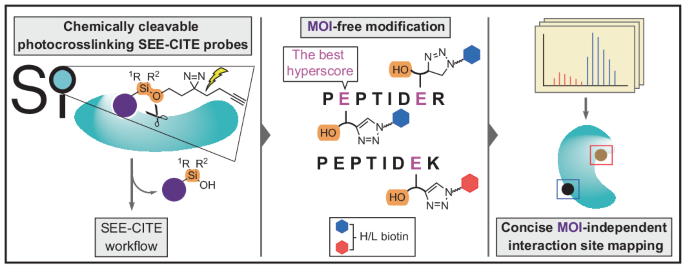
For peptide-directed SEE-CITE quantitative analyses with variable modification search, isoTOP-ABPP workflow was used as the template, adjusted for the SEE-CITE modification masses. MS1 labelling quantification with IonQuant79 was enabled, with Light set as *+436.2256 and Heavy set as *442.2633. The MS1 intensity ratio of heavy and light labelled peptides were reported. This analysis used Fragpipe version 20.0, MSFragger version 3.8, IonQuant version 1.9.8 and Philosopher version 5.0.0.
For peptide-directed SEE-CITE quantitative analyses with mass offset search, custom mass offset search-based workflow was used. SEE-CITE modifications with Light set as *+436.2256 and Heavy set as *442.2633 were specified as mass offsets allowed on all amino acids. Met oxidation, N-term acetylation and cysteine alkylation are still specified as variable modifications. Further details for mass offset search are discussed in the Supplementary Information. This analysis used FragPipe version 21.2-build38 (now released in FragPipe 22 under the name ‘PAL’), MSFragger version 4.1-rc33, IonQuant version 1.10.23 and Philosopher version 5.1.1-RC13. In all variable modification and mass offset searches, precursor and fragment mass tolerance was set as 20 ppm. Missed cleavages were allowed up to 2. Peptide length was set to 7–50, and peptide mass range was set to 500–5,000.
For protein-level AfBPP analyses, LFQ with IonQuant featuring FDR-controlled match-between-runs (MBR)79 was used. Normalization was enabled only for probe–probe LFQ analyses, while competitive and/or UV-dependent LFQ experiments were searched without the normalization module, allowing accurate protein quantification for samples with large differences in abundance in these LFQ experiments. Identified proteins from the LFQ-MBR search output were filtered by Perseus 2.0.11 to retain only proteins identified in at least two replicates (for experiments with three replicates per condition) or four replicates (for experiments with six replicates per condition). Missing values were then imputed by Perseus on the basis of the normal distribution. Imputed proteins were processed with our custom R scripts via RStudio, version 2024.09.0+375, to generate volcano plots for visualization and classification of enriched (UP), not significant (NS) and not enriched (DOWN) with log2(FC) (where FC is fold change) and raw P values. For competitive analyses, significant proteins were defined as log2(FC) >0.5 and P < 0.05. For other probe–probe and UV-dependent labelling experiments, significant proteins were defined as log2(FC) >1.0 and P < 0.05. This analysis used FragPipe version 22.0, MSFragger version 4.1, IonQuant version 1.10.27, diaTracer version 1.1.3 and Philosopher version 5.1.1. Spectra were visualized in PDV53. Custom Python scripts were implemented to compile labelled peptide and protein datasets. Unique proteins and unique peptides were quantified for each dataset. Unique proteins were established on the basis of UniProt protein IDs. Unique peptides were found on the basis of sequences containing modified residues. Unique modified peptides were classified by an identifier consisting of a UniProt protein ID, the modified residue and the corresponding amino acid number (ProteinID_*#); residue numbers were found by aligning the peptide sequence to the corresponding UniProt protein sequence. When there are multiple modified residues in one peptide, all the modified residue numbers will be reported as ProteinID_*#_*#.
For other non-proteomics statistical analyses, statistical values including the exact n, statistical test and significance are reported in the figure legends. Statistical significance was defined as P < 0.05 and, unless indicated otherwise, determined by two-tailed paired and unpaired Student’s t-tests calculated by Prism, version 10.4.1 (532).
Pathway analysisFor Kyoto Encyclopedia of Genes and Genomes (KEGG) and GO analyses, the subset of proteins to be analysed was searched using the Enrichr algorithm80,81,82 and plotted using Prism, version 10.4. The entirety of the proteins in the dataset used the ‘background’ dataset for statistical comparison. Pathway groups with an adjusted P value <0.05 were considered significantly enriched over background. The first ten terms were shown in the histograms.
Gel-based AfBPP analyses of ABL1 kinase domainRecombinant human c-ABL His-tag protein (1 μM) (R&D Systems, #11091-AL) was spiked into HEK293T cells (0.5 mg ml−1 in Fig. 3b or 1 mg ml−1 in Supplementary Fig. 4b,c). For Fig. 3b, competitive gel-based AfBPP analyses were done by pretreating ABL1 in lysate with asciminib or dasatinib (0, 2, 20 μM, 0.5 h) followed by probe treatment with 4c or 5c (1 μM, 0.5 h). For Supplementary Fig. 4b,c, ABL1 in lysates were either pretreated with asciminib or dasatinib (100 μM, 0.5 h), followed by probe treatment with 4b, 5c, 4c or 5c (10 μM, 0.5 h) (Suppplementary Fig. 4b) or simply treated with 4c or 5c (1, 10 μM) (Suppplementary Fig. 4c). Drug and probe stocks were prepared in DMSO as 100× stocks. Post-treated samples were UV-irradiated on ice at 350 nm for 20 min. All samples underwent the following protocols: click chemistry for gel-based AfBPP, SDS–PAGE analysis and imaging, and western blotting, as described earlier.
Purification of AP fusion proteinsHEK293T cells were transiently transfected with AP fusion proteins for 24 h. The transfection medium was replaced with serum-free DMEM, and the cells were left to incubate for 24 h at 37 °C to produce secreted AP fusion proteins. The media containing proteins were collected and concentrated gently at 2,000g at 4 °C with intervals of 5 min to prevent protein precipitation until having ~1 ml. NTA Ni resin (250 μl per protein) was equilibrated with 20 mM Tris–HCl pH 7.40, 150 mM NaCl. To 1 ml of AP fusion proteins, washed resin was added, and proteins were rotated with resin for 2 h at 4 °C. After 2-h incubation, protein–resin slurry was transferred to the column. Protein-bound resin was washed with ten bed volumes (~5 ml) of freshly prepared 20 mM Tris–HCl pH 7.40, 150 mM NaCl and 20 mM imidazole. AP fusion proteins were eluted with ten bed volumes (~5 ml) of freshly prepared 20 mM Tris–HCl pH 7.40, 150 mM NaCl and 200 mM imidazole. Eluted fractions were subject to buffer exchange with MWCO 10 kDa (Amicon) to remove high salt at 2,000g at 4 °C until reaching ~250 μl. Purified proteins were determined concentrations using a Bio-Rad detergent-compatible protein assay kit (Bio-Rad Life Science #5000113 and #5000114) and stored at −80 °C as 5-μl or 10-μl aliquots for future binding assays.
Nogo66–Nogo66R (RTN4–RTNR) AP binding assayHEK293T or HeLa cells stably expressing GFP-FLAG-His or RTNR-FLAG-His were plated into six-well plates to reach 100% confluency before the assay. Experiments were conducted as previously described69. Cells were washed once with a cold HBAH buffer containing Hanks’ balanced salt solution (ThermoFisher #14025092), bovine serum albumin (0.5 mg ml−1) (Fisher Scientific #BP1600-100), 0.1% (w/v) NaN3, 20 mM HEPES, pH 7.45. AP fusion proteins were diluted in HBAH to reach 100 nM and added to the cells gently. Cells were incubated with protein at 4 °C for 3 h. After incubation, protein solution was removed, and cells were washed five times with cold HBAH with 5-min incubation in HBAH between each wash. Cells were lysed with 200 μl Triton–Tris buffer (1% (v/v) Triton X-100 and 10 mM Tris–HCl, pH 8.0) at room temperature. Lysates were collected into Eppendorf tubes and spun at 3,000g for 5 min at 4 °C to remove cell nuclei. Then, 150 μl lysates were transferred to new Eppendorf tubes and heated at 65 °C for 10 min to heat-inactivate endogenous AP. Per 100-μl lysate after heat inactivation, 100 μl of 4-nitrophenyl phosphate (p-NPP) prepared in buffer containing 20 mM homoarginine, 1 mM MgCl2 and 21% diethanolamine, pH 10.40, was added to reach 12 mM working concentration. Heat-stable AP activity was detected by measuring absorbance of samples at 405 nM at 37 °C for 3 h using a multimodal plate reader (BioTek Synergy H1).
Seahorse XF analysisAll respirometry was conducted in a Seahorse XF96 or XFe96 Analyzer (Agilent Technologies). All experiments were conducted at 37 °C and at pH 7.2. The placement of treatment groups on the XF plate was randomized across biological replicates as best as possible to avoid biased results.
Recombinant, mutant perfringolysin O (rPFO; commercially XF Plasma Membrane Permeabilizer [XF PMP, Agilent Technologies]) was used to selectively permeabilize the plasma membrane of cells. Experiments were conducted as previously described83,84. Immediately prior to the assay, cell medium was replaced with MAS buffer (70 mM sucrose, 220 mM mannitol, 10 mM KH2PO4, 5 mM MgCl2, 2 mM HEPES, 0.2% (w/v) Fraction V BSA and 1 mM 4-(2-hydroxyethyl)piperazine-1-ethane-sulfonic acid (EGTA); pH 7.2) containing 2 nM rPFO, 5 mM pyruvate with 1 mM malate and 4 mM ADP. The ADP-stimulated respiration rate (referred to as ‘state 3’ respiration) was measured, and background signal was measured after treatment with 0.2 μM rotenone with 1 μM antimycin A.
When normalizing respirometry experiments to cell number, cells were fixed immediately upon completion of the assay with 2% (w/v) formaldehyde for 20 min at room temperature and kept refrigerated between 1 and 14 days until assessment. On the day before cell counting, cells were stained with Hoechst (Thermo Fisher #33342) at 10 ng ml−1 overnight at room temperature. Cell counts were obtained using the Operetta High-Content Imaging System (PerkinElmer).
FLAG immunoprecipitationFor ubiquitin assay, HEK293T cells stably overexpressing COX5A–HA were transiently transfected with COX5A–FLAG for 48 h. All other FLAG-immunoprecipitation experiments required parental HEK293T cells transiently overexpressing FLAG-tagged GFP, wild-type COX5A and mutant COX5A (T79G-, T79W-, Y80W- and D81W-COX5A) before asciminib treatment. As annotated in detail per experiment, cells with 90–100% confluency in 10-cm plates were untreated or subjected to 1 h treatment with asciminib (10 μM) or dasatinib (10 μM) with or without 20-min UV irradiation at 350 nm. Treated cells from ubiquitin assay were lysed using the lysis method 5, and all other FLAG-immunoprecipitation-lysed cells by lysis method 1. Both lysis methods and the corresponding determination of protein concentrations were described in detail earlier. For each normalized lysate sample (350 μl, 3 mg ml−1) lysates, 10 μl of anti-FLAG EZView resins (Sigma #F2426) were washed with buffer B containing 50 mM Tris–HCl, pH 7.40, 150 mM NaCl and resuspended in buffer B (100 μl). Normalized samples were rotated with prewashed resins for 2 h at 4 °C, with 50 μl of lysate being saved as input samples. After incubation, resins were spun down at 8,200g for 1 min., followed by removal of supernatant, and washed three times with buffer B. Elution of immunoprecipitated proteins was done by adding 4× Laemmli loading dye containing no 10% β-mercaptoethanol (30 μl) to each sample and heating the samples for 5 min at 95 °C. To each input sample, 16 μl of 4× Laemmli sample buffer with 10% β-mercaptoethanol was added, and the mixture was boiled at 95 °C for 5 min. Eluted samples were subjected to SDS–PAGE and western blot analyses as described earlier in the ‘SDS–PAGE analysis and imaging’ and ‘Western blots’ sections.
BN-PAGE analysis to study OXPHOS complex assemblyParental HEK293T cells at 90% confluency in 10-cm plates were treated with DMSO as vehicle, dasatinib (10 μM) or asciminib (10 μM) for 6 h at 37 °C and 5% CO2. Treated cells were collected and stored as cell pellets at −80 °C until usage. Experiments were conducted as previously described85. Cell pellets were thawed on ice, resuspended in PBS-Digitonin 25% (8 mg ml−1) (400 μl) and incubated for 10 min. Samples were centrifuged twice for 5 min at 10,000g at 4 °C. Pellets were resuspended in 1.5 M aminocaproic acid, 50 mM Bis-Tris/HCl pH 7.0 and 1% digitonin. Samples were centrifuged for 30 min at 20,000g at 4 °C. Supernatant was collected and resuspended with sample buffer prepared with 0.75 M aminocaproic acid, 50 mM Bis-Tris–HCl pH 7.0, 0.5 mM EDTA and 5% SERVA Blue G. Samples were loaded into native PAGE 3–12% (Invitrogen #BN1003BOX), run for 3 h at 150 V and underwent western blot analysis. Antibodies used in this experiment include COXIV (Proteintech, #11242-1-AP, #00110030) and SDHA (Invitrogen, #459200 and #YB3840708).
Cell line sourcesAll cell lines used were purchased from ATCC: HEK293T (ATCC, CRL-3216), HeLa (ATCC, CCL-2), K562 (ATCC, CCL-243), KCL22 (ATCC, CRL-3349) and MOLT4 (ATCC, CRL-1582).
Protein structural analysisDepictions of protein structures obtained directly from the Protein Data Bank (PDB) were generated using the licensed PyMOL Molecular Graphics System, Version 2.5.5 Schrödinger, LLC.
Reporting summaryFurther information on research design is available in the Nature Portfolio Reporting Summary linked to this article.
Comments (0)