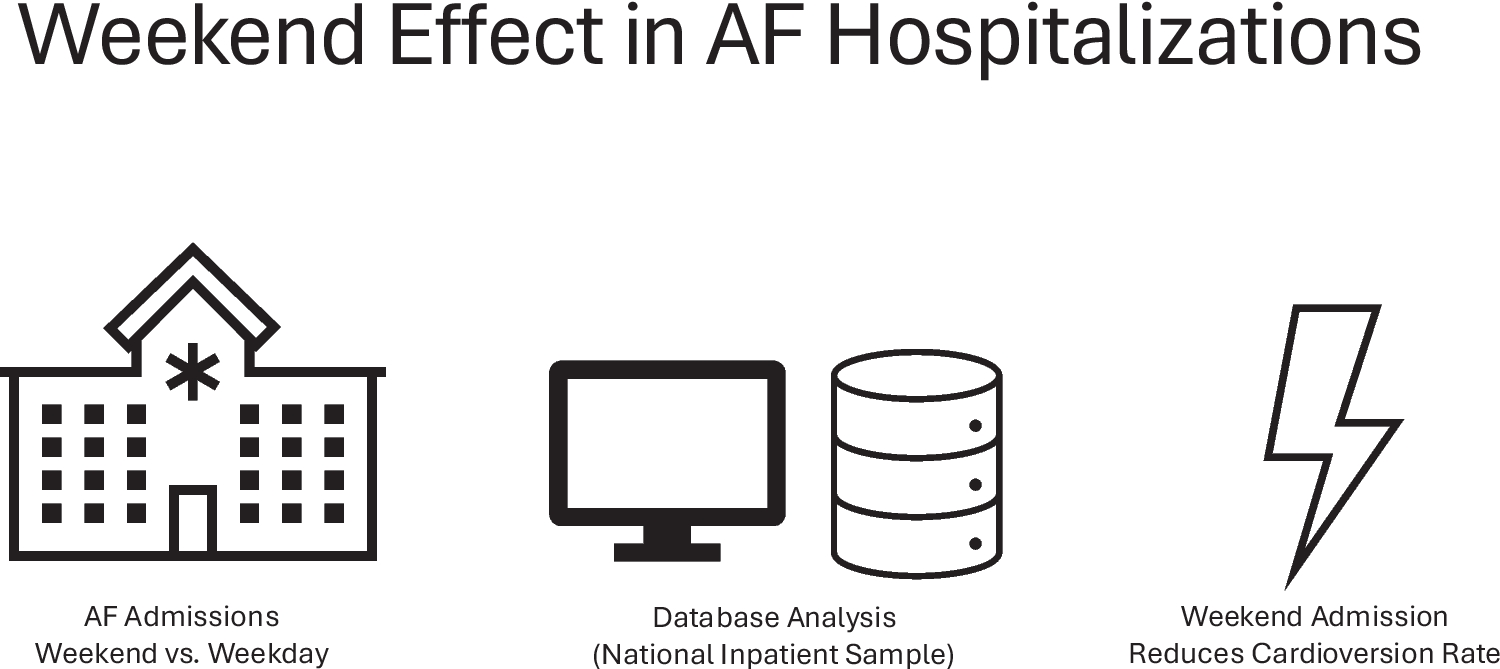
In this nationwide analysis of atrial fibrillation hospitalizations, weekend admission was associated with significantly lower likelihood of undergoing cardioversion compared with weekday admission. However, weekend admissions were not significantly associated with in-hospital mortality or length of stay, and total hospital charges were modestly lower among weekend admissions, potentially reflecting the lower frequency of cardioversion procedures. Although differences in cardioversion rate among weekend admissions were statistically significant, the absolute difference was modest (AD − 3.14%) and was not accompanied by a significant difference in in-hospital mortality.
Prior literature analyzing the “weekend effect” in atrial fibrillation has produced heterogeneous results. A 2023 meta-analysis found a 58% greater mortality among weekend admissions, supporting the existence of a weekend effect in this population [2]. However, the included studies were based on data from 2012 to 2019 and may not reflect contemporary management.
In comparison, the most recent NIS-based study addressing this question used 2014 data and found no significant difference in mortality or length of stay [7]. Since then, the transition to ICD-10 coding and substantial changes in atrial fibrillation management, including broader adoption of direct oral anticoagulants and increased emphasis on early rhythm-control, highlight the importance of re-addressing this question using contemporary data [3, 4].
Although weekend admission was associated with reduced use of cardioversion, this difference was not accompanied by statistically significant differences in mortality or length of stay. Our findings suggest that while access to cardioversion may differ by day of presentation, short-term outcomes may be preserved in clinical practice. Clinically, these findings suggest that lower rates of cardioversion on the weekends did not translate into worse short-term outcomes, supporting the safety of selective rhythm-control strategies when immediate cardioversion is not feasible. However, whether these differences influence longer-term mortality, symptom control, or recurrent hospitalizations is not known. Formal interaction testing demonstrates no significant heterogeneity of the weekend association across hospital teaching status, bed size, geographic region, or urban/rural location, indicating that this pattern is likely consistent across hospital types.
The lower likelihood of cardioversion among weekend admission may reflect differences in patient selection or hospital workflow; however, the NIS does not contain information on staffing patterns, pharmacological rhythm-control strategies, or timing of intervention, precluding definitive mechanistic conclusions.
We also observed higher rates of shock and endotracheal intubation/mechanical ventilation among patients who underwent cardioversion on weekends. These represent in-hospital events observed among admissions receiving ICD-10-PCS code 5A2204Z that are not necessarily temporally or causally linked to the cardioversion itself, but rather likely reflect selection of higher acuity cases for cardioversion during weekends.
Although the original analytic plan focused on adults younger than 75 years, the revised cohort includes all adults aged ≥ 18 years. Older patients with atrial fibrillation, particularly those ≥ 80 years, experience substantially higher risks of all-cause mortality, stroke, myocardial infarction, and major bleeding compared with younger patients, underscoring the vulnerability of this population and the importance of further investigation [8]. In sensitivity analyses, we observed that the association between weekend admission and receipt of cardioversion was similar among patients aged ≥ 75 years compared with those aged < 75 years, supporting the generalizability of our findings across age groups. Because the NIS is a nationally representative sample of US inpatient hospitalizations, these findings are generalizable to adult hospitalizations for atrial fibrillation across a broad range of hospital types and geographic regions; however, they should not be applied to outpatient management or long-term rhythm-control strategies.
Limitations
This study has several limitations. First, the use of a retrospective administrative database introduces possible misclassification and variability in ICD-10 coding practices across institutions. Although atrial fibrillation diagnosis codes have demonstrated reasonable validity in prior studies, coding error remains possible [9, 10].
Second, the ICD-10 coding system does not capture atrial fibrillation subtype (paroxysmal vs persistent vs longstanding persistent), symptom burden, hemodynamic stability, anticoagulation status or pharmacological cardioversion attempts, all of which are clinically relevant and may influence clinical decision making. The NIS lacks detailed information regarding clinical severity, staffing patterns or provider availability. Therefore, residual confounding related to unmeasured patient acuity or hospital workflow cannot be excluded. Although we adjusted for a broad range of demographic, clinical and hospital-level covariates and observed no heterogeneity across hospital characteristics, unmeasured confounding is likely to persist.
Third, while cardioversion was identified using ICD-10-PCS code 5A2204Z, which is not specific to cardioversion and may also capture defibrillation. Although we performed sensitivity analyses excluding hospitalizations involving shock, vasopressor use, and mechanical ventilation to mitigate misclassification; it is likely that some degree of misclassification remains. Because the ICD-10-PCS code used is not specific to cardioversion and may include defibrillation, our findings should be interpreted as reflecting electrical rhythm restoration procedures rather than cardioversion alone.
Fourth, admission timing in the NIS is based on inpatient admission date and does not capture emergency department arrival or boarding times, which may result in misclassification of weekend exposure for hospitalizations occurring near midnight. In addition, transfer hospitalizations may not reflect the initial site or timing of presentation. We performed a sensitivity analysis excluding interhospital transfers; however, some misclassification may persist.
Finally, we restricted the primary analytic cohort to hospitalizations with atrial fibrillation coded as the principal diagnosis to improve specificity for admissions primarily driven by atrial fibrillation. This approach may exclude clinically important cases in which AF occurs secondary to other acute conditions such as sepsis or heart failure. Conversely, expanding case identification to atrial fibrillation in any diagnosis position may capture hospitalizations reflecting a history of AF rather than the primary reason for admission. To evaluate the impact of this design choice, we performed a sensitivity analysis including atrial fibrillation in any diagnostic position, which yielded similar results, supporting the robustness of our findings.

Comments (0)