
Remember me
Growing evidence has supported the role of autophagy in accelerating tumor growth. Here, we detected the positive expression of ATG5 in ameloblastoma specimens and alveolar bone tissues (Fig. 2A–C). The expression level of ATG5 was significantly enhanced in ameloblastoma specimens. Interestingly, ATG5 was co-localized with the mesenchymal marker Vimentin in ameloblastoma specimens, validating the presence of mesenchymal stroma in the components of ameloblastoma (Fig. 2B).
Fig. 2
Basal autophagy in ameloblastoma and identification of mesenchymal components in M-AMCs. A H&E staining of ATG5 in ameloblastoma and alveolar bone specimens (magnification = 5 × and 20 ×). B, C Immunofluorescent staining of Vimentin (green) and ATG5 (red) in ameloblastoma specimens (magnification = 40 ×). Cell nuclei were stained with DAPI (blue). D Growth state of P0 and P3 M-AMCs (scale bar: 25 μm). E Colony formation of M-AMCs (scale bar: 200 μm). F Flow cytometry of CD44, CD133, CD73, CD90 and CD105 in M-AMCs. via flow cytometry. **p < 0.01
In primary ameloblastoma cells (P0), epithelial components appeared like paving stones while mesenchymal components were spindle-shaped. They proceeded to proliferate and merge progressively with the prolongation of cell culture. After cell passage into the third generation (P3), mesenchymal components were predominant in ameloblastoma cells (Fig. 2D) Colony formation assay consistently proved the similar characteristics between M-AMCs and tumor stem cells (Fig. 2E). Moreover, M-AMCs were positive for mesenchymal markers on the cell surface, including CD44, CD133, CD73, CD90, and CD105 (Fig. 2F). These findings implied that M-AMCs possessed strong colony formation, proliferation, and self-renewal ablilities.
3.2 M-AMCs inhibit the proliferation, differentiation, migration, and autophagy of co-cultured HBMSCsA co-culture system of M-AMCs and HBMSCs was prepared to investigate the influence of M-AMCs on the behaviors of HBMSCs (Fig. 3A). After 3 days and 7 days of co-culture, the percentage of EdU-positive HBMSCs was significantly lower than that in mono-cultured HBMSCs (Fig. 3B–C). The migratory ability at 24 and 72 h was significantly reduced in co-cultured HBMSCs compared with that in mono-cultured HBMSCs (Fig. 3D). Mineralized nodules formed by HBMSCs in the co-culture system were fewer than those in the mono-culture system, indicating the inhibited osteogenic differentiation (Fig. 3F). Significant downregulations of ALP, RUNX2, OSX, and OPN proved the suppression of osteogenesis in co-cultured HBSMCs (Fig. 3G–H). Immunofluorescence of co-cultured HBMSCs three days after osteogenic induction revealed a significant decrease in the positive expression of ATG5 (Fig. 3I). Moreover, seven days of co-culture significantly downregulated ATG5, Beclin1, and LC3 II/I protein levels in HBMSCs by M-AMCs (Fig. 3J–K). Overall, M-AMCs significantly inhibited the proliferation, differentiation, migration, and autophagy in co-cultured HBMSCs.
Fig. 3
M-AMCs inhibit cell behaviors of co-cultured HBMSCs. A A schematic diagram of M-AMCs in inhibiting proliferation, differentiation and migration of co-cultured HBMSCs. B, C EdU-positive HBMSCs (red) in the mono-culture and co-culture systems (scale bar: 25 μm). Cell nuclei were stained with DAPI (blue). D, E Transwell migration assay of HBMSCs in the mono-culture and co-culture systems (scale bar: 50 μm). F ALP and ARS staining of HBMSCs in the mono-culture and co-culture systems (scale bar: 100 μm). G, H Protein expressions of ALP, RUNX2, OSX and OPN in HBMSCs of the mono-culture and co-culture systems. I Immunofluorescent staining of ATG5 (red) in HBMSCs of the mono-culture and co-culture systems (scale bar: 25 μm). Cell nuclei were stained with DAPI (blue). J, K Protein expressions of ATG5, LC3 II/I and Beclin1 in HBMSCs of the mono-culture and co-culture systems. **p < 0.01
3.3 HBMSCs promote the proliferation, migration, invasion, and autophagy of co-cultured M-AMCsTo explore the cross-talk between M-AMCs and HBMSCs, we later explored the influence of HBMSCs on the behaviors of M-AMCs in the co-culture system (Fig. 4A). Attributed to the mesenchymal components in M-AMCs, HBMSCs significantly increased the percentages of EdU-positive M-AMCs at 3 days and 7 days of co-culture (Fig. 4B, C), as well as higher migratory (Fig. 4D, E) and invasive capacities (Fig. 4F, G) at 24 h and 72 h. Significantly upregulated MMP2 and MMP9 in co-cultured M-AMCs consistently validated the mesenchymal property in M-AMCs (Fig. 4H, I). In addition, the upregulated ATG5, Beclin1 and LC3 II/I in co-cultured M-AMCs by HBMSCs indicated the enhanced autophagy (Fig. 4K, L). We confirmed that M-AMCs and HBMSCs interacted to regulate their behaviors.
Fig. 4
HBMSCs promote cell behaviors of co-cultured M-AMCs. A A schematic diagram of HBMSCs in promoting proliferation, invasion and migration of co-cultured M-AMCs. B, C EdU-positive M-AMCs (red) in the mono-culture and co-culture systems (scale bar: 25 μm). Cell nuclei were stained with DAPI (blue). D, E Transwell migration assay of M-AMCs in the mono-culture and co-culture systems (scale bar: 50 μm). F, G Transwell invasion assay of M-AMCs invasion assay in the mono-culture and co-culture systems (scale bar: 50 μm). H, I Protein expressions of MMP2 and MMP9 in M-AMCs of the mono-culture and co-culture systems. J Immunofluorescent staining of ATG5 (red) in M-AMCs of the mono-culture and co-culture systems (scale bar: 25 μm). Cell nuclei were stained with DAPI (blue). K, L Protein expressions of ATG5, LC3 II/I and Beclin1 in M-AMCs of the mono-culture and co-culture systems. **p < 0.01
3.4 HAMSCs inhibit the proliferation, migration, invasion, and autophagy of co-cultured M-AMCsSimilarly, in the co-culture system of HAMSCs and M-AMCs, the regulatory effects of HAMSCs on the behaviors of co-cultured M-AMCs were examined (Fig. 5A). After 3 days and 7 days of co-culture, the percentage of EdU-positive M-AMCs was significantly reduced by HAMSCs (Fig. 5B, C). Migratory (Fig. 5D, E) and invasive capacities (Fig. 5F, G) were significantly suppressed at 24 h and 72 h in co-cultured M-AMCs. As expected, MMP2 and MMP9 were significantly downregulated in the co-culture system of M-AMCs (Fig. 5H, I). Suppressed autophagy in co-cultured M-AMCs was validated by the less positive staining of ATG5 (Fig. 5J) and lower protein expressions of ATG5, Beclin1, and LC3 II/I in the co-culture system of M-AMCs (Fig. 5K, L). Besides suppressing autophagy, HAMSCs exerted inhibitory effects on the proliferation, migration, and invasion of M-AMCs.
Fig. 5
HAMSCs inhibit cell behaviors of co-cultured M-AMCs. A A schematic diagram of HAMSCs in promoting proliferation, invasion and migration of co-cultured M-AMCs. (B, C) EdU-positive M-AMCs (red) in the mono-culture and co-culture systems (scale bar: 25 μm). Cell nuclei were stained with DAPI (blue). D, E Transwell migration assay of M-AMCs in the mono-culture and co-culture systems (scale bar: 50 μm). F, G Transwell invasion assay of M-AMCs invasion assay in the mono-culture and co-culture systems (scale bar: 50 μm). H, I Protein expressions of MMP2 and MMP9 in M-AMCs of the mono-culture and co-culture systems. J Immunofluorescent staining of ATG5 (red) in M-AMCs of the mono-culture and co-culture systems (scale bar: 25 μm). Cell nuclei were stained with DAPI (blue). K, L Protein expressions of ATG5, LC3 II/I and Beclin1 in M-AMCs of the mono-culture and co-culture systems. **p < 0.01
3.5 HAMSCs promote the proliferation, migration, differentiation, and autophagy of co-cultured HBMSCsNotably, HAMSCs are excellent donor cells to promote endogenous bone regeneration by activating the autophagy signalling pathway. When co-cultured with HBMSCs (Fig. 6A), HAMSCs contributed to significantly enhancing the percentage of EdU-positive (Fig. 6B, C) and migratory HBMSCs (Fig. 6D, E). We also observed more pronounced ALP and ARS staining (Fig. 6F) and higher protein expressions of ALP, RUNX2, OSX and OPN (Fig. 6G, H) in co-cultured HBMSCs than mono-cultured HBMSCs, suggesting the accelerated osteogenic differentiation by HAMSCs. In addition, a stronger positive staining of ATG5 (Fig. 6I) and higher protein levels of ATG5, LC3 II/I and Beclin1 (Fig. 6J, K) were indicative of enhanced autophagy in co-cultured HBMSCs.
Fig. 6
HAMSCs promote cell behaviors of co-cultured HBMSCs. A A schematic diagram of HAMSCs in promoting proliferation, differentiation and migration of co-cultured HBMSCs. B, C) EdU-positive HBMSCs (red) in the mono-culture and co-culture systems (scale bar: 25 μm). Cell nuclei were stained with DAPI (blue). D, E Transwell migration assay of HBMSCs in the mono-culture and co-culture systems (scale bar: 50 μm). F ALP and ARS staining of HBMSCs in the mono-culture and co-culture systems (scale bar: 100 μm). G, H Protein expressions of ALP, RUNX2, OSX and OPN in HBMSCs of the mono-culture and co-culture systems. I Immunofluorescent staining of ATG5 (red) in HBMSCs of the mono-culture and co-culture systems (scale bar: 25 μm). Cell nuclei were stained with DAPI (blue). J, K Protein expressions of ATG5, Beclin1 and LC3 II/I in HBMSCs of the mono-culture and co-culture systems. **P < 0.01
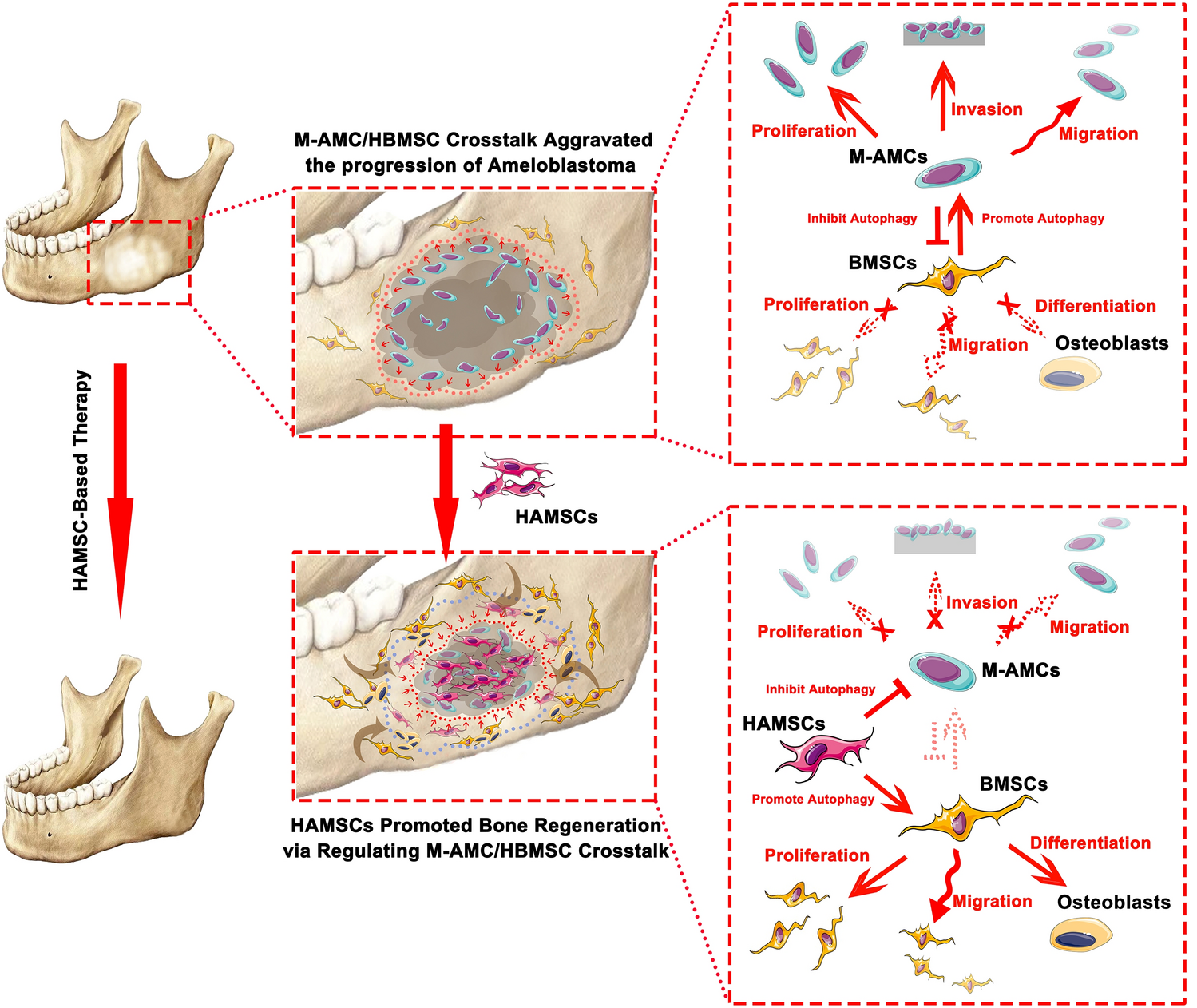
3.6 Role of HAMSCs in the TME where M-AMCs and HBMSCs co-existWe inoculated and directly co-cultured HAMSCs, HBMSCs, and M-AMCs to clarify whether HAMSCs can inhibit M-AMCs or enhance HNMSCs in the TME through their excellent paracrine effects.
3.7 HAMSCs inhibit the behaviors of M-AMCs promoted by HBMSCsA complicated co-culture system of HAMSCs, M-AMCs, and HBMSCs was prepared to illustrate the role of HAMSCs in regulating the cross-talk between the latter two in the TME of ameloblastoma via the paracrine effect (Fig. 7A). Interestingly, we observed that HAMSCs significantly inhibited the behaviors of M-AMCs promoted by HBMSCs. Compared with those in the co-culture system of HBMSCs and M-AMCs, we detected significantly lower percentage of EdU-positive M-AMCs (Fig. 7B, C) and lower migratory (Fig. 7D, E) and invasive capacities (Fig. 7F, G) in co-cultured M-AMCs with HAMSCs and HBMSCs. Significantly downregulated MMP2, MMP9, ATG5, Beclin1, and LC3 II/I were detected in M-AMCs co-cultured with HAMSCs and HBMSCs than those co-cultured with HBMSCs (Fig. 7H–L). These findings showed that HAMSCs inhibited the role of HBMSCs in promoting the behaviors of co-cultured M-AMCs.
Fig. 7
HAMSCs inhibit cell behaviors of M-AMCs promoted by HBMSCs. A A schematic diagram of HAMSCs in inhibiting the proliferation, invasion and migration of M-AMCs promoted by HBMSCs. B, C EdU-positive M-AMCs (red) in HBMSCs/M-AMCs co-culture system and HAMSCs/HBMSCs/M-AMCs co-culture system (scale bar: 25 μm). Cell nuclei were stained with DAPI (blue). D, E Transwell migration assay of M-AMCs in HBMSCs/M-AMCs co-culture system and HAMSCs/HBMSCs/M-AMCs co-culture system (scale bar: 50 μm). F, G Transwell invasion assay of M-AMCs in HBMSCs/M-AMCs co-culture system and HAMSCs/HBMSCs/M-AMCs co-culture system (scale bar: 50 μm). H, I Protein expressions of MMP2 and MMP9 in M-AMCs of HBMSCs/M-AMCs co-culture system and HAMSCs/HBMSCs/M-AMCs co-culture system. J Immunofluorescent staining of ATG5 (red) in M-AMCs of HBMSCs/M-AMCs co-culture system and HAMSCs/HBMSCs/M-AMCs co-culture system (scale bar: 25 μm). Cell nuclei were stained with DAPI (blue). K, L Protein expressions of ATG5, LC3 II/I and Beclin1 in M-AMCs of HBMSCs/M-AMCs co-culture system and HAMSCs/HBMSCs/M-AMCs co-culture system. **p < 0.01
3.8 HAMSCs promote cell behaviors of HBMSCs inhibited by M-AMCsWe detected a significantly higher percentage of EdU-positive HBMSCs (Fig. 8B, C) and higher migratory (Fig. 8D, E) and more pronounced ALP and ARS staining (Fig. 8F) of co-cultured HBMSCs with HAMSCs and M-AMCs, compared with those of HBMSCs co-cultured with M-AMCs. ALP, RUNX2, OSX, OPN, ATG5, Beclin1, and LC3 II/I were significantly upregulated in HBMSCs co-cultured with HAMSCs and M-AMCs, compared to those in HBMSCs co-cultured with M-AMCs (Fig. 8G–K). Collectively, HAMSCs enhanced the role of M-AMCs in inhibiting the behaviors of co-cultured HBMSCs.
Fig. 8
HAMSCs recover cell behaviors in HBMSCs inhibited by M-AMCs. A schematic diagram of HAMSCs in promoting the proliferation, invasion and migration of HBMSCs promoted by M-AMCs. B, C EdU-positive HBMSCs (red) in HBMSCs/M-AMCs co-culture system and HAMSCs/HBMSCs/M-AMCs co-culture system (scale bar: 25 μm). Cell nuclei were stained with DAPI (blue). D, E Transwell migration assay of HBMSCs in HBMSCs/M-AMCs co-culture system and HAMSCs/HBMSCs/M-AMCs co-culture system (scale bar: 50 μm). F ALP and ARS staining of HBMSCs in HBMSCs/M-AMCs co-culture system and HAMSCs/HBMSCs/M-AMCs co-culture system (scale bar: 50 μm). G, H Protein expressions of ALP, RUNX2, OSX and OPN in HBMSCs of HBMSCs/M-AMCs co-culture system and HAMSCs/HBMSCs/M-AMCs co-culture system. I Immunofluorescent staining of ATG5 (red) in HBMSCs of HBMSCs/M-AMCs co-culture system and HAMSCs/HBMSCs/M-AMCs co-culture system (scale bar: 25 μm). Cell nuclei were stained with DAPI (blue). J, K Protein expressions of ATG5, LC3 II/I and Beclin1 in HBMSCs of HBMSCs/M-AMCs co-culture system and HAMSCs/HBMSCs/M-AMCs co-culture system. **p < 0.01
3.9 HAMSCs promote bone regeneration in vivoTo further explore the in vivo role of HAMSCs in stimulating bone regeneration by suppressing cell behaviors of M-AMCs, we assessed macrophage infiltration in nude mice of the four groups at 4 weeks after scaffold transplantation (Fig. 9A). New bone formation was significantly inhibited in mice transplanted with silk scaffolds containing M-AMCs. The area of new bones was larger in mice transplanted with silk scaffolds containing both HAMSCs and M-AMCs than in other groups, suggesting that HAMSCs promoted osteogenesis in bone defects (Fig. 9B, D). Interestingly, ALP was co-localized with ATG5 in the new bone area (Fig. 9C). The percentages of ATG5-positive area and ALP-positive area were significantly higher in mice transplanted with silk scaffolds containing both HAMSCs and M-AMCs than those with silk scaffolds containing M-AMCs, indicating the involvement of enhanced autophagy in HAMSCs-induced bone regeneration (Fig. 9E, F).
Fig. 9
HAMSCs promote bone regeneration in vivo. A A schematic diagram of nude mice subcutaneously transplanted with silk scaffolds containing blank control, BMP-2, M-AMCs and M-AMCs co-cultured with HAMSCs (n = 6 per group). B H&E staining, Masson’s trichrome staining and immunofluorescence of ALP (green), ATG5 (red) and nuclei (blue) in harvested tissue blocks of silk scaffolds (scale bar: 200 μm in H&E and Masson’s trichrome staining; 100 μm in immunofluorescent staining). C Co-localization of ALP and ATG5 in the new bone area (scale bar: 100 μm). D–F Percentage of new bone area D ALP-positive new bone area (E) and ATG5-positive new bone area (F). **p < 0.01
Comments (0)