From Podium to Publication: the Fate of Abstracts Presented at ICS and IUGA/AUGS 2022
Introduction and Hypothesis
Conference presentations are a cornerstone of academic dissemination, yet the proportion of abstracts that reach full-text publication varies. Limited data exist on publication outcomes from major Urogynecology conferences. This study was aimed at comparing publication rates of abstracts presented at the 2022 International Continence Society (ICS) and International Urogynecological Association/American Urogynecologic Society (IUGA/AUGS) meetings.
Methods
Abstracts from the ICS (oral presentations only) and IUGA/AUGS (oral and poster presentations) 2022 conferences were reviewed. A systematic PubMed search (January 2022–August 2024) was conducted to identify corresponding peer-reviewed publications. Abstracts were considered published if a full-text article with substantial overlap in study design and authorship was identified. Two reviewers independently confirmed publication status, with a third reviewer resolving discrepancies. Publication characteristics and author counts were recorded. Chi-squared and Mann–Whitney U tests were used for statistical comparisons.
Results
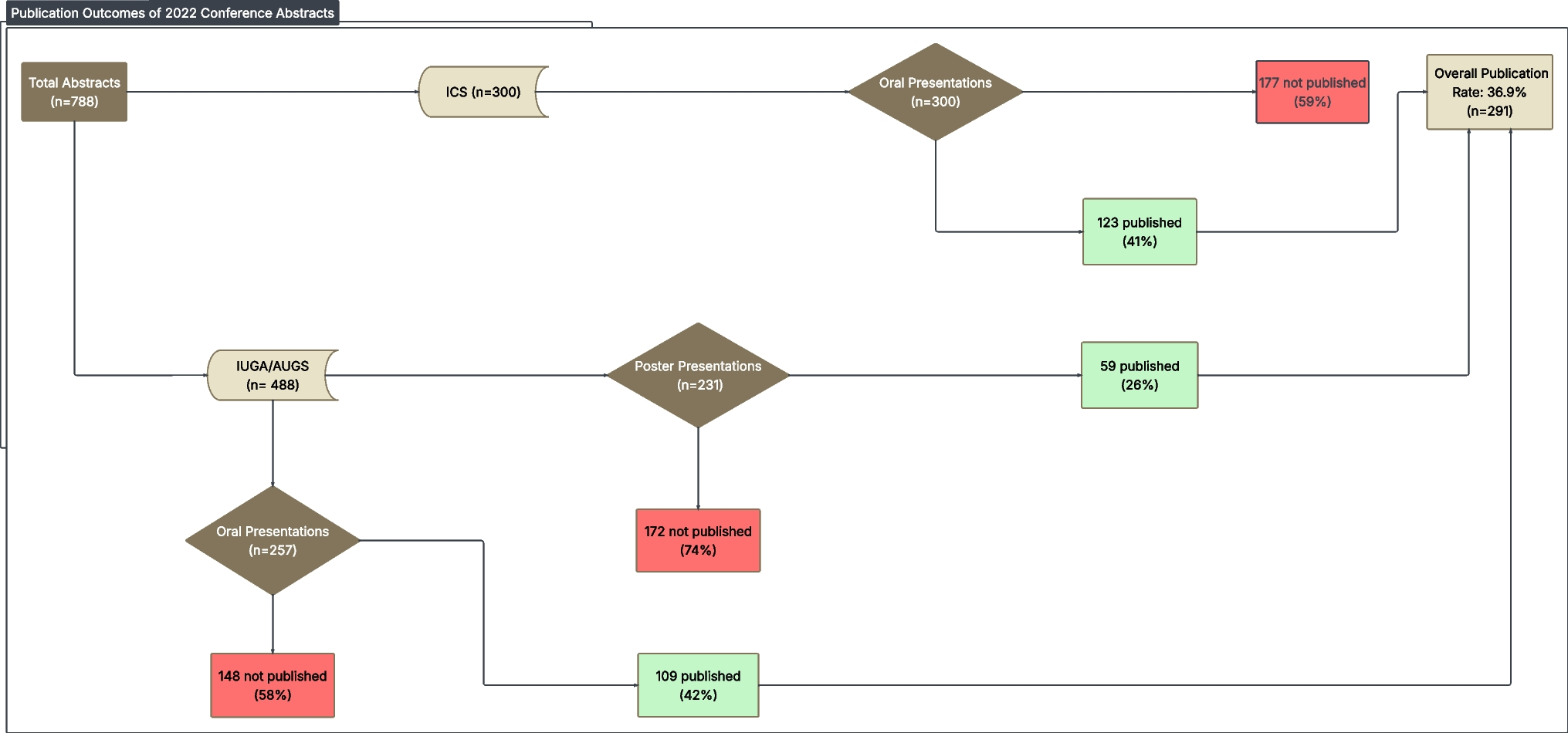
Among 788 abstracts (ICS: 300; IUGA/AUGS: 488), a total of 291 (36.9%) were published. Publication rates were similar for oral presentations at ICS and IUGA/AUGS (41.0% vs 42.4%, p = 0.80). Within the IUGA/AUGS, oral presentations were significantly more likely to be published than posters (42.4% vs 26.0%, p < 0.001). Published abstracts had more authors than unpublished ones (median 6 vs 5, p < 0.001). Over half of publications appeared in three journals: Urogynecology, International Urogynecology Journal, and Neurourology and Urodynamics. In multivariable analysis, oral presentations and higher author count independently predicted publication, whereas the conference was not a significant factor.
Conclusions
More than one-third of abstracts progressed to publication, with oral presentations and higher author counts associated with increased publication rates. These findings underscore the enduring academic value of conference research and suggest that structured post-conference support might help to translate more abstracts into high-impact publications.

Comments (0)