In this large Norwegian cohort, pregnant women with endometriosis exhibited a higher risk of PPD compared to those not reporting the condition. Mediation analyses indicated that a substantial proportion of this increased risk was explained by a higher prevalence of major depression among women with endometriosis. When examining the role of underlying infertility, it appeared that infertility resulted in a lower risk of PPD among women with endometriosis.
Comparison with existing studies
Only one previous study has evaluated the association between PPD and endometriosis [17]. In this Japanese population-based cohort study of 82,489 participants, 14% experienced PPD at one month postpartum, which is slightly higher than our observed rate of 10.3%. The study reported an odds ratio (OR) of 1.27 (95% CI: 1.15–1.41), suggesting a higher risk of PPD among women with endometriosis, consistent with our findings.
Several differences exist between the Japanese study and ours. We used a shorter 4-item EPDS scale with a cut-off of 6 instead of their utilization of the full 10 item scale with a cut-off of 9. Additionally, we evaluated PPD at six months postpartum while they measured PPD at one month postpartum. Moreover, our adjustment strategy differed. The Japanese study adjusted for several factors that might be considered potential mediators, including for example parity, mode of conception, mode of delivery, and complications during pregnancy and birth, which may have caused them to underestimate the association.
Although cultural differences may influence the comparison of PPD prevalence across populations, a 2021 systematic review revealed only minor variations in the prevalence rates of PPD between Japan (27 studies; combined prevalence rate: 13.30%, 95% CI: 12.25–14.41) and Norway (12 studies; combined prevalence rate: 11.24%, 95% CI: 8.31–15.03) [9]. The systematic review identified national income and development as key predictors of PPD prevalence [9], and both Norway and Japan rank highly in these areas, making comparisons valid, and other cultural differences less significant in these comparisons.
Previous studies have not examined potential mediators, interaction effects, and the role of parity in the association between endometriosis and PPD.
Potential explanatory mechanisms
Managing endometriosis often leads to fatigue, and pain catastrophizing [30], which may be compounded by the stress of surgical and medical treatments and their side effects [4]. Further, the condition has been found to aggravate mood alterations and depressive symptoms [6, 7], diminishing quality of life [4, 5]. Women affected by endometriosis frequently face stigmatization, trivialization, and inadequate support from partners, family, coworkers, and healthcare providers [5, 31]. This cumulative impact of symptoms and experiences leads to feelings of isolation, heightened stress reactions, and increases susceptibility to anxiety and depression [7, 32]. Furthermore, the hormonal state during pregnancy will often temporarily alleviate endometriosis symptoms due to menstrual cycle suppression, but emotional distress often arises when these symptoms reemerge postpartum [33].
The pathophysiology of endometriosis is characterized by proliferation of endometriotic tissue, followed by macrophage recruitment and cytokine secretion, which initiate localized inflammation that may progress to systemic inflammatory responses [3, 34]. Additionally, hormonal imbalances, including oestrogen dominance due to increased accumulation and synthesis of oestrogens and decreased sensitivity to progesterone, further drive proliferation and inflammation [2, 35]. With substantial inflammation, endometriosis shares features with autoimmune diseases, that may result in neurological effects by altering gene expression and volume in areas of the brain associated with pain sensitization and mood disorders, causing anxiety and depression [35].
Inflammatory pathways altering brain chemistry and stress responses, common to both endometriosis [34] and depression [28], may further link these conditions. Moreover, postpartum hormonal shifts, particularly oestrogen withdrawal, may increase PPD risk in women with a biological vulnerability, already susceptible to hormonal fluctuations [28].
We conducted mediation analysis to explore the relationship between endometriosis and PPD, aiming to determine whether intermediate factors could account for the observed effect. The analysis revealed that a substantial part of the increased PPD risk was mediated by a lifetime history of major depression, correlating with the higher prevalence of depression experiences earlier in life in women with endometriosis compared to those without endometriosis.
In contrast, infertility, or more precisely a successful pregnancy and live birth following infertility, was associated with a NIE below 1, consistent with reduced PPD risk along the infertility pathway. This suggests a potential protective effect of infertility-related factors. Our infertility subgroup analyses showed comparable protective mediating effects for both (1) pregnancies conceived using ART and (2) spontaneous conceptions following prolonged infertility, with the ART subgroup exhibiting a slightly stronger effect.
This potential protective effect may reflect the satisfaction and fulfilment of achieving a planned pregnancy after considerable effort [36], unlike the higher PPD risk observed after unintended pregnancies [37], which are more common among those who conceive without fertility difficulties. Additional contributing factors could include greater psychological preparedness, heightened desire for motherhood, or the “healthy survivor” effect, where highly motivated women with higher resilience, stronger psychological support and adequate financial resources are more likely to persist with treatment until conception [38]. Selection bias may also contribute to the observed effect, for example, if women undergoing ART are more likely to remain in the study while those experiencing PPD are more likely to drop out. Moreover, social desirability and reporting tendencies could contribute if some women feel pressure to report fewer depressive symptoms after overcoming infertility and receiving intensive support. Finally, enhanced clinical monitoring and access to supportive services in fertility care and ART programs may facilitate earlier identification and mitigation of perinatal mental health concerns.
While this study focused on examining two intermediary factors, other variables known to predict PPD risk were not accounted for, highlighting the need for future research to explore additional intermediary factors and potential pathways.
Clinical implications
PPD can have serious short and long term consequences for both the mother [10], the child [39], and their dyadic interplay [40], posing substantial costs to society [41]. Globally, suicide is a leading cause of perinatal maternal death [42], underscoring the need for improved screening practices to address the often undetected and untreated cases of PPD [43]. Effective early detection through screening tools like the EPDS is cost-effective for preventing severe outcomes [44]. Simple screening interactions are inaccurate as a diagnostic tool, but are still valuable in identify at-risk women [45], ensuring timely intervention to prevent or lessen the negative effects associated with PPD. Considering endometriosis as a predictor of PPD could enhance detection and intervention strategies.
Strengths and limitations
Strengths of this study include its novelty as one of the few investigations into the association between endometriosis and PPD. The large size and population-based sample of the MoBa-cohort are additional advantages. Moreover, it is the first study to consider mediation from lifetime history of major depression and infertility.
However, the study has limitations, such as utilizing a modified 4-item EPDS scale, which has also been employed in other recent publications [21, 22]. The absence of detailed information about the diagnosis method, stage, duration, and severity of endometriosis, along with reliance on unvalidated self-reported cases, presents challenges related to reporting and recall bias.
Nevertheless, we believe identifying endometriosis cases through self-reported diagnoses is valid, particularly in light of the substantial disparity observed in the use of ART (22% among those with endometriosis vs. 2% among those not reporting the condition). Our findings align with previous research showing significant correlations between endometriosis and associated conditions, such as a higher prevalence of lifetime history of major depression [7], ART reliance [46], and infertility [47]. However, the observed endometriosis prevalence rate of 1.5% is lower than the 2% reported in a 1997 Norwegian study [48], likely due to the underrepresentation of women with endometriosis-related infertility in a pregnancy-focused cohort. Our dataset, spanning 1999 to 2008, predates advances in understanding endometriosis, with current prevalence estimated at 10% [1]. Endometriosis is challenging to diagnose, with significant diagnostic delays probably leading to underdiagnosis [1, 2], which creates potential for underreporting and misclassification bias. If self-reported endometriosis misclassification is non-differential, the observed association with PPD could bias the true association, potentially masking a stronger relationship. Conversely, self-reporting likely captures women with severe symptoms, introducing selection bias that results in confounding, where severe symptoms lead to both diagnosis and PPD, inflating the observed association. These considerations necessitate caution when relating our findings to current practices.
The timeframe for defining PPD is debated, with some experts favouring a stricter definition of 4 weeks to 3 months postpartum [11]. Administering the EPDS earlier would enable a more valid comparison with the Japanese cohort study, which assessed PPD at 1-month postpartum [17]. However, in our study, the MoBa questionnaire was first administered six months postpartum, with no earlier postpartum data available due to the nature of data collection. Assessing EPDS earlier could also mitigate limitations in data interpretation caused by uncertainties about whether women received PPD detection or follow-up, like psychotherapy or antidepressants. Additionally, it would help address gaps related to factors potentially influencing depressive episode remission, such as changes in sleep schedules, return to work, and additional childcare support, and which may explain the lower PPD rates compared to the Japanese study [17]. While we anticipate these interventions to be evenly distributed among groups, individuals with endometriosis may have had more healthcare follow-up due to ART involvement, potentially leading to an underestimated prevalence of PPD in this group.
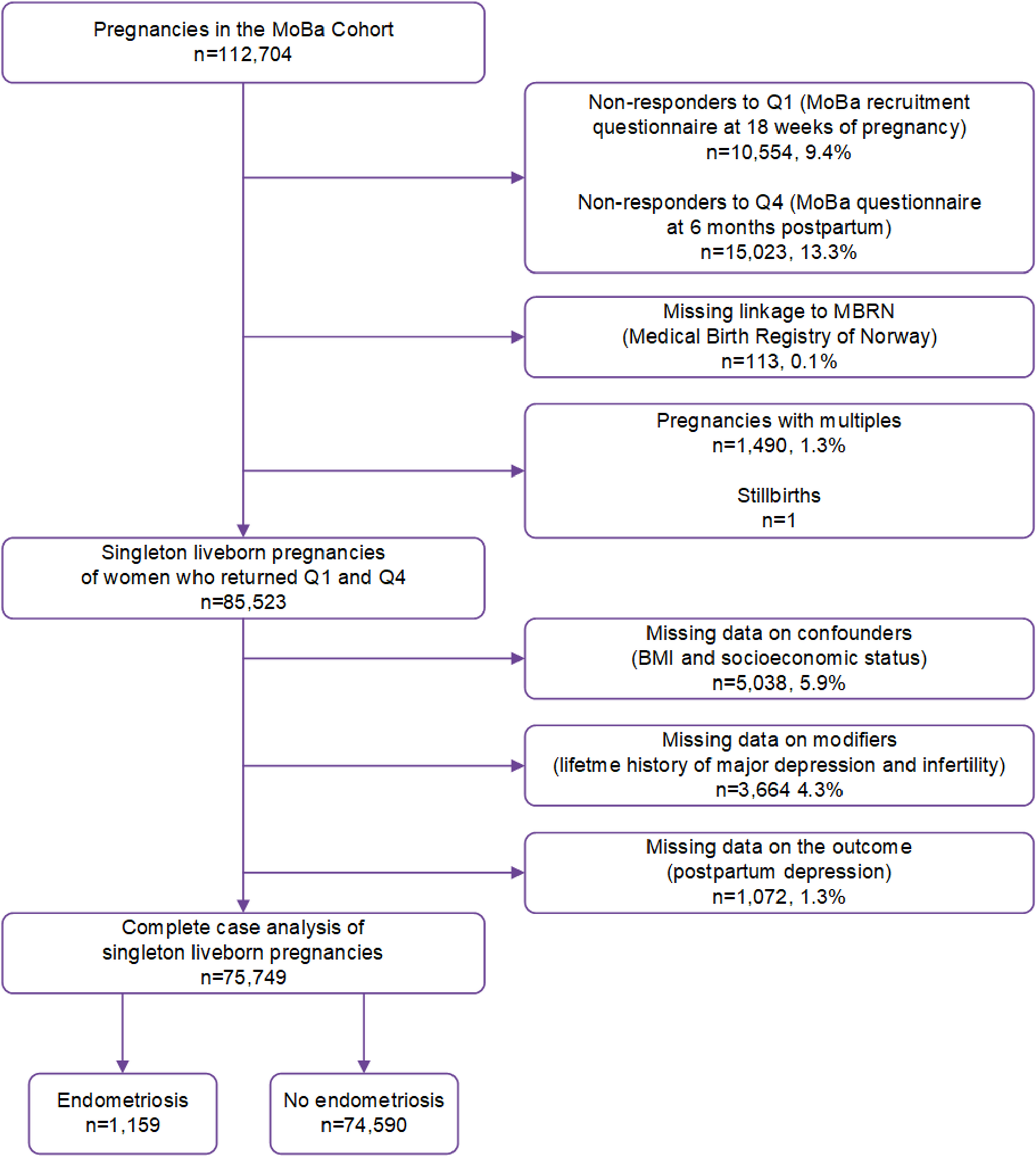
A 41% participation rate in the MoBa-cohort, skewed toward higher socioeconomic backgrounds [49], raises questions about generalizability to the broader endometriosis population. However, selection into MoBa does not inherently bias PPD estimates [50], as the primary objective was to examine associations. Although limited to the MoBa cohort, the comprehensive data and health registry linkage provide robust insights into endometriosis and PPD in Norway. We urge future studies, including newer cohorts from other countries, to broaden these findings, enhance generalizability, and explore causal mechanisms.

Comments (0)