
Remember me
A 29-year-old patient who was admitted to the emergency room at the university hospital in Erlangen (Universitätsklinikum Erlangen) reported the injection of a saturated solution of Cr(VI)oxide (chromium trioxide) into his left cubital vein in suicidal intent. Extreme pain at the injection site had led him to interrupt the injection and call an ambulance.
The rescue team documented livid discoloration in the patient’s lower arms and an indurated cubital vein. Upon admission to the hospital (~ 3.5 h post-injection), blood tests showed a positive result for cannabinoids and extremely elevated lipase activity (2752 U/l). Following consultation with the poison center, continuous veno-venous hemodialysis (CVVHD), combined with volume replacement and acetylcysteine therapy, was initiated.
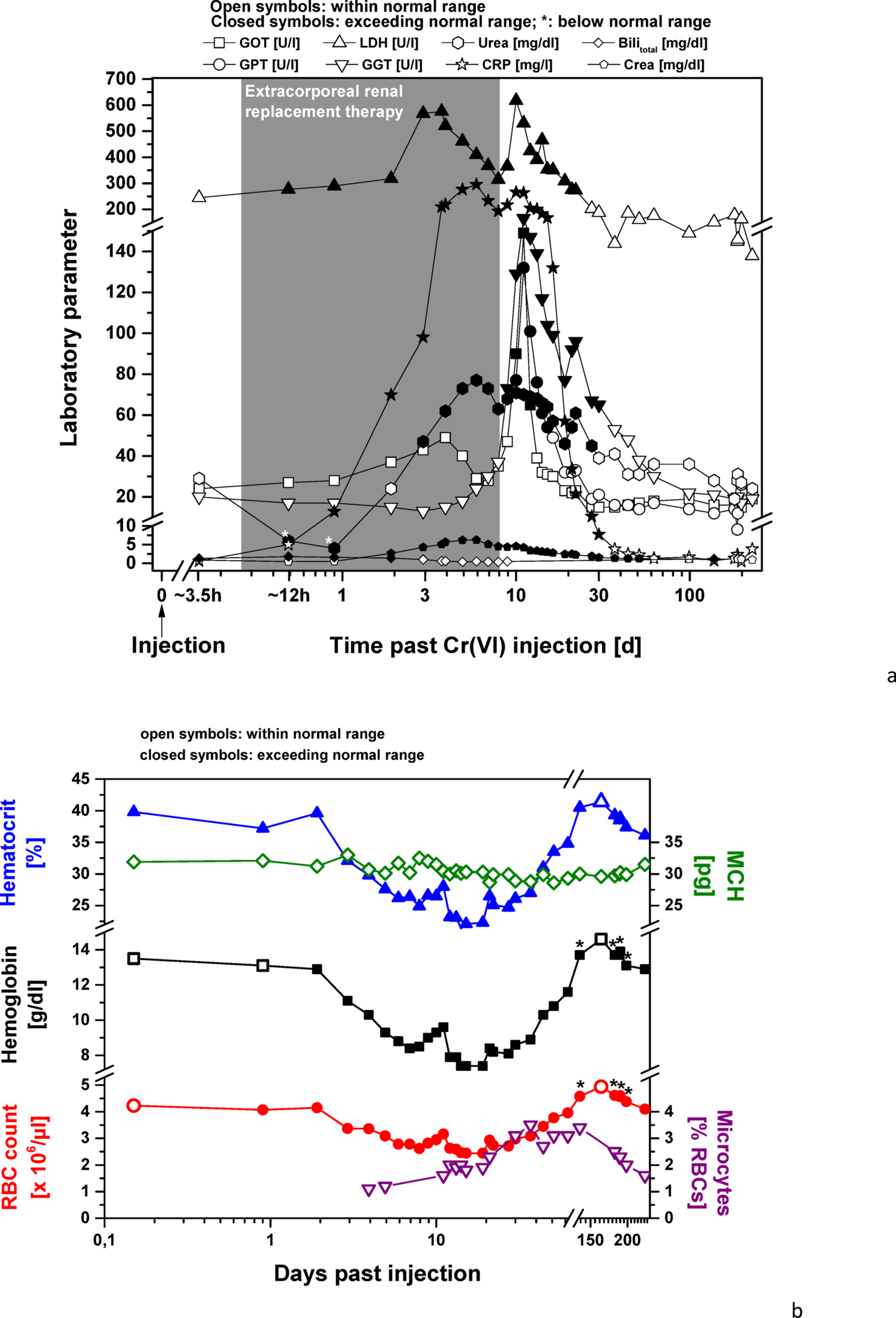
A few hours after the injection, the patient complained of abdominal pain and diarrhea, which lasted for about 2 days. He began to develop anemia with increased hemolytic markers, the latter normalizing within the second day. Due to the presence of metabolic acidosis and an acute kidney injury (AKIN) (Stage 3), a substitution therapy and forced diuresis were initiated in addition to dialysis. GOT (serum glutamic oxaloacetic transaminase = aspartate transaminase) and GGT (gamma-glutamyltransferase) stayed within the normal range, while GPT (serum glutamic pyruvic transaminase = alanine transaminase) levels started to rise on Day 3. The patient described an impaired sense of taste, which lasted for 1–2 weeks. Following termination of renal replacement therapy, the patient was transferred to the psychiatric department of Universitätsklinikum Erlangen on Day 9. After a peak around Day 10–11, most laboratory values returned to their respective normal ranges within the next 3 weeks. Liver-function parameters initially increased in the following order: GGT > GOT > GPT. GGT levels remained elevated for 3 weeks, GPT for 1 week, and GOT for 3 days. Kidney function recovered within the same time frame. Blood coagulation, hemolytic markers, and C-reactive protein (CRP) also normalized during this period (Fig. 1a and b).
Fig. 1
a Changes in selected laboratory parameters of liver function (GOT; GPT; LDH; GGT), kidney function (urea; crea), hemolysis (total Bili; GOT; LDH), and the acute-phase protein CRP following injection of chromium trioxide. Values within the normal range are depicted by open symbols. Values exceeding the normal range are represented by closed symbols; if below the normal range, closed symbols are asterisked. b Changes in selected RBC parameters (count; Hb; Hct; MCH; and microcytes). Values within the normal range are depicted by open symbols. Values below the normal range are represented by closed symbols. Slightly varying normal ranges were given by the different laboratories processing the routine blood work. As a result, values just within the reference range in one laboratory could be just outside the reference range of another laboratory. Those values are asterisked
Changes in hemogramThe increase in bilirubin within 3.5 h of the injection of Cr(VI) was indicative of intravascular hemolysis caused by Cr(VI) intoxication. Acute hemolysis lasted for a maximum of 2.5 days, since bilirubin values returned to normal in less than 3 days. At about that time, the RBC count and the Hb started to drop substantially. Apart from the chromium-related RBC breakdown, this drop was probably due to a dilution effect from volume-replacement therapy and a loss of RBCs during CVVHD on Days 1–8. Afterwards, other factors–like an adverse effect of the RBCs’ chromium load–may have caused a further decrease in these parameters. About three weeks after the incident, RBC count and hemoglobin had reached their lowest levels and started to rise again, whereas the hemoglobin concentration somewhat lagged.
It took about 17 weeks (120 days) to reach initial values (as taken 3.5 h post-injection), which then further increased to 115% of the initial RBC count and 108% of the initial Hb concentration in the following 3.5 weeks. Since the first measurement was taken in the acute phase, it is likely that the values were already low at that time and therefore appeared elevated later.
Chromium in blood and urineBased on the patient’s description of the preparation of the Cr(VI) solution, it can be calculated that he injected himself with about 1–2 ml of a saturated Cr(VI)-oxide solution intravenously. Since the solubility of Cr(VI)O3 is 0.63 g/ml and chromium accounts for ~ 52% of the weight of the oxide, the amount of injected chromium was between 0.33 and 0.66 g. Taking into account the patient’s body weight of 60 kg and his height of 173 cm, his estimated total blood volume was 4435 ml, according to the Nadler equation (Nadler et al. 1962), which adds up to an estimated amount of 0.074–0.148 g chromium per liter blood.
Starting from this range, values dropped within 6 days to 6.52 mg/l in blood, 8.15 mg/l in RBCs, and 4.47 mg/l in serum. At the same time, 35 mg chromium/l were excreted in urine at a glomerular filtration rate of 11 ml/min. Over the following weeks, the chromium concentration decreased exponentially in all tested media (Fig. 2).
Fig. 2
Changes in chromium concentration in RBCs, plasma, and urine following intentional intravenous injection of hexavalent chromium
Calculation of RBC lifespanFollowing a period with a very steep decline, which corresponds to an RBC breakdown rate of 3.1% per day, the decline in RBC chromium content leveled off, resulting in an RBC breakdown rate of about 0.9% a day. Based on this breakdown rate, the average lifespan of the patient’s RBCs is calculated to be approximately 111 days (Fig. 3A). RBC chromium content leveled off around Week 24 post-injection, reaching a final concentration of 1.6 µg/L, which corresponds to the upper range of background exposure values (Lewalter et al. 1991; Santonen et al. 2022). At post-injection Day 111 ( ≙ calculated average RBC lifespan), the ratio of chromium content of RBCs vs. plasma was still elevated (7.5), but was determined to be in a phase of steep decline, yielding a maximum RBC lifespan of about 141.4 days (Fig. 3B). At later points in time, the ratio of chromium content of RBCs vs. plasma reached and remained at 0.08, indicating a balanced chromium distribution between RBCs and plasma.
Fig. 3
shows the calculated lifespan of RBCs. The average RBC lifespan of about 111 days is shown in (A) and the maximum RBC lifespan of about 141.4 days is shown in (B)
Comments (0)