Data collected during the development program of aztreonam–avibactam and used in the assessment of MIC breakpoints have been compiled and summarized in this publication.
Microbiological Surveillance Data
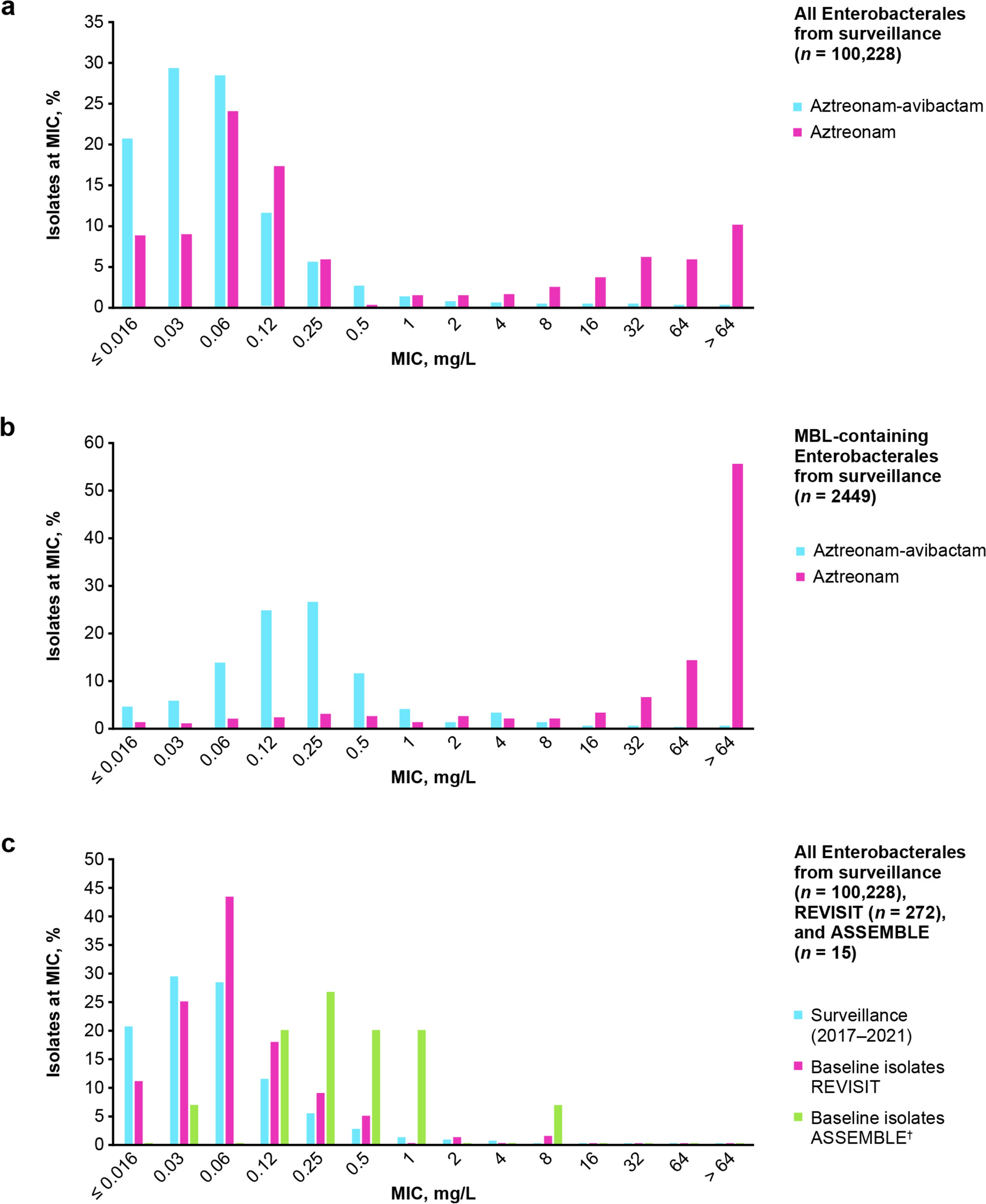
The Antimicrobial Testing Leadership and Surveillance (ATLAS) database was used to provide aztreonam–avibactam global, regional, and local in vitro susceptibility data, as well as longitudinal data on changing global bacterial resistance patterns [18]. MIC distributions for aztreonam–avibactam against Enterobacterales from ATLAS (2017–2021) were compared with distributions of baseline Enterobacterales from the phase 3 trials (REVISIT [NCT03329092] and ASSEMBLE [NCT03580044]) [2, 3].
Phase 3 Clinical Trials
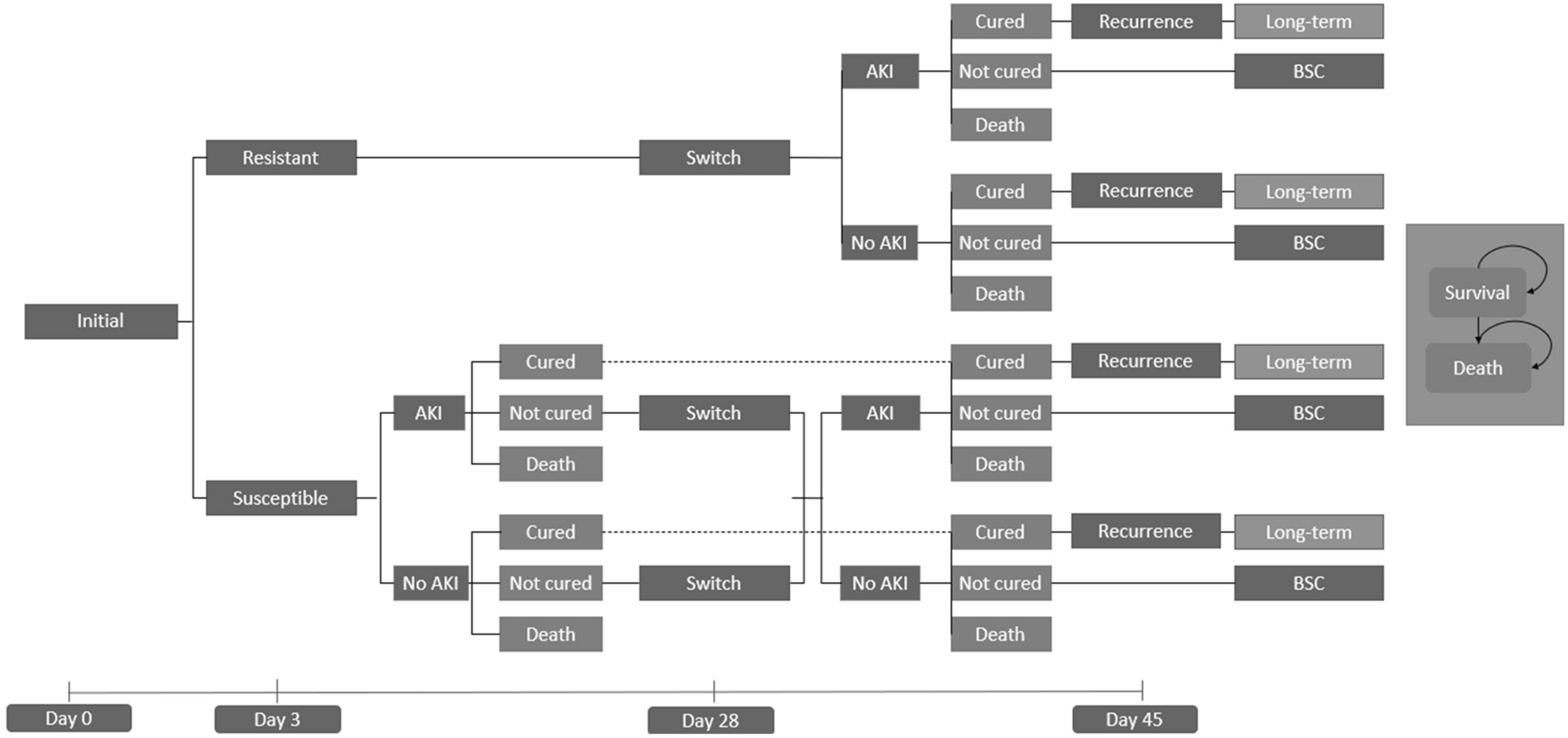
The REVISIT and ASSEMBLE phase 3 trials were both prospective, randomized, open-label, parallel-group, comparative studies in hospitalized adults [2, 3]. An overview of the study designs and main outcomes is shown in Supplementary Table S1.
REVISIT included patients with cIAI or nosocomial pneumonia (NP) (HAP/VAP) with infection confirmed or suspected to be caused by a Gram-negative pathogen and treated with either aztreonam–avibactam (+ metronidazole in patients with cIAI) or meropenem ± colistin. The co-primary endpoints were the proportion of patients with clinical cure at the test-of-cure (TOC) visit in the intent-to-treat (ITT; aztreonam–avibactam, n = 282; meropenem, n = 140) and clinically evaluable (aztreonam–avibactam, n = 213; meropenem, n = 105) analysis sets. Secondary endpoints included favorable per-patient microbiological response at the TOC visit, 28-day mortality, and safety [2].
ASSEMBLE included patients with cIAI, NP (HAP/VAP), cUTI, or bloodstream infection (BSI), caused by confirmed MBL-producing Gram-negative pathogens, treated with either aztreonam–avibactam (+ metronidazole in patients with cIAI) or the best available therapy. The primary endpoint was clinical cure at the TOC visit in the microbiological ITT (micro-ITT) analysis set (aztreonam–avibactam, n = 12; best available therapy, n = 3). Secondary endpoints included 28-day mortality and safety [3].
Per-pathogen favorable microbiological responses at TOC were also evaluated according to aztreonam–avibactam MIC for the micro-ITT analysis sets in both studies. Overall efficacy results, and per-pathogen results by MIC were used to verify clinical effectiveness and observe potential trends in response versus pathogen MIC.
Ethical Approval
Appropriate ethics approval and patient consent were obtained for the individual studies included here, as reported in the individual publications [2, 3]. The studies were carried out in accordance with good clinical practice guidelines and the Declaration of Helsinki. Written informed consent was obtained from patients before screening. The final study protocols were approved by the relevant independent ethics committees and/or institutional review boards.
Population PK Modeling and Simulation AnalysesAztreonam–Avibactam PK/PD Targets
Previously established joint PK/PD targets for aztreonam–avibactam were used in these analyses: free aztreonam concentration above a nominal aztreonam–avibactam MIC value for 60% of the dosing interval (60% free plasma concentration time [fT] > MICATM-AVI) and free avibactam concentration above a threshold concentration of 2.5 mg/l for 50% of the dosing interval (50% fT > critical concentration threshold [CT] of 2.5 mg/l) [19,20,21]. These PK/PD targets were derived from in vitro hollow fiber and neutropenic mouse thigh and lung infection models, which used aztreonam-resistant Enterobacterales that co-produced an MBL and an ESBL, and/or a class C β-lactamase (CMY type) [19,20,21].
Population PK Model
For aztreonam–avibactam, initial population PK models to support phase 3 dose selection were developed for aztreonam and avibactam separately; model development followed an iterative process that was updated as further data became available [19]. Following completion of the phase 3 REVISIT and ASSEMBLE trials [2, 3], a simultaneous population PK model was developed. The model was used to: simulate exposures in phase 3 patients; confirm aztreonam–avibactam dose regimen recommendations across renal function groups, including augmented renal clearance; propose a dose regimen for end-stage renal disease; and propose a simplified loading dose for use in clinical practice. Details of the final model and simulations have been published previously [16].
The final simultaneous model incorporated PK concentrations from two aztreonam-alone studies in renal impairment, three phase 1 studies of aztreonam–avibactam (in healthy young and older [≥ 65 years of age] adults, Chinese participants enrolled at investigative sites in China, and adults with severe renal impairment [Pfizer, data on file]), as well as patients with cIAI, HAP/VAP, cUTI, and BSI that were included in the phase 2 REJUVENATE, and phase 3 REVISIT and ASSEMBLE studies [1,2,3]; and additionally included avibactam data from the ceftazidime–avibactam and ceftaroline–fosamil–avibactam clinical programs (Pfizer, data on file]). Simultaneous modeling of aztreonam and avibactam was employed to include estimated correlation of PK variability that would then be used in parametric simulations without the need to make additional assumptions.
PTA Analyses
The final simultaneous aztreonam and avibactam population PK model was used to derive steady-state exposure metrics based on post hoc parameter estimates, and to simulate exposures and individual joint PK/PD target attainment for phase 3 patients by infection type and renal function. Joint PTA (JPTA) was estimated by Monte Carlo simulations using the final population PK model. JPTA was calculated for the joint PK/PD targets of fT > MICATM-AVI during a dosing interval across a range of MICATM-AVI from 0.015 to 128 mg/l for aztreonam and fT > CT of 2.5 mg/l for avibactam, based on steady-state plasma exposures for 5000 simulated patients with cIAI, NP (HAP/VAP), or cUTI per renal function group. Free (unbound) plasma percentages of 62% and 92% were assumed for aztreonam and avibactam, respectively.
JPTA by MICATM-AVI were plotted and overlaid with the frequency distribution of observed MICATM-AVI based on 2017–2021 ATLAS surveillance studies for Enterobacterales. Simulations used the approved doses for aztreonam–avibactam [13, 14].
Exposure–Response Analyses
Efficacy endpoints, including clinical response (cure, failure, or indeterminate) and microbiological response (favorable or unfavorable) at the TOC visit, were plotted against aztreonam and avibactam exposures for patients in REVISIT and ASSEMBLE [2, 3] who had both PK and efficacy endpoint data available.
Data from each trial were combined (endpoint of clinical cure in the ITT, micro-ITT, and microbiologically evaluable analysis sets; microbiological response in the micro-ITT and microbiologically evaluable analysis sets). Efficacy endpoints were analyzed by infection type (cIAI, NP [HAP/VAP], cUTI, and BSI), pathogen category (Enterobacterales, Gram-negative aerobe except Enterobacterales, Gram-positive, and anaerobe), and pathogen resistance type (aztreonam–non-susceptible, ESBL-positive, and MBL-positive).
Aztreonam and avibactam exposure parameters, i.e., maximum plasma concentration for a dosing interval at steady-state (Cmax,ss) and area under the plasma concentration–time curve (AUC) over 24 h at steady state (AUC24,ss), and PK/PD targets (% fT > MICATM-AVI of 8 mg/l for aztreonam and % fT > CT of 2.5 mg/l for avibactam) were examined graphically as potential predictors of clinical and microbiological response at TOC. These drug exposure–response analyses have not been published previously elsewhere.

Comments (0)