Nyberg C, Karlsson T, Ronne-Engström E. Predictors of increased cumulative serum levels of the N-terminal prohormone of brain natriuretic peptide 4 days after acute spontaneous subarachnoid hemorrhage. J Neurosurg. 2014;120(3):599–604. https://doi.org/10.3171/2013.8.JNS13625.
Article
CAS
PubMed
Google Scholar
Ikram A, Javaid MA, Ortega-Gutierrez S, Selim M, Kelangi S, Anwar SMH, et al. Delayed cerebral ischemia after subarachnoid hemorrhage. J Stroke Cerebrovasc Dis. 2021;30(11):106064. https://doi.org/10.1016/j.jstrokecerebrovasdis.2021.106064.
Article
PubMed
Google Scholar
Terao Y, Oji M, Toyoda T, Inoue H, Fukusaki M, Hara T. An observational study of the association between microalbuminuria and increased N-terminal pro-B-type natriuretic peptide in patients with subarachnoid hemorrhage. J Intensive Care. 2015;3:42. https://doi.org/10.1186/s40560-015-0108-1.
Article
PubMed
PubMed Central
Google Scholar
Tung PP, Olmsted E, Kopelnik A, Banki NM, Drew BJ, Ko N, et al. Plasma B-type natriuretic peptide levels are associated with early cardiac dysfunction after subarachnoid hemorrhage. Stroke. 2005;36(7):1567–9. https://doi.org/10.1161/01.STR.0000170699.59783.d6.
Article
CAS
PubMed
Google Scholar
Kishima H, Mine T, Ando T, Yamada Y, Tsuji M, Ohmura T, et al. Plasma brain natriuretic peptide level on admission predicts long-term outcome in patients with non-traumatic subarachnoid hemorrhage. J Clin Neurosci. 2020;79:7–11. https://doi.org/10.1016/j.jocn.2020.07.031.
Article
CAS
PubMed
Google Scholar
Zhang L, Zhang B, Qi S. Impact of echocardiographic wall motion abnormality and cardiac biomarker elevation on outcome after subarachnoid hemorrhage: a meta-analysis. Neurosurg Rev. 2020;43(1):59–68. https://doi.org/10.1007/s10143-018-0985-6.
Article
PubMed
Google Scholar
van der Bilt IA, Hasan D, Vandertop WP, Wilde AA, Algra A, Visser FC, et al. Impact of cardiac complications on outcome after aneurysmal subarachnoid hemorrhage: a meta-analysis. Neurology. 2009;72(7):635–42. https://doi.org/10.1212/01.wnl.0000342471.07290.07.
Article
PubMed
Google Scholar
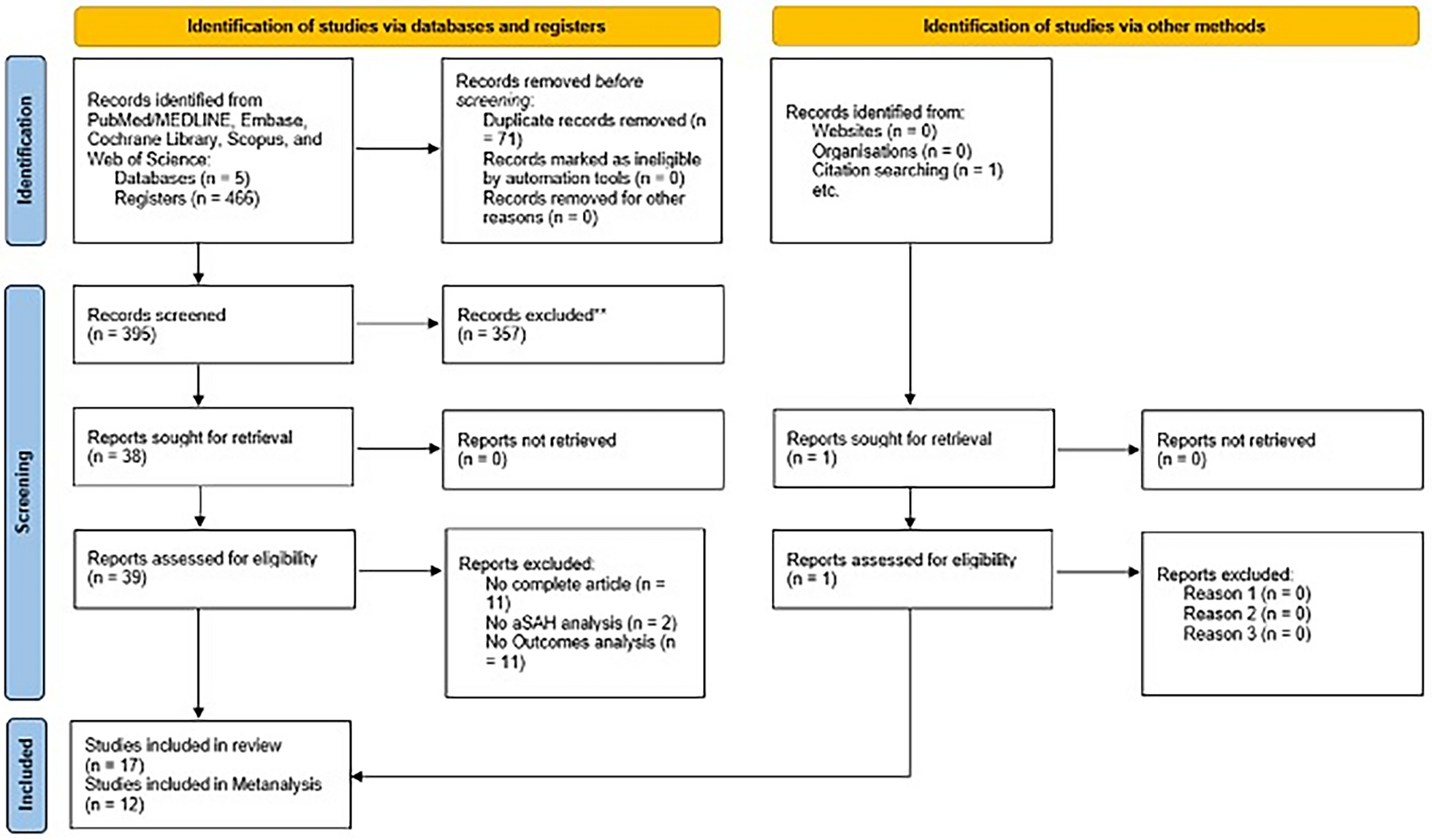
Page MJ, McKenzie JE, Bossuyt PM, Boutron I, Hoffmann TC, Mulrow CD, et al. The PRISMA 2020 statement: an updated guideline for reporting systematic reviews. BMJ (Clin Res ed). 2021;372:71. https://doi.org/10.1136/bmj.n71.
Article
Google Scholar
Vergouwen MD, Vermeulen M, van Gijn J, Rinkel GJ, Wijdicks EF, Muizelaar JP, et al. Definition of delayed cerebral ischemia after aneurysmal subarachnoid hemorrhage as an outcome event in clinical trials and observational studies: proposal of a multidisciplinary research group. Stroke. 2010;41(10):2391–5. https://doi.org/10.1161/STROKEAHA.110.589275.
Article
PubMed
Google Scholar
Ouzzani M, Hammady H, Fedorowicz Z, Elmagarmid A. Rayyan-a web and mobile app for systematic reviews. Syst Rev. 2016;5(1):210. https://doi.org/10.1186/s13643-016-0384-4.
Article
PubMed
PubMed Central
Google Scholar
R Core Team. R: a language and environment for statistical computing. Vienna: R Foundation for Statistical Computing; 2024. https://www.R-project.org/
Duello KM, Nagel JP, Thomas CS, Blackshear JL, Freeman WD. Relationship of troponin T and age- and sex-adjusted BNP elevation following subarachnoid hemorrhage with 30-day mortality. Neurocrit Care. 2015;23(1):59–65. https://doi.org/10.1007/s12028-014-0105-6.
Article
CAS
PubMed
Google Scholar
Xue J, Lin F, Liu M, Song W, Li R, Chen Y, et al. Predicting prognosis using stroke-heart indicator: brain natriuretic peptide in patients with aneurysmal subarachnoid hemorrhage. Front Neurol. 2025;16:1510235. https://doi.org/10.3389/fneur.2025.1510235.
Article
PubMed
PubMed Central
Google Scholar
Kaur G, Damodara N, Feldstein E, Dominguez J, Huang KT, Ogulnick JV, et al. Relation between brain natriuretic peptide and delayed cerebral ischemia in patients with aneurysmalsubarachnoid hemorrhage. Clin Neurol Neurosurg. 2021;211:107031. https://doi.org/10.1016/j.clineuro.2021.107031.
Article
PubMed
Google Scholar
Lu GD, Wang C, Wang B, Zhao LB, Liu S. Higher levels of admission N-terminal pro-brain natriuretic peptide are associated with delayed cerebral ischemia following aneurysmal subarachnoid hemorrhage. Neurocrit Care. 2023;38(1):52–9. https://doi.org/10.1007/s12028-022-01556-6.
Article
CAS
PubMed
Google Scholar
McAteer A, Hravnak M, Chang Y, Crago EA, Gallek MJ, Yousef KM. The relationships between BNP and neurocardiac injury severity, noninvasive cardiac output, and outcomes after aneurysmal subarachnoid hemorrhage. Biol Res Nurs. 2017;19(5):531–7. https://doi.org/10.1177/1099800417711584.
Article
CAS
PubMed
Google Scholar
Papanikolaou J, Makris D, Karakitsos D, Saranteas T, Karabinis A, Kostopanagiotou G, et al. Cardiac and central vascular functional alterations in the acute phase of aneurysmal subarachnoid hemorrhage. Crit Care Med. 2012;40(1):223–32. https://doi.org/10.1097/CCM.0b013e31822e9fab.
Article
PubMed
Google Scholar
Svedung Wettervik T, Howells T, Hånell A, Nyberg C, Ronne-Engström E. NT-proBNP and troponin I in high-grade aneurysmal subarachnoid hemorrhage: relation to clinical course and outcome. J Crit Care. 2022;72:154123. https://doi.org/10.1016/j.jcrc.2022.154123.
Article
CAS
PubMed
Google Scholar
Sviri GE, Shik V, Raz B, Soustiel JF. Role of brain natriuretic peptide in cerebral vasospasm. Acta Neurochir. 2003;145(10):851–60. https://doi.org/10.1007/s00701-003-0101-7.
Article
PubMed
Google Scholar
Taub PR, Fields JD, Wu AH, Miss JC, Lawton MT, Smith WS, et al. Elevated BNP is associated with vasospasm-independent cerebral infarction following aneurysmal subarachnoid hemorrhage. Neurocrit Care. 2011;15(1):13–8. https://doi.org/10.1007/s12028-011-9535-6.
Article
CAS
PubMed
PubMed Central
Google Scholar
van der Bilt I, Hasan D, van den Brink R, Cramer MJ, van der Jagt M, van Kooten F, et al. Cardiac dysfunction after aneurysmal subarachnoid hemorrhage: relationship with outcome. Neurology. 2014;82(4):351–8. https://doi.org/10.1212/WNL.0000000000000057.
Article
PubMed
Google Scholar
Wijdicks EF, Schievink WI, Burnett JC Jr. Natriuretic peptide system and endothelin in aneurysmal subarachnoid hemorrhage. J Neurosurg. 1997;87(2):275–80. https://doi.org/10.3171/jns.1997.87.2.0275.
Article
CAS
PubMed
Google Scholar
Yarlagadda S, Rajendran P, Miss JC, Banki NM, Kopelnik A, Wu AH, et al. Cardiovascular predictors of in-patient mortality after subarachnoid hemorrhage. Neurocrit Care. 2006;5(2):102–7. https://doi.org/10.1385/NCC:5:2:102.
Article
PubMed
Google Scholar
Yokobori S, Watanabe A, Igarashi Y, Tagami T, Kuwamoto K, Ishinokami S, et al. The serum level of brain natriuretic peptide increases in severe subarachnoid hemorrhage thereby reflecting an increase in both cardiac preload and afterload. Cerebrovasc Dis (Basel, Switz). 2014;38(4):276–83. https://doi.org/10.1159/000368217.
Article
CAS
Google Scholar
Borovikova LV, Ivanova S, Zhang M, et al. Vagus nerve stimulation attenuates the systemic inflammatory response to endotoxin. Nature. 2000;405:458–62.
Article
CAS
PubMed
Google Scholar
Wang H, Yu M, Ochani M, et al. Nicotinic acetylcholine receptor α7 subunit is an essential regulator of inflammation. Nature. 2003;421:384–8.
Article
CAS
PubMed
Google Scholar
Tracey KJ. Physiology and immunology of the cholinergic anti-inflammatory pathway. Nat Rev Immunol. 2007;7:111–7.
Google Scholar

Comments (0)