
Remember me

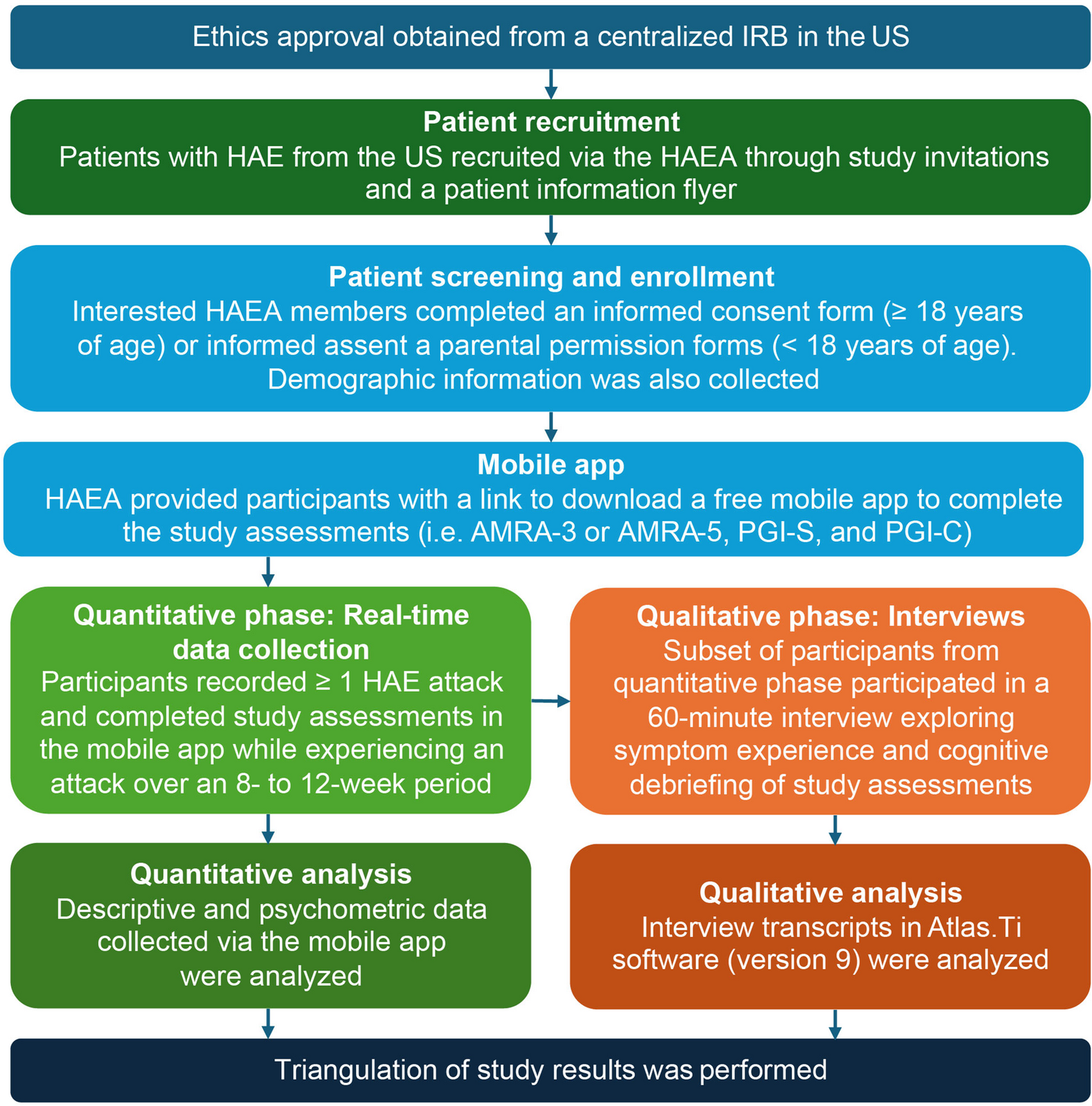
The total sample (N = 35) included 34 adults and one adolescent, and the interview subsample (N = 20) comprised only adults. The demographics of the total sample and the interview subsample were similar (Table 3). Target enrollment of ≥ 6 participants was met for both sexes (female, n = 26; male, n = 9) but not race (non-White, n = 5). Thirty participants reported at least one non-upper-airway attack, and 11 participants reported at least one upper-airway attack, including laryngeal attack (scoring greater than 0 on at least one of the two additional scales associated with AMRA-5).
Table 3 Baseline demographic and clinical characteristicsQuantitative PhaseDescriptive AnalysesThirty-five participants recorded ≥ 1 HAE attack in the mobile app. Of the 133 HAE attacks recorded, 98 were classified as non-upper-airway (median three attacks per participant) and 35 as upper-airway, including laryngeal attacks (median two attacks per participant). The minimum–maximum percentage of participants who completed the scheduled PROs in the mobile app at each timepoint from 30 min to 12 h was 54%–71% for non-upper-airway attacks and 51%–74% for upper-airway attacks, including laryngeal attacks. Completion rates were much higher at the 24-hour timepoint (95% for non-upper-airway and 91% for upper-airway attacks, including laryngeal attacks) and 48-hour timepoint (92% and 80%, respectively; Table S2). The most frequently taken medications at the onset of non-upper-airway HAE attacks were icatibant (60.2%), plasma-derived C1INH concentrate (22.5%), and recombinant C1INH (9.2%) (Table S3).
Higher AMRA composite endpoint scores were associated with increasing severity on the PGI-S for non-upper-airway and upper-airway attacks, including laryngeal attacks (Fig. 2). Individual attack-level data strongly suggested an association between AMRA composite scores and percentage CFB and PGI-S and PGI-C scores (data not shown). When data across attacks were collated, the associations were less distinct given the natural variability of the responses between participants, but the shifts in AMRA median scores between the PGI-S and PGI-C categories were evident.
Fig. 2 The alternative text for this image may have been generated using AI.
Scatterplots for AMRA-3 (non-upper-airway attacks) composite endpoint against PGI-S (MAS). The MAS included all participants who completed all expected baseline PRO assessments for ≥ 1 treated HAE attack. For the AMRA-3, higher values indicate worse symptoms. Three attacks had no post-baseline data and were therefore not included in the plot. AMRA-3 Angioedema syMptom Rating scAle 3-symptom, HAE hereditary angioedema, MAS main analysis set, PGI-S Patient Global Impression of Severity, PRO patient-reported outcome
Psychometric Analysis of AMRA-3 and AMRA-5At baseline, participants used nearly the full range of AMRA-3 and AMRA-5 item scores, indicating no strong floor or ceiling effects (Figs. S1, S2). For AMRA-3, skin pain and skin swelling items were closely correlated, whereas abdominal pain did not strongly correlate with these symptoms (Table S4). For AMRA-5, “difficulty swallowing” and “voice change” were highly correlated and moderately related to the other items (Table S5).
Confirmatory factor analysis (CFA) suggested the three AMRA-3 items may not equally contribute to the overall score, mainly owing to low correlation between abdominal pain and the other symptoms (Fig. 3). However, using a more complex weighted scoring approach offered little advantage over the simpler unweighted average for both AMRA-3 and AMRA-5 (Table 4, S6, S7).
Fig. 3 The alternative text for this image may have been generated using AI.
AMRA-3 multilevel confirmatory factor analysis path diagram of unidimensional model (all attack types, primary PsAS-AMRA-3, N = 35). The primary PsAS-AMRA-3 included all participants who have completed all expected baseline PRO assessments for ≥ 1 treated HAE attack. Only 1 attack per participant (the first attack available) was included in the analysis, utilizing all timepoints available. Values for arrows between F1 and AMRA-3 items represent standardized factor loadings. Values associated with arrows pointing up toward the AMRA-3 items represent residual variances. AMRA Angioedema syMptom Rating scAle, AMRA-3 Angioedema syMptom Rating scAle 3-symptom, F1 latent factor, HAE hereditary angioedema, PRO patient-reported outcome, PsAS psychometric analysis set
Table 4 Internal consistency reliability of the AMRA-3 composite score at baseline (primary PsAS-AMRA-3)aInternal consistency reliability (which measures consistency across item scores within a scale) was low for AMRA-3 and acceptable for AMRA-5. Weighted scoring according to the CFA factor loadings improved internal consistency reliability somewhat but did not enhance validity. Test–retest reliability (stability in participants with no change in symptoms) was excellent for both AMRA-3 and AMRA-5 unweighted scores (ICC > 0.90, Table 5). Both scales also showed strong convergent validity: higher AMRA scores were associated with higher patient-reported severity (PGI-S; all correlations > 0.5, Table S8).
Table 5 Test–retest reliability of the AMRA-3 and AMRA-5 composite endpoints and weighted (factor) scores (TRTAS)aGiven the similar performance of weighted and unweighted scores, all further analyses used unweighted composite scores.
Known-groups analysis confirmed that AMRA-3 scores distinguished well between patients with different levels of symptom severity (PGI-S groups), with larger between-group effect sizes observed with greater PGI-S severity (Table 6). Results for AMRA-5 were comparable (Table S9).
Table 6 Known-groups analysis of the AMRA-3 composite scores using PGI-S defined groupsAMRA-3 and AMRA-5 scores were sensitive to changes in symptom severity and showed expected patterns of improvement or worsening post treatment, as measured by PGI-S and PGI-C anchors (Table 7, Table S10-13). Empirical cumulative distribution function (eCDF) and probability density function (PDF) plots generally showed separation between improved, stable, and worsened participants, although this varied by group size and timepoint. The results of the supportive analysis using pooled data across multiple attacks and timepoints showed a clearer separation in the distribution of AMRA-3 and AMRA-5 change and percentage CFB between PGI-S and PGI-C anchor change groups (Figs. 4, S4).
Table 7 Sensitivity to change of the AMRA-3 composite endpoint using PGI-C anchor at selected timepoints and across timepoints (N = 29)Fig. 4 The alternative text for this image may have been generated using AI.
eCDF plot of percentage change from baseline of AMRA-3 composite endpoint pooled across all post-treatment timepoints by (a) PGI-S anchor score change and (b) PGI-C anchor response (DIcAS-AMRA-3). The DIcAS-AMRA-3 included participants who completed all expected PRO assessments at baseline and ≥1 post-treatment timepoint for a non-upper-airway attack. Only non-upper-airway attacks were analyzed. Analysis using pooled data combines data across all timepoints taking data from a maximum of 2 attacks per participant for any given timepoint. There were no events for PGI-C “Much Worse.” For presentation purposes, the x-axis has been limited to a maximum of 150%; percent change values >150% have been included in the generation of the plots but may not be presented due to the x-axis truncation. The number of truncated observations was 3. AMRA-3 Angioedema syMptom Rating scAle 3-symptom, DIcAS detection and interpretation analysis set, eCDF empirical cumulative distribution function, PGI-C Patient Global Impression of Change, PGI-S Patient Global Impression of Severity, PRO patient-reported outcome
The eCDF curves indicated a meaningful change threshold between a 20- to 40-point absolute reduction or 40%–60% reduction on the AMRA-3 would include mainly participants with one- or two-category improvement on the PGI-S and responses of “better” and “much better” on the PGI-C. Using only the PGI-C, a lower 20- to 30-point absolute reduction or 30% reduction on the AMRA-3 may be appropriate to identify a higher proportion of PGI-C “a little better.” Distribution-based methods (1.96 × standard error of measurement [SEM]) showed absolute changes greater than 27.38 (SEM = 13.97) for AMRA-3 and 20.08 (SEM = 10.24) for the AMRA-5 composite endpoints, which represented changes exceeding the measurement error of the instrument, but the small sample size limited interpretability.
Symptom Relief AnalysisMost attacks (non-upper-airway and upper-airway, including laryngeal attacks) met symptom relief definitions; thus, agreement statistics for pairwise comparisons of attacks achieving AMRA symptom relief versus PGI symptom relief were very high (e.g., matching coefficient of 98.98% for AMRA-3 ≥20% and ≥30% reduction with PGI-C “a little better” [or greater] symptom relief endpoints). For non-upper-airway attacks, similar results were observed for median time to symptom relief for the AMRA-3 ≥ 20% reduction definition and the PGI-C definition of “a little better” (or greater) for two consecutive timepoints (Fig. 5): 2 h 12 min and 2 h 9 min, respectively. The AMRA-3 ≥30% reduction definition was comparable to the AMRA-3 ≥20% reduction and the PGI-C “a little better” (or greater) definitions, particularly beyond 6 h post treatment. The AMRA-3 ≥ 50% reduction definition more closely aligned with the PGI-C “better” (or greater) and PGI-S one-level improvement definitions. Median time to end of progression was 0.75 h for both the AMRA-3 (earliest post-treatment timepoint with the highest AMRA-3 score) and PGI-C (earliest post-treatment timepoint after which all subsequent PGI-C ratings are stable or improved within 12 h) definitions (Fig. 5). However, the infrequency of early post-treatment assessments may have limited the accuracy of this measure.
Fig. 5 The alternative text for this image may have been generated using AI.
Kaplan–Meier plot of attacks achieving symptom relief (non-upper-airway attacks, MAS) (a) up to 5 h post-treatment and (b) up to 48 h post-treatment. The MAS included all participants who completed all expected baseline PRO assessments for ≥1 treated HAE attack. (1) The AMRA-3 symptom relief definitions were X% reduction or greater for at least 2 consecutive timepoints. (2) The AMRA-3 EoP definition was the earliest post-treatment timepoint with the highest AMRA-3 score. (3) The PGI-C EoP definition was the earliest post-treatment timepoint after which all subsequent PGI-C ratings are stable or improved within 12 hours. (4) The PGI-C symptom relief definitions were “better” or greater improvement for 1 timepoint or “a little better” (or greater) for 2 consecutive timepoints. (5) The PGI-S symptom relief definition was a 1-level reduction in severity. Median survival times are based on the Kaplan–Meier estimates with CIs derived using the log–log transformation of the Greenwood formula variance. AMRA-3 Angioedema syMptom Rating scAle 3-symptom, CI confidence interval, EoP end of progression, HAE hereditary angioedema, MAS main analysis set, PGI-C Patient Global Impression of Change, PGI-S Patient Global Impression of Severity, PRO patient-reported outcome
Additional comparisons of the AMRA-3 ≥ 20% and ≥ 30% and PGI-C “a little better” (or greater) symptom relief definitions further highlighted the numerous instances when attacks met definitions at the same time (e.g., 60 out of 98 attacks, 61.2%, recorded the same time for AMRA-3 ≥ 30% reduction and PGI-C “a little better” [or greater]; Fig. S4). For upper-airway attacks, including laryngeal attacks, symptom relief definitions did not exhibit such close similarities between definitions, although the AMRA-5 ≥ 20% and PGI-C “a little better” (or greater) definitions showed equivalent median time to symptom relief (1 h and 31 min; Fig. S5). As with the other analyses of upper-airway attacks, including laryngeal attacks, the small sample size may have affected these results.
Qualitative PhaseSymptom ExperienceReported frequency of HAE attacks mostly ranged from weekly to monthly. Across their lifetime, 20, 18, and 12 participants reported experiencing at least a cutaneous, an abdominal, and an upper-airway attack, including a laryngeal attack, respectively. Reported cutaneous HAE attack symptoms included swelling (n = 18) and pain (n = 11). Most participants reporting pain with a cutaneous attack did not use “skin pain” to describe symptoms but instead discussed experiencing pain at the swelling location or spoke about pain more generally. Reported abdominal attack symptoms included abdominal pain (n = 16), vomiting (n = 6), nausea (n = 5), and nonspecific GI symptoms (n = 4). Reported upper-airway attack symptoms included throat swelling (n = 6), voice change (n = 4), and difficulty swallowing (n = 3).
Cognitive debriefing of the AMRA-3 and AMRA-5 showed most participants (≥ 84.2%) understood the instructions for each item, and only a few participants did not understand the instructions for the items assessing skin pain (n = 3) and skin swelling (n = 1; Table S14). Overall, most concepts of interest (skin swelling, abdominal pain, difficulty swallowing, and voice change) were well understood by all participants. However, approximately one-third of participants (n = 7) did not understand the concept of skin pain or provided unclear responses when probed on the meaning, as they discussed feelings of discomfort, tightness, and being uncomfortable. All asked participants showed an understanding of the response scale for items assessing abdominal pain (n = 19), difficulty swallowing (n = 18), and voice change (n = 18), and most showed an understanding of the response scale for the item assessing skin swelling (n = 18) and skin pain (n = 11). All interview participants (n = 14) had an understanding of the recall period.
On the AMRA-3 and AMRA-5, ≥95.0% of participants deemed most concepts to be relevant, with skin pain the only exception, as six participants commented they had only experienced abdominal pain (n = 3) or skin swelling (n = 1) or never experienced skin pain (n = 2) during HAE attacks. All participants who reported an abdominal attack (n = 18) deemed the abdominal pain item to be relevant to their experience. Finally, all participants who reported an upper-airway attack, including a laryngeal attack (n = 8), deemed the items assessing difficulty swallowing and voice change to be relevant.
All 20 participants indicated the PGI-S item was well understood and deemed it relevant. The most frequently reported symptoms participants considered when describing the severity of their HAE attack for this item (n = 14) were swelling (n = 11), general pain (n = 6), and abdominal pain (n = 6). All 20 participants understood the response scale, and all asked participants showed an understanding of the recall period. Cognitive debriefing of the PGI-C showed the item was well understood by most participants, and the response scale and recall period were understood by all asked participants.
Meaningful Improvement in SymptomsAmong 12 participants who discussed their perceived meaningful improvement for the AMRA-3 composite scores recorded for their most recent non-upper-airway attack, the average (range) CFB was 13.3 (0–37.5) points (Fig. 6). Participants most often reported a 4.5–11-point change as meaningful and associated this level of improvement with a reduction or improvement in symptoms. Of these, 10 were asked how the change in symptoms would impact the way they felt, to which they described positive changes in emotional wellbeing (n = 6), physical functioning (n = 5), and activities of daily living (n = 3).
Fig. 6 The alternative text for this image may have been generated using AI.
Meaningful improvement for the AMRA-3 composite score. Each individual participant was assigned a unique ID, indicated by a 2-digit number in the order in which they were recruited into the study followed by the letters “AP.” Each arrow in this figure represents the point change from baseline that participants perceived to be a meaningful improvement from their composite score for the AMRA-3 for the individual participant listed on the x-axis. AMRA-3 Angioedema syMptom Rating scAle 3-symptom
The average (range) CFB was 14.6 (0–40.0) points among five participants who discussed their perceived meaningful improvement for the AMRA-5 composite scores recorded for their most recent upper-airway attack, including laryngeal attacks. Participants most often reported a 0- to 5-point CFB as meaningful and associated this level of improvement with knowledge their attack was not going to worsen. Of these, three were also asked how the symptom change would impact the way they felt; all described positive changes in emotional wellbeing, and one reported a change in physical functioning. For the AMRA-3 and AMRA-5, participants discussed symptoms they would most like to see changes in, including swelling, abdominal pain, general pain, and vomiting.
For the PGI-S, all participants discussed their perceived meaningful improvement. Most reported a one-level improvement from baseline to be a meaningful change in symptom severity and associated this with a reduction or improvement in symptoms and their attack feeling more manageable or under control. Additionally, all asked participants (n = 19) confirmed that a one-level improvement at their first improvement from their worst score recorded would be a meaningful change in symptom severity, and they associated this level of improvement with a reduction or improvement in symptoms, seeing or feeling the attack was improving, and the treatment working.
For the PGI-C, participants (n = 19) discussed perceived meaningful improvement from their worst score and associated this with a reduction or improvement in symptoms and knowledge the attack would not worsen.
Comments (0)