The supraspinatus muscle undergoes asymmetric changes in degeneration and fatty infiltration following severe RCT in humans [7, 8, 10, 16, 17]; however, the early spatial localization of degenerative, inflammatory, and regenerative changes associated with supraspinatus muscle pathology have not previously been characterized. Through histological analysis in distinct muscle regions, the current study illustrated that fiber cross-sectional area, regeneration, and inflammation were all differentially represented in the lateral MTJ region and near the intramuscular tendon when compared with the MB or far from the intramuscular tendon, respectively. Fatty infiltration was low for the timepoints characterized in this model, but did show an increased incidence in the MTJ versus the MB after 3 weeks. Collagen fibrous infiltration was more pervasive throughout the muscle, rather than being concentrated in specific areas along the muscle length. Together, these data indicate that there are regional differences in damage and repair of the supraspinatus muscle in the early post-injury phase which may suggest differing damage/repair mechanisms governing the pathological process.
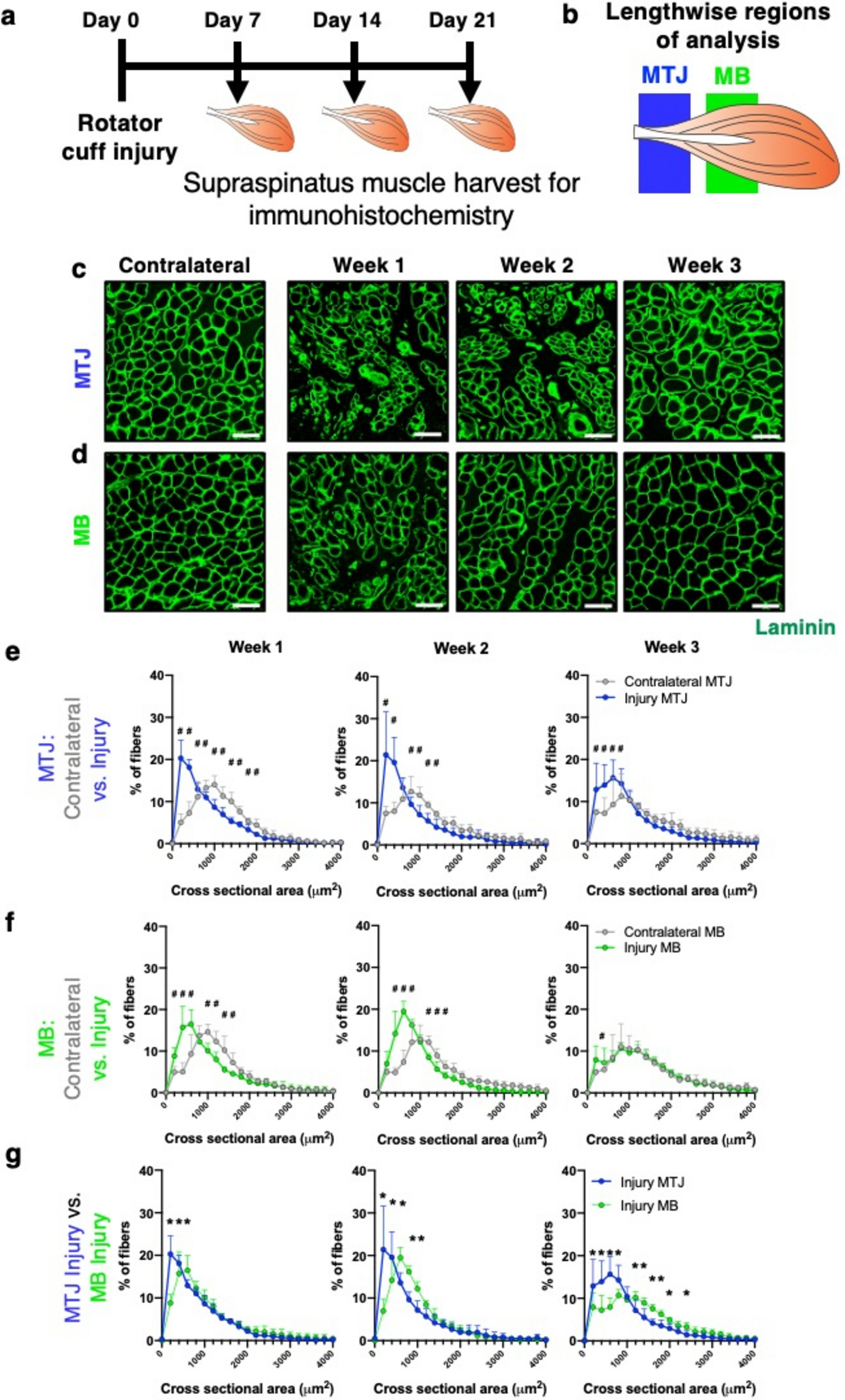
Whereas gross atrophy is a known hallmark of RCT-related muscle disease, the measurement of gross atrophy may miss more subtle degenerative changes in the muscle and does not allow for the understanding of regional differences within the muscle. The current study highlights the many muscle fiber level changes that occur regionally within the muscle earlier than when gross atrophy is detectable in the supraspinatus at 2 weeks. Through histological fiber cross-sectional area analysis, the muscle pathology associated with rotator cuff tendon tear was evident within 1 week of injury, before detection of gross atrophy. Myofiber cross-sectional area is most affected 1 to 2 weeks after RCT, and the myofiber population returns to a normal distribution by 3 weeks in the MB, but remains smaller in the MTJ, suggesting a more persistent injury. These results are consistent with previous reports that muscle atrophy and cross-sectional area display the most deficit around 2 weeks and then return to control levels between 4 and 9 weeks in rodent models [18].
This is the first report, to our knowledge, showing differing patterns of degeneration along the length of the muscle. Corroborating this finding, recent studies have demonstrated that fibrosis and adipogenesis progress over time along the length of the muscle from lateral to medial [11]. In female animals, we also observed significant shifts in myofiber cross-sectional area 1 week after injury in the MTJ and near the intramuscular tendon (Fig. S8, Supplemental Information), suggesting that this spatial phenomenon is common to both male and female animals, although the relative differences between injured and uninjured cross-sectional area were less for female animals. However, for the remainder of the study, only male animals were used because we believed the relatively larger injury in the muscles (as shown by differences in myofiber size) of the male animals would facilitate investigation of underlying cellular mechanisms of de- and re-generation.
Myofiber degeneration as defined by decreased fiber area was localized to the lateral aspect of the muscle (MTJ) versus MB in lengthwise analysis and near the intramuscular tendon in cross-section (< 500um), while contralateral controls are not different regardless of location. The proximity of early degeneration and regeneration laterally near the tendon in the MTJ and in cross-section near the intramuscular tendon suggests that signals from the tendon (mechanical, biochemical, cellular) may drive degeneration, regeneration, or both [19]. Muscle atrophy is thought to be a result of mechanical unloading in RCT and nerve dysfunction [4], however, it is unclear whether this is related to the position of muscle fibers relative to the tendon. Since fibers in the MB have a differing pennation angle relative to fibers in the lateral region near the MTJ [16, 20], mechanical unloading may differentially affect these regions. Clinically, after RCT, the pennation angle of the muscle to the intramuscular tendon is altered dependent on the extent of tendon damage [21, 22].
Spatial analysis showed that regenerating eMHC-stained fibers were concentrated in the lateral MTJ area of the muscle and were more frequent near the intramuscular tendon. In embryonic muscle development, TGF-β super-family members such as Bmp4 signaling at the tendon–muscle interface activates satellite cell proliferation preferentially near the tendon attachment point [19, 23]. In addition, in development and injury, satellite cells are found in higher frequency near the ends of the myofibers and support growth from the ends near the tendon–muscle interface [24]. These lines of evidence suggest that muscle regeneration may be more active at the ends of muscle fibers and closer to tendon–muscle junctions [23, 24], which may explain the increased eMHC + fibers and central nuclei in the MTJ and adjacent to the intramuscular tendon where bi-pennate muscle fibers attach. Previous work has shown the activation of satellite cells in the murine model of RCT [25], however, future analysis will be needed to assess spatial satellite cell activation in this injury model.
Fibrotic and fatty infiltration are thought to be hallmarks of RCT muscle-related clinical pathology [7]. In the current study, collagen was present between myofibers throughout the injured muscle, but not in the contralateral controls. In previous analysis of fibrous infiltration in this model using Masson’s Trichrome stain instead of antibody-based staining, significant fibrosis was observed from week 3–6 [15]. Here, by examining distinct regions of the muscle, collagen staining area was found to be elevated 1 week after RCT and remained elevated but did not further increase after the first week, consistent with recent reports in mouse [11]. In contrast to the spatiotemporal patterning of the degeneration and regeneration, collagen infiltration was similar between MTJ and MB near the intramuscular tendon, but was elevated in MTJ compared with MB in the region far from the intramuscular tendon. These data may indicate that differing mechanisms drive degeneration/regeneration versus collagen infiltration. Further studies will be needed to assess soluble and cellular signals that may be differentially represented near and far from the intramuscular tendon in this model.
Perilipin stained many cells in both injured and uninjured contralateral control that were frequently located near vascular structures. Perilipin + cells in this study did not show large lipid droplets or the characteristic globular shape of mature adipose tissue [26] and may be indicative of early fibro-adipogenic progenitor differentiation toward adipose lineage. Fatty infiltration is progressive and in clinical studies is shown to continue to increase with time in repaired or unrepaired RCT [27]. Here, Perilipin + cells were most elevated at the final timepoint assessed at 3 weeks post-RCT both near and far from the intramuscular tendon.
Inflammatory cells play a multifaceted role in muscle injury response [28,29,30,31] and therefore understanding the spatiotemporal localization of different inflammatory functional cells is an important step in examining their role in supraspinatus muscle pathology. Here we found that, following RCT, there are differing innate inflammatory cells recruited to the injured MTJ and MB, but not controls. In the MTJ, M1- and M2-like cells are elevated at all weeks, however by week 3, there are more M1- and M2-like near the intramuscular tendon, suggesting a balanced inflammatory environment followed by a later increase in pro-inflammatory cells at 3 weeks. Alternatively, in the MB, M1-like cells are dominant over M2-like cells throughout the timecourse, suggesting sustained inflammatory environment through 3 weeks. A limitation of this study is that M1- and M2- like cells were discriminated by only CD86 and CD206 surface markers rather than functional cytokine markers that might better define their role in the tissue. Further studies will be needed to address this point.
M1-like pro-inflammatory macrophages signal satellite cell proliferation, while M2-like macrophages signal myotube fusion [28]. In the MTJ, where M1- and M2-like cell populations were not different in the first 2 weeks, there were significantly more eMHC + fibers and centrally located nuclei indicating myoblast fusion. However, in the MB and far from the intramuscular tendon where cellular inflammation was primarily inflammatory M1-like cells, myofiber regeneration was significantly lower than in the MTJ. Highlighting the importance of macrophages in myofiber healing, we previously found that depletion of macrophages prior to RCT led to an increase in myofiber degeneration or an increase in small cross-sectional area fibers one week after injury [32]. Together, these data support an association between myofiber regeneration and the presence of differing subsets of macrophages.
Adaptive immune cells can also contribute to muscle pathology and repair, for example, regulatory T cells can potentiate muscle repair and frequently infiltrate muscle during the M2 macrophage-dominant repair phase [33]. In human RCT muscle samples and previous analysis in rodent models, total T-cells were not elevated relative to control muscles, suggesting T cells may not play a large role in the inflammatory response to RCT [32, 34]. By isolating distinct regions of interest within the muscle, here we were able to discern small, but significant, differences in T-cell infiltration compared with contralateral control. In RCT, T cells were elevated near the intramuscular tendon in both the MTJ and MB after 1 week, however at a much lower frequency than macrophages. The relatively low population of T cells following RCT may represent an opportunity for therapies targeting recruitment of pro-regenerative adaptive immune cells.
Overall, this study demonstrates that the supraspinatus muscle undergoes regional changes after supraspinatus tendon injury, particularly that changes in muscle fiber size, markers of regeneration, and macrophage infiltration are more substantial in the lateral muscle near the myotendinous junction and radially near the intramuscular tendon. For pre-clinical models, these data suggest that experimental design must take into account the location in the muscle where data are collected. Moreover, the overall differences observed between the MTJ and MB suggest that further exploration of the role of tendon–muscle cross-talk in the context of RCT is warranted. Moving forward, these data suggest that novel therapeutic strategies that more specifically target a specific region may be required to achieve regeneration of the muscle after RCT.

Comments (0)