Diagnostic value of rising smoke sign on MRI: a characteristic finding of odontogenic maxillary sinusitis
Objectives
To evaluate the diagnostic utility of MRI findings, particularly the rising smoke sign, in differentiating odontogenic maxillary sinusitis (OMS) from non-odontogenic unilateral sinonasal disease.
Methods
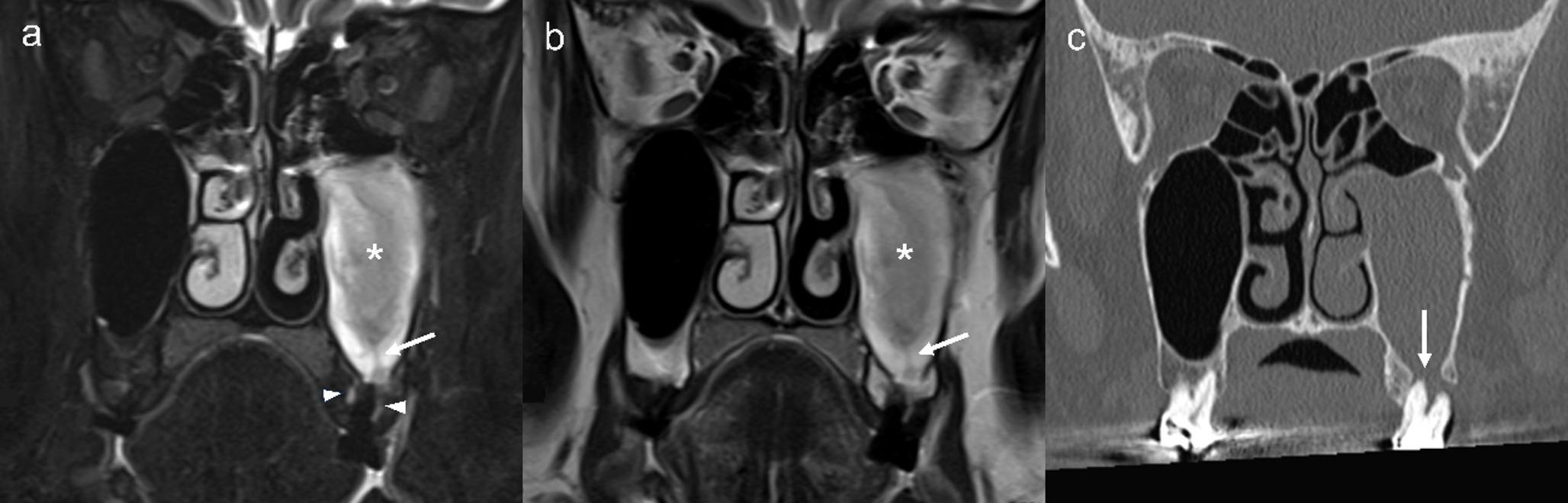
This retrospective study included patients with unilateral sinonasal disease who underwent CT and MRI between January 2020 and March 2025. Patients were classified into OMS and non-odontogenic groups based on clinical, CT, and when available, surgical pathological findings. Two radiologists evaluated MRI findings including the rising smoke sign (smoke-like low signal intensity continuous from the inferior maxillary sinus on T2-weighted or STIR images) and periapical inflammation on STIR images. Statistical analysis used the Mann-Whitney U test and Fisher’s exact test.
Results
Forty-seven patients were included (26 OMS, 21 non-odontogenic). The rising smoke sign was significantly more frequent in OMS (88.5%, 23/26) versus non-odontogenic disease (28.6%, 6/21) (p < 0.0001), with sensitivity 0.86, specificity 0.71, and accuracy 0.809. Periapical inflammation on STIR images was more common in OMS (80.8%, 21/26 vs. 4.8%, 1/21; p < 0.0001), with sensitivity 0.81, specificity 0.95, and accuracy 0.87. Both findings simultaneously were present in 69.2% (18/26) of OMS versus 0% (0/21) of non-odontogenic cases (p < 0.0001), demonstrating sensitivity 0.69, specificity 1.00, and accuracy 0.83.
Conclusions
The rising smoke sign is characteristic of OMS with high sensitivity, while periapical inflammation on STIR images demonstrates high specificity. Their simultaneous presence is virtually pathognomonic for OMS with perfect specificity, enabling reliable differentiation from non-odontogenic disease.

Comments (0)