
Remember me
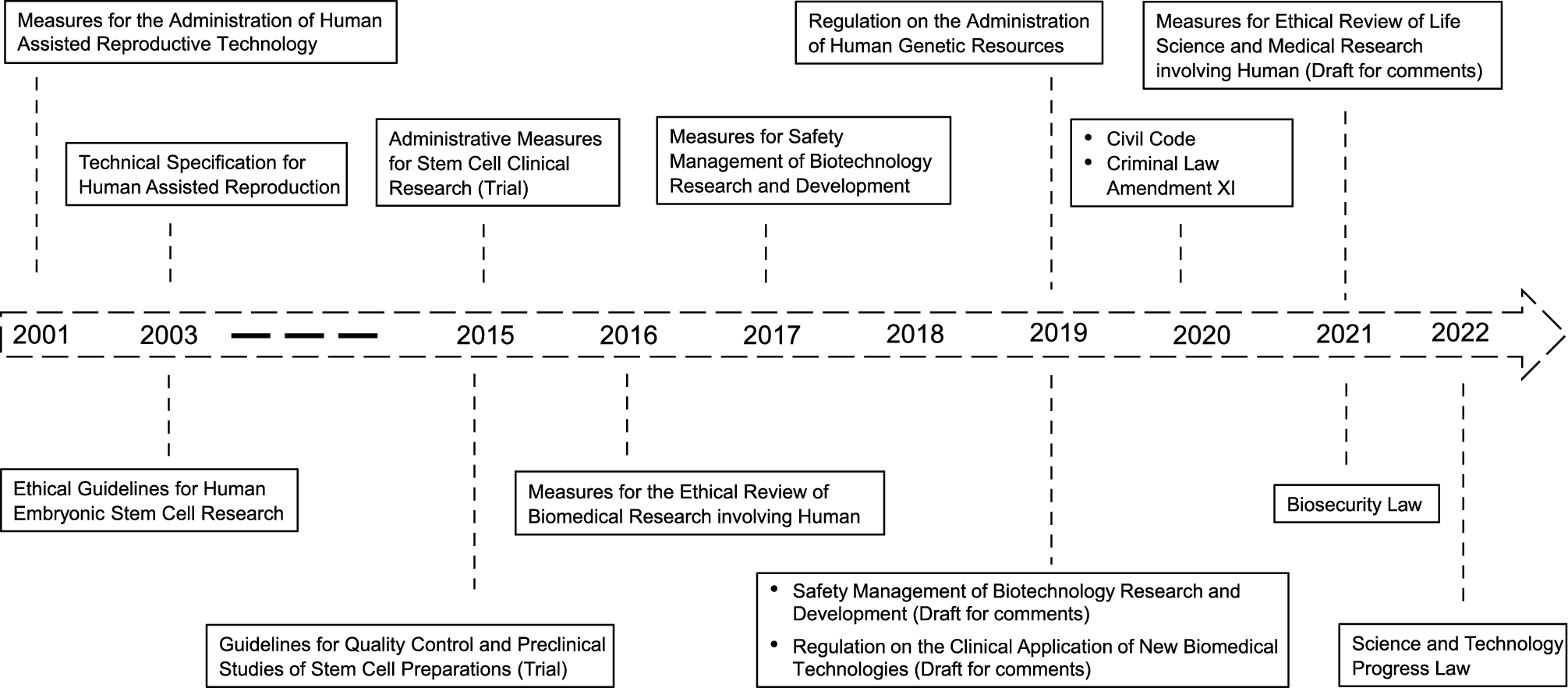
Considering the importance of embryonic and pertinent research, the possibility of international policy adjustment, and the recent reform of science and technology ethical governance, it is time for China to re-examine the 14-day rule. From the discussions above, we can conclude that extending the 14-day rule, to a certain extent, will not evoke intense repercussions from the Chinese public. Nevertheless, a comprehensive, prudent, and stepwise approach (Fig. 2) to promote the revision and improvement of China’s legislation and policies will help this country ensure the social acceptance of human embryonic research at home and gain more support and trust from the international community in the long term.
Figure 2
Responsible framework and strategies for reforming the 14-day rule in China
First, if China intends to revise the 14-day rule, the fundamentally effective way is to comprehensiv.ely re-examine and improve the rules for embryonic and related research. The precautionary principle, enshrined in China’s Biosecurity Law (Article 3), should be one fundamental principle to be applied to reflect on any improvement of the rules as well as any review and approval of embryonic and related research. Since it is still unclear what a human embryo is under China’s current legal framework, clarifying the definition of the embryo while reforming the 14-day rule would be a fundamental element. In addition, drawing a new specific line to replace the 14-day limit for proper embryo research is also an important consideration, as it helps to provide more detailed and clear guidance to scientists and regulators. In the meantime, it is time for China to consider the clarification of regulating new technologies, such as research on “admixed” embryos, stem cell-based embryonic models, and three-dimension bioprinting. Noteworthily, it would be appropriate for China to continue to make relevant provisions on these issues in the form of guidelines (e.g., the Ethical Guidelines). Unlike laws or regulations, the guidelines in China present a certain degree of binding force and, at the same time, are more plastic to be revised than laws and regulations in adapting to the rapid advance of life science and technology.
Second, it is imperative to clarify scientific issues according to China’s specific needs, especially local significance. As stated in the ISSCR latest updated Guidelines, only based on the accurate judgments on the critical scientific problems to be solved beyond 14 days as well as their importance and necessity can we further decide how to extend. However, the ISSCR Guidelines do not consider a crucial issue: although the scientific community is generally curious about the unexplored developmental events, from gastrulation onward to the stages when abortus materials are available, due to different social, cultural traditions, population health, demographic and natural environment, the layout of raised basic scientific questions and clinical benefits raised by the extension of the 14-day rule may vary widely by country and region. For instance, probably due to diet or folic acid supplements, the incidence of perinatal neural tube defects varies among European countries (Wadman, 2021). In China, recently, the incidence of perinatal neural tube defects has considerably decreased due to a series of programs related to the prevention and control of birth defects, such as distributing folic acid to pregnant women, but that of congenital heart defects and oral facial clefts has not (Li and Di, 2021). Moreover, with the implementation of the three-child policy (announced on May 31, 2021) in China, the proportion of birth to women with advanced maternal age (> 35) will increase and, thus, the prevalence of congenital anomalies may rise. In this regard, one of the key concerns of China’s biomedical research, especially the research on embryos beyond 14 days, should probably focus on dissecting the etiology of these specific and increasingly severe congenital anomalies in this country. In the meantime, a clear distinction must be drawn between which scientific issues can be solved by embryos research within the 14-day period or alternative research and which can only be addressed by using embryos research beyond 14 days.
The above-mentioned discussions can be initiated by scientific associations and societies related to embryo research in China, such as the Chinese Society for Stem Cell Research (CSSCR). The government may provide infrastructural support and promote intellectual cross-disciplinary interactions through running research fellowships, studentships, seminars, workshops, etc. On this basis, it is vital to seek more extensive expert opinions and strive to reach a basic scientific consensus.
Third, while revisiting and modifying the rules related to embryo research, China could formulate more innovative policies and institutions, with adequate and institutionalized processes of concurrent evaluation. For instance, we recommend that a pilot project be launched to allow a small number of laboratories with specific qualifications and conditions to conduct such research at first. At the same time, for these projects, China may consider establishing a specialized, strict procedure to review, approve, and supervise the in vitro embryo research beyond 14 days of these specific laboratories to deter drifts. The procedure should include a scientific peer-review process and an independent specialized ethics review and oversight process (Hyun et al., 2021). More importantly, in this procedure, the ethics committee should be composed of scientists, ethicists, legal and regulatory experts, and community members familiar with embryo research.
In addition, China may consider hierarchical and classified management for in vitro embryo research beyond 14 days. For instance, abnormal embryos, such as embryos with gene defects and triploid embryos, which do not have the capability of developing into whole human beings, can be allowed to be used for such research first, and then normal human embryos. In addition, the development of alternative ways, including the use of artificial intelligence simulations, device simulations, animal experiments, embryoids, to reduce the use of human embryos, including research beyond 14 days, ultimately to replace unnecessary human embryo experiments, is also something worth advocating in this country. Only when no valid alternative approach to obtaining the same information exists can embryo research beyond 14 days be allowed.
Fourth, regulators, scientists, and educators are recommended to place more emphasis on public education and conversations to allow for broad engagement and public trust regarding the future expansion of the 14-day rule. As analyzed above, the relevant public debate in China is limited, and embryo research is complicated and ethically controversial worldwide. Considering complex issues concerning ethics and policy, especially in the West, constructing serious and rigorous educational systems of disseminating adequate, evidence-based, timely and culturally pertinent information regarding embryonic research in China would also be helpful to promote scientists’ and the public’s understanding of domestic and international concerns. More importantly, it is vital for scientists and educators, based on China’s specific conditions, to propose detailed advice on the content of the education, the instructional approaches, and the expected goal of the education for the public. This will be an excellent opportunity to raise Chinese public awareness and understanding of embryo research in general and its related research, such as stem cell-based embryo models and chimera research.
In addition to public education, efforts should also be made to promote broader dialogue among multiple stakeholders, including policymakers, scientists, the public, patients, embryo donors, and funders. The dialogue should focus on broader issues, including the scientific, ethical, legal, ethical, and policy issues, raised by permitting such research. In China, we believe that it is more beneficial and feasible for the dialogue to be initiated by academic institutions and research entities from a small scale to a large scale. Stakeholders, such as embryo donors and patients, are encouraged to be involved in the communication in the form of conferences, seminars, or workshops attended by multidisciplinary experts to further promote understanding and trust among different stakeholder groups and contribute to the implementation of relevant policies.
Fifth, it would be necessary for China to participate actively in discussing relevant international policies and strengthen international communication based on value pluralism. The latest ISSCR updated guidelines do not define a clear boundary for human embryo research. It can be foreseen that it is unlikely to reach an agreement around the world on limits or criteria for the change of the 14-day rule in a short time, and various policies will highly possibly be developed in the future, due to the influence of social, cultural, religious, and other factors. Despite this, international conversations and regulatory cooperation are still crucial, particularly considering the responsible global governance of biotechnology.
In promoting the revision of domestic legislation and policies, countries, including China, need to remain transparent and maintain high-quality international dialogue, to promote the trust and support of the international community. Ongoing international dialogue should focus on scientific, ethical, biosafety, intellectual property and other issues concerning embryonic research, particularly regarding the potential impact of extending the 14-day rule on the international community and society. For instance, in the matter of the intellectual property issues, given that the patentability of inventions related to embryo research varies globally (Cuchiara et al., 2013), researchers from the jurisdiction that first extend the 14-day rule will have more opportunities to gain the advantage of developing global patent portfolio. This requires legislators and policymakers worldwide to fully consider its far-reaching impact in the field of biomedicine pertinent to embryonic research. Thus, countries, at least biotechnology developed countries, should try their best to reach an agreement on the revision of the 14-day rule through communication and consultation. Perhaps if several countries intend to revise the 14-day rule, it would be better for them to have a certain degree of synchronization in the time of modifying the rule. Doing so can promote the realization of effective global governance of life technology and avoid competing countries falling into the “slippery slope” of regulation due to factors such as patent considerations.
Comments (0)