
Remember me

Correction: Reproductive Sciences
The original online version of this article was revised to replace the artwork for Figures 1, 3, and 6.

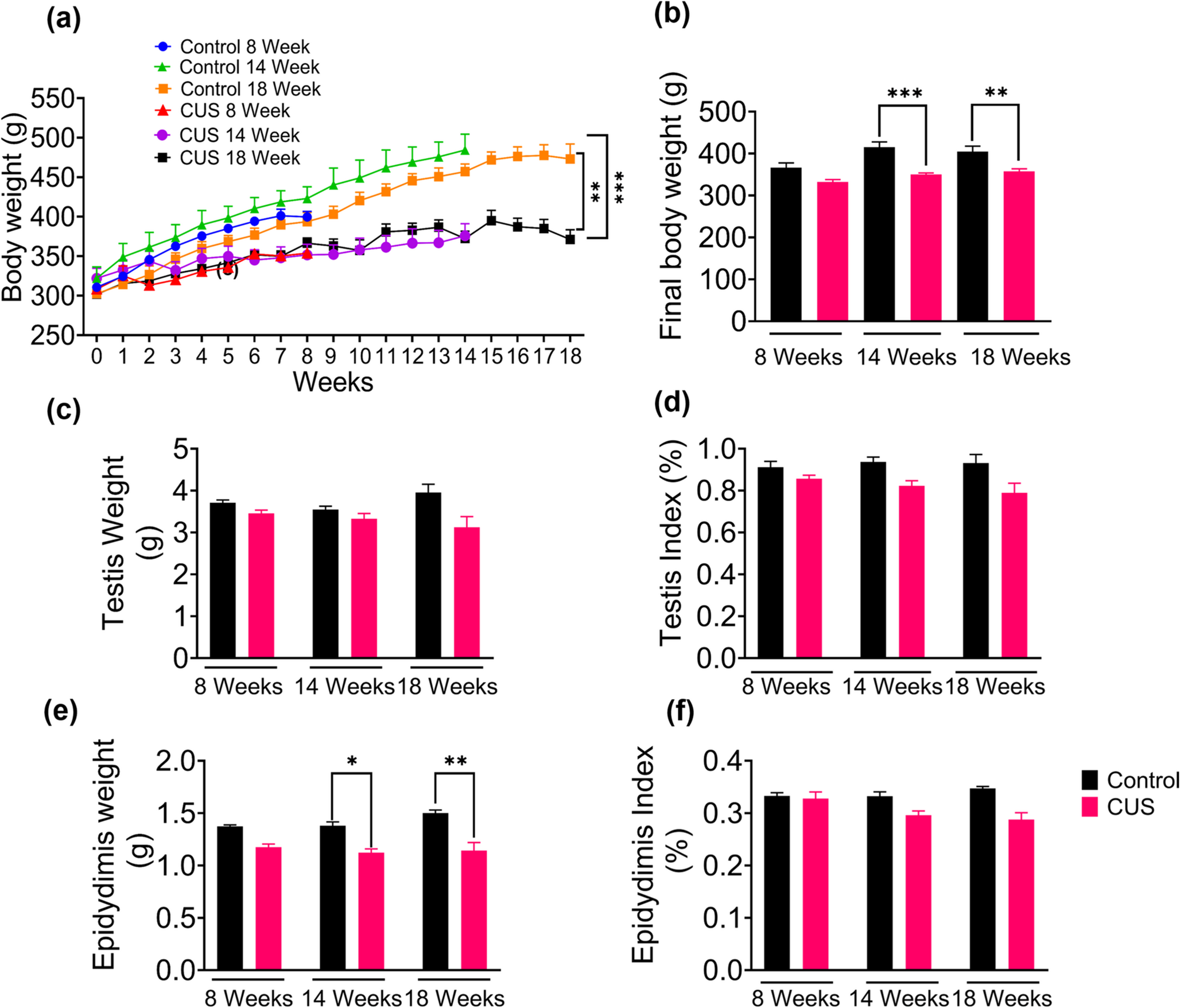
Fig. 1 Duration-dependent effect of CUS on: a body weight changes throughout the study, b final body weight at 8, 14, and 18 weeks, c absolute testis weight, d testis index, e absolute epididymis weight, and f epididymis index. Data are presented as mean ± SEM (n = 6). A two-way ANOVA followed by Tukey’s multiple comparison test was used. ***p < 0.001 (Control vs. 14-week CUS); **p < 0.01 (Control vs. 18-week CUS); and *p < 0.05 (Control vs. 14-week CUS)

Fig. 3 Graph showing the duration-dependent effect of CUS on a Sperm count, b sperm progressive motility, c non-progressive motility, d viable sperms, e sperm morphology, f sperm abnormal chromatin integrity. Representative photomicrographs of eosin-stained rat sperm observed under a light microscope g (1000 × magnification). The upper left panel shows control sperm with an intact head and tail. All other panels represent sperm from the CUS group: the upper right panel displays quasinormal sperm; the panel below the control shows grossly abnormal sperm; and the lower right panel depicts sperm with a detached head. h Acridine orange-stained rat sperm observed under a fluorescent microscope. The upper panel shows sperm from the control group with intact DNA, indicated by green-stained heads. The middle and bottom panels show sperm from the CUS group with partially denatured and fragmented DNA, represented by yellow- and orangestained heads, respectively. Values are expressed as mean ± SEM. Two-way ANOVA followed by Tukey’s multiple comparison test was used. ***p < 0.001 (Control vs. 14- and 18-week CUS; 8-week CUS vs. 18-weeks CUS). **p < 0.01 (Control vs. 8-week CUS; 8-week CUS

Fig. 6 Representative photomicrographs of the epididymis from control CUS-treated rats, stained with hematoxylin and eosin (H&E). In the CUS group, reduced sperm density is indicated by a black star (*), and increased interstitial space is marked by a black arrow ( →), reflecting structural alterations associated with stress-induced reproductive dysfunction. Images magnifications (100 ×, 200 ×, and 400 ×)
The original article has been corrected.
Comments (0)