The aim of this study was to investigate whether sex is associated with trauma mechanisms and if certain trauma mechanisms lead to specific facial fractures in paediatric patients. The hypothesis was that sex has an influence on trauma mechanisms and that trauma mechanisms and facial fractures have a connecting pattern. We also examined the presence of characteristic patterns in facial fractures, treatment, and contributing factors.
To begin with, the difference in incidence between female and male subjects was remarkable, as there were approximately four times more boys than girls. This was expected, since males are generally more likely to experience accidents and facial trauma, which has been stated in various other studies as well (Goswami 2024; Kaura et al. 2018; Khan et al. 2019; Vyas et al. 2008; Wusiman et al. 2020). Goswami’s study reported a male-to-female ratio in children aged 12 years or less of 1.6:1 (Goswami 2024). The difference compared to our 4.3:1 ratio could be explained by the fact that older boys (> 12 years) are more often involved in contact sports or other higher-risk free time activities, such as motocross, than girls.
This also explains the slightly higher mean age in males compared to females. Differing from some other studies of facial fractures in paediatric patients, our subjects were all 6 years or older. This is because facial fractures are very rare in the youngest age group due to their flexible bone and cartilage structure, the relatively dominant skull size, and the protective frontal bone (Alhumsi and Gilardino 2014; Rogan et al. 2024; Rogan and Fang 2024; Vyas et al. 2008). Moreover, the age distribution was clearly more emphasized in adolescents than in younger children, which aligns with previous studies (Ferreira et al. 2005; Grunwaldt et al. 2011). This is due to progressive independence and greater involvement in contact sports and driving, as seen in our study, but also supported in other studies (Braun et al. 2017; Grunwaldt et al. 2011). In contrast, bicycle accidents were the most common cause of facial fractures in school-aged children, which is consistent with the fact that ages 6 to 12 are typically when children learn to ride a bicycle.
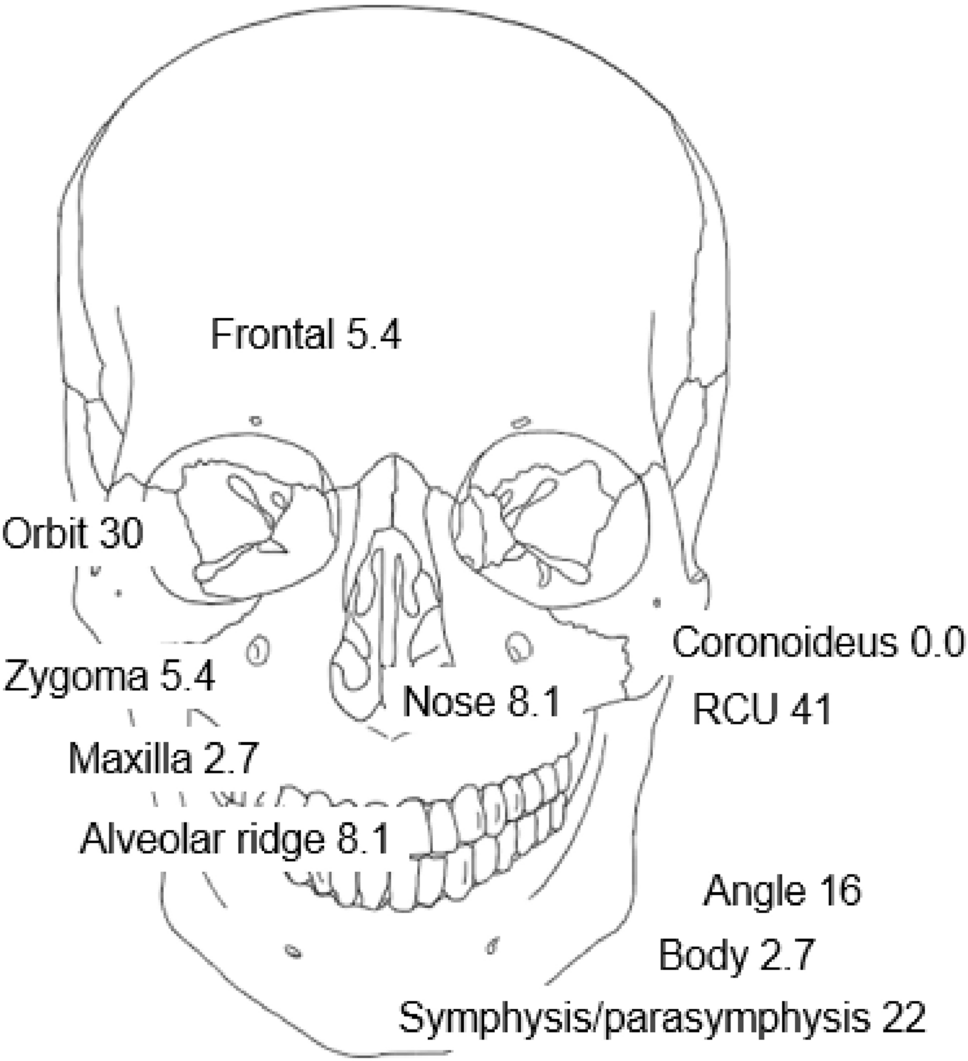
Over half (60%) of the subjects’ facial fractures emerged in the mandible, making it clearly the most common fracture site. This is in line with other studies about maxillofacial fractures in both paediatric patients and adults (Goswami 2024; Khan et al. 2019; Wusiman et al. 2020). The mandible is prone to fractures due to its prominent appearance and low facial position (Wusiman et al. 2020). We found that fractures in the RCU were the most common (41%), followed by fractures in the symphysis or parasymphysis area (22%). This is consistent with studies of paediatric mandibular fractures by Smith et al., who found RCU fractures in 56% and symphysis or parasymphysis fractures in 27% of the subjects, and by Steed et al., who also stated that mandibular fractures occur most often in the RCU, followed by symphysis or parasymphysis (Smith et al. 2013; Steed and Schadel 2017). When comparing our study to those involving the whole population, Gualtieri et al.’s mandibular fracture sites aligned with ours, whereas Wusiman et al. found the symphysis or parasymphysis to be the most commonly fractured in adults, though followed with condyle fractures (Gualtieri et al. 2021; Wusiman et al. 2020).
The remaining facial fractures were mostly midfacial, with orbital fractures being distinctly the most common (30%) due to the orbit´s fragile, paper-thin bone structure (Felding 2018). However, only one of our subjects was diagnosed with an orbital trapdoor fracture (2.7%), although other studies report an incidence between 24 to 40% in paediatric patients (Bansagi and Meyer 2000; Chi et al. 2010). The low percentage could be because trapdoor fractures are acute conditions that require immediate treatment and are therefore directed forward from PHCH if there is not a maxillofacial surgeon on call at that instant. The nasal bone, which is often fractured in adults, was fractured in only 8.1% of subjects. This aligns with Landeen et al. who stated that nasal fractures are less common in paediatric patients than in adults (Landeen et al. 2022). The frontal bone was fractured in 2 subjects (5.4%), which corresponds with other studies reporting a frequency of 5–15% for frontal fractures (Marinheiro et al. 2014; Schultz et al. 2017).
In contrast to our study, where none of the patients it the younger age group had an upper facial fracture, earlier studies have reported that in younger patients the cranial part is more frequent to fracture than the midface (Imahara et al. 2008; Rogan and Fang 2024; Vyas et al. 2008). Several factors may explain this difference. First, our study did not include patients younger than 6 years, in whom the cranium still predominates in size. In addition, the most severe cranial fractures may have been referred elsewhere for treatment, while the mildest cases may have gone unnoticed to avoid unnecessary radiation exposure in young children.
All in all, a study on adult facial fractures from the same region and time period than ours, found that 40% of adult subjects had mandibular fractures and 56% had midfacial fractures (Färkkilä et al. 2024). This differs from our findings, where mandibular fractures were the most common (60%) and midfacial fractures occurred in 35% of subjects. However, the divergence is coherent since, as mentioned earlier, children have smaller sinuses and a more protective cranium due to different face-to-skull bone size ratios, which prevent them from fractures in the midface (Imahara et al. 2008; Rogan et al. 2024; Rogan and Fang 2024; Totonchi et al. 2012; Vyas et al. 2008).
When examining unilateral fractures, a notable in side distribution was observed. A significant majority (80%) of fractures occurred on the left side of the head, which could be linked to the fact about 90% of people are right-handed (Levander and Schalling 1988; Papadatou-Pastou et al. 2020). Consequently, the dominant hand may instinctively protect the same side of the face in accidents, for example, directly covering the face in sports incidents or indirectly in falls or bicycle accidents. However, in MVAs for instance, the handedness does not necessarily influence trauma distribution, which may reduce the proportion of left-sided fractures.
As could be expected from the age distribution, which was weighted towards adolescents, most subjects had permanent dentition. No clear patterns between dentition stage and fracture site could be identified, partly due to the small number of subjects in most of the dentition stages. In the larger group of subjects with permanent dentition, mandibular fractures were only slightly more common than fractures in the midface or upper face, similar to the pattern observed when comparing the two age groups.
In our subjects overall, the most common trauma mechanisms were sports incidents (32%), followed by MVAs (27%) and bicycle accidents (24%). The aetiology varies somewhat between our and other´s studies. According to Irgebay et al., sports were the leading cause of injury (42%) in patients aged 12 to 18 years, whereas those younger than 6 years were mostly injured in activities of daily living (46%) (Irgebay et al. 2024). Ferreira et al. in Portugal and Grunwaldt et al. in the U. S. found MVAs to be the most common trauma mechanism (53% and 25%, respectively), whereas Ghosh et al. found falls to be the most common cause in India (59%) (Ferreira et al. 2005; Ghosh et al. 2018; Grunwaldt et al. 2011). It is also relevant to note that in our study, motorcross accidents were classified as MVAs, whereas some other studies consider them sport incidents, which affects the distribution of trauma mechanisms (Diab et al. 2021). Additionally, it is noteworthy that all our subjects who encountered assault (11%) were over 15 years old, indicating that younger patients who experienced assault did not sustain fractures.
There was a clear difference in trauma mechanisms between paediatric patients and adults from the same study period. In adults, falls (37%) and assaults (32%) were the most common causes, whereas in children, sports incidents (32%), MVAs (27%), and bicycle accidents (24%) were the leading trauma mechanisms (Färkkilä et al. 2024). This is understandable, as elderly people are more prone to get facial trauma from falls and young and middle-aged adults from assaults, whereas these causes are clearly less frequent in children.
When analysing trauma mechanisms in relation to fracture sites, bicycle accidents and assaults appeared to lead to mandibular fractures more frequently than to other facial fractures. This is supported by another study, which described the mandible as an exposed and difficult-to-protect structure (Nogami et al. 2021). Following bicycle accidents (19%), MVAs and sports related incidents (both 14%) were the next most common causes of mandibular fractures. Similarly, Smith et al. identified bicycle accidents (29%) as the most common trauma mechanism in paediatric mandibular fractures, followed by MVAs (28%) (Smith et al. 2013). In fractures of the midface or upper face, sports incidents (19%) were the leading trauma mechanism, followed by MVAs (14%).
In male subjects, the most common trauma mechanisms were sports and MVAs (both 24%) followed by bicycle accidents (16%). In contrast, in females, sports incidents and bicycle accidents were equally common (both 8.1%). This is a notable difference and can be explained by the fact that females are generally less involved in contact sports and traffic accidents than males, except in the youngest age groups (Braun et al. 2017; Grunwaldt et al. 2011). Nevertheless, it is important to keep in mind that the number of female subjects in our study is rather concise, and therefore, cannot be perfectly relied on.
Half of our subjects were treated operatively and the other half non-operatively. Only 16% of our subjects experienced AIs, suggesting that paediatric patients often confront relatively simple trauma with fewer serious AIs. The same trend applies to adults, of whom about one in five sustain AIs (Färkkilä et al. 2024). However, some studies have reported different results. For example, Grundwaldt et al. found that up to 56% of patients sustained severe concomitant injuries, most commonly soft tissue injuries and neurological trauma, with concussion being the most frequent neurological injury (Grunwaldt et al. 2011). The lower AI rate can be explained with that our AIs did not include soft tissue injuries, which are quite common in facial trauma (Mukhopadhyay et al. 2020). On the other hand, Kirvelä et al. found that 27% of paediatric patients with facial fractures had AIs and reported that the occurrence of AIs varies with age and, among teenagers, also with sex (Kirvelä et al. 2023). All our subjects had a normal GCS score of 15, which may reflect some bias, as the most severe trauma cases with lower GCSs may have been referred forward for treatment. The same applies to the fact that none of our patients sustained cervical spine injuries. In effect, this could also explain the lower AI percentage in our findings. Notably, 4 of 6 of the subjects with AIs were injured in MVAs. This is in line with other studies, as MVAs often tend to be severe, high-energy injuries (Ferreira et al. 2005). AIs most frequently affected the extremities, followed by the head and the thorax, which aligns with other studies as well (Wusiman et al. 2020).
Regarding the treatment of fractures involving the dentate regions, the major difference between distinct dentition stages is that in patients with primary or mixed dentition, titanium plates and screws must always be removed if used, to avoid interference with the developing permanent teeth. In patients with permanent dentition, the need for removal is assessed on a case-by-case basis, as the clinical situation of a 12-year-old differs from that of a 17-year-old. Open reduction and internal fixation can be more challenging in patients with mixed dentition, since screws must be placed carefully to avoid damaging permanent teeth. Additionally, fractures in paediatric patients may affect occlusion and bite development due to ongoing jaw growth.
There were notable seasonal variations in the occurrence of facial fractures. Summer (35%) and spring (30%) were the peak seasons, which can be explained by the Finnish climate that reduces outdoor activities in late autumn (22%) and especially in winter (14%). However, this should be interpreted cautiously, as some of the subjects with facial fractures during holiday periods are directly directed from PHCH to Level 1 trauma centre in Helsinki, Finland due to a lack of maxillofacial surgeon on call.
Limitations of our study include relatively small cohort size, despite a ten-year study period, as facial fractures in paediatric patients are infrequent. Another drawback is that some patients with major trauma are referred directly to tertiary hospitals. Similarly, patients with only dentoalveolar fractures are treated at various locations within the region and are therefore not certainly recorded in the PHCHs patients register. In addition, since all data was collected retrospectively, it might distort the found results slightly.

Comments (0)