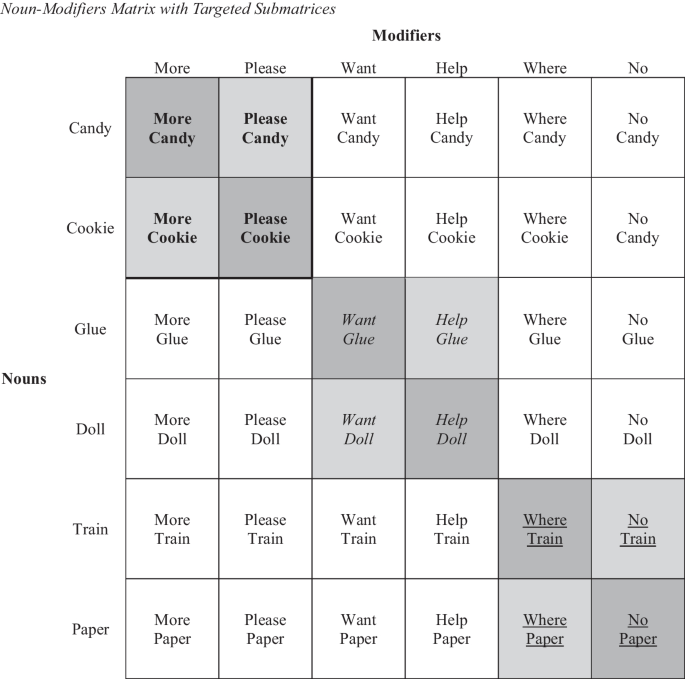
Axe, J. B., & Sainato, D. M. (2010). Matrix training of preliteracy skills with preschoolers with autism. Journal of Applied Behavior Analysis, 43(4), 635–652. https://doi.org/10.1901/jaba.2010.43-635
Article
PubMed
PubMed Central
Google Scholar
Bartman, S., & Freeman, N. (2003). Teaching language to a two-year-old with autism. Journal on Developmental Disabilities, 10(1), 47–53.
Google Scholar
Behavior Analyst Certification Board. (n.d). BACB certificant data. Retrieved fromhttps://www.bacb.com/BACB-certificant-data.
Beukelman, D.R., & Light, J.C. (2020). Augmentative and alternative communication processes for children and adults with complex communication needs. In Augmentative & alternative communication: Supporting children and adults with complex communication needs, 5th edition. (pp. 1–17). Retrieved from https://brookespublishing.com/wp-content/uploads/2020/01/Beukelman-First-Proofs-Excerpt.pdf
Bonvillian, J., Kissane Lee, N., Dooley, T. T., & Loncke, F. (2020). Simplified signs: A manual sign-communication system for special populations (Vol. 1). Open Book Publishers.
Braaten, L. F., & Arntzen, E. (2023). The effect of meaningful stimuli on eye movements in stimulus equivalence class formation. European Journal of Behavior Analysis, 24(1–2), 190–212. https://doi.org/10.1080/15021149.2023.2269340
Article
Google Scholar
Brodhead, M. T., Brouwers, L. F., Sipila-Thomas, E. S., & Rispoli, M. J. (2020). A comparison of manual sign and speech generating devices in the natural environment. Journal of Developmental and Physical Disabilities, 32, 785–800. https://doi.org/10.1007/s10882-019-09720-1
Article
Google Scholar
Brown, K., Rosales, R., & Garcia, Y. (2023). A review of applied research on pairing procedures to facilitate emergent language. The Psychological Record, 73, 221–236. https://doi.org/10.1007/s40732-023-00543-3
Article
Google Scholar
Chadwick, D. D., & Jolliffe, J. (2009). A pilot investigation into the efficacy of a signing training strategy for staff working with adults with intellectual disabilities. British Journal of Learning Disabilities, 37(1), 34–42. https://doi.org/10.1111/j.1468-3156.2008.00503.x
Article
Google Scholar
Cymbal, D. J., Litvak, S., Wilder, D. A., & Burns, G. N. (2022). An examination of variables that predict turnover, staff and caregiver satisfaction in behavior-analytic organizations. Journal of Organizational Behavior Management, 42(1), 36–55. https://doi.org/10.1080/01608061.2021.1910099
Article
Google Scholar
Falcomata, T. S., Wacker, D. P., Ringdahl, J. E., Vinquist, K., & Dutt, A. (2013). An evaluation of generalization of mands during functional communication training. Journal of Applied Behavior Analysis, 46(2), 444–454. https://doi.org/10.1002/jaba.37
Article
PubMed
Google Scholar
Fitzgerald, J. R., Reid, D. H., Schepis, M. M., Faw, G. D., Welty, P. A., & Pyfer, L. M. (1984). A rapid training procedure for teaching manual sign language skills to multidisciplinary institutional staff. Applied Research in Mental Retardation, 5(4), 451–469. https://doi.org/10.1016/S0270-3092(84)80038-7
Article
PubMed
Google Scholar
Frampton, S. E., & Axe, J. B. (2023). A tutorial for implementing matrix training in practice. Behavior Analysis in Practice, 16(1), 334–345. https://doi.org/10.1007/s40617-022-00733-5
Article
PubMed
Google Scholar
Grow, L. L., Carr, J. E., Kodak, T. M., Jostad, C. M., & Kisamore, A. N. (2011). A comparison of methods for teaching receptive labeling to children with autism spectrum disorders. Journal of Applied Behavior Analysis, 44(3), 475–498. https://doi.org/10.1901/jaba.2011.44-475
Article
PubMed
PubMed Central
Google Scholar
Grow, L. L., Kodak, T., & Carr, J. E. (2014). A comparison of methods for teaching receptive labeling to children with autism spectrum disorders: A systematic replication. Journal of Applied Behavior Analysis, 47(3), 600–605. https://doi.org/10.1002/jaba.141
Article
PubMed
Google Scholar
Horne, P. J., & Lowe, C. F. (1996). On the origins of naming and other symbolic behavior. Journal of the Experimental Analysis of Behavior, 65(1), 185–241. https://doi.org/10.1901/jeab.1996.65-185
Article
PubMed
PubMed Central
Google Scholar
Howlin, P. (2003). Outcome in high-functioning adults with autism with and without early language delays: Implications for differentiation between autism and Asperger syndrome. Journal of Autism and Developmental Disorders, 33(1), 3–13. https://doi.org/10.1023/A:1022270118899
Article
PubMed
Google Scholar
Iacono, T., Trembath, D., & Erickson, S. (2016). The role of augmentative and alternative communication for children with autism: Current status and future trends. Neuropsychiatric Disease and Treatment, 12, 2349–2361. https://doi.org/10.2147/NDT.S95967
Article
PubMed
PubMed Central
Google Scholar
Kemmerer, A. R., Vladescu, J. C., Carrow, J. N., Sidener, T. M., & Deshais, M. A. (2021). A systematic review of the matrix training literature. Behavioral Interventions, 36(2), 473–495. https://doi.org/10.1002/bin.1780
Article
Google Scholar
Leader, G., Barnes, D., & Smeets, P. M. (1996). Establishing equivalence relations using a respondent-type training procedure. The Psychological Record, 46(4), 685-706. https://doi.org/10.1007/BF03395192
Ledford, J. R. (2017). No randomization? No problem: Experimental control and random assignment in single case research. American Journal of Evaluation, 39(1), 71–90. https://doi.org/10.1177/1098214017723110
Article
Google Scholar
Ledford, J. R., & Zimmerman, K. N. (2023). Rethinking rigor in multiple baseline and multiple probe designs. Remedial and Special Education, 44(2), 154–167. https://doi.org/10.1177/07419325221102539
Article
Google Scholar
Longo, A., Reeve, K. F., Jennings, A. M., Vladescu, J. C., Reeve, S. A., & Colasurdo, C. R. (2022). Comparing stimulus equivalence-based instruction to self-study of videos to teach examples of sign language to adults. Behavioral Interventions, 37(3), 713–731. https://doi.org/10.1002/bin.1871
Article
Google Scholar
Love, J. R., Carr, J. E., Almason, S. M., & Petursdottir, A. I. (2009). Early and intensive behavioral intervention for autism: A survey of clinical practices. Research in Autism Spectrum Disorders, 3(2), 421–428. https://doi.org/10.1016/j.rasd.2008.08.008
Article
Google Scholar
McNaughton, D., Rackensperger, T., Benedek-Wood, E., Kresman, C., Williams, M. B., & Light, J. (2008). “A child needs to be given a chance to succeed”: Parents of individuals who use AAC describe the benefits and challenges of learning AAC technologies. Augmentative and Alternative Communication, 24(1), 43–55. https://doi.org/10.1080/07434610701421007
Article
PubMed
Google Scholar
Michael, J. (1985). Two kinds of verbal behavior plus a possible third. The Analysis of Verbal Behavior, 3, 1–4. https://doi.org/10.1007/BF03392802
Article
PubMed
PubMed Central
Google Scholar
Miguel, C. F. (2016). Common and intraverbal bidirectional naming. The Analysis of Verbal Behavior, 32, 125–138. https://doi.org/10.1007/s40616-016-0066-2
Article
PubMed
PubMed Central
Google Scholar
Miguel, C. F. (2018). Problem-solving, bidirectional naming, and the development of verbal repertoires. Behavior Analysis: Research and Practice, 18(4), 340–353. https://doi.org/10.1037/bar0000110
Article
Google Scholar
Napier, J., Leigh, G., & Nann, S. (2007). Teaching sign language to hearing parents of deaf children: An action research process. Deafness & Education International, 9(2), 83–100. https://doi.org/10.1002/dei.214
Article
Google Scholar
Nunes, D. R. P. (2008). AAC interventions for autism: A research summary. International Journal of Special Education, 23(2), 17–26.
Google Scholar
Parsons, M. B., Rollyson, J. H., & Reid, D. H. (2017). Evidence-based staff training: A guide for practitioners. Behavior Analysis in Practice, 5, 2–11. https://doi.org/10.1007/BF03391819
Article
Google Scholar
Rosen, R. S. (2010). American sign language curricula: A review. Sign Language Studies, 10(3), 348–381.
Article
Google Scholar
Sarokoff, R. A., & Sturmey, P. (2004). The effects of behavioral skills training on staff implementation of discrete‐trial teaching. Journal of Applied Behavior Analysis, 37(4), 535–538. https://doi.org/10.1901/jaba.2004.37-535
Article
PubMed
PubMed Central
Google Scholar
Scattone, D., & Billhofer, B. (2008). Teaching sign language to a nonvocal child with autism. The Journal of Speech Language Pathology and Applied Behavior Analysis, 3(1), 78–85. https://doi.org/10.1037/h0100234
Article
Google Scholar
Sigafoos, J., O’Reilly, M. F., Lancioni, G. E., & Sutherland, D. (2014). Augmentative and alternative communication for individuals with autism spectrum disorder and intellectual disability. Current Developmental Disorders Reports, 1, 51–57. https://doi.org/10.1007/s40474-013-0007-x
Article
Google Scholar
Skinner, B. F. (1957). Verbal behavior. Appleton-Century-Crofts.
Google Scholar
Sundberg, C. T., & Sundberg, M. L. (1990). Comparing topography-based verbal behavior with stimulus selection-based verbal behavior. The Analysis of Verbal Behavior, 8, 31–41. https://doi.org/10.1007/BF03392845
Article
PubMed
PubMed Central
Google Scholar
Sundberg, M. L., & Michael, J. (2001). The value of Skinner’s analysis of verbal behavior for teaching children with autism. Behavior Modification, 25, 698–724. https://doi.org/10.1177/0145445501255003
Article
PubMed
Google Scholar


Comments (0)