Callaghan, W. M., MacDorman, M. F., Rasmussen, S. A., Qin, C. & Lackritz, E. M. The contribution of preterm birth to infant mortality rates in the United States. Pediatrics 118, 1566–1573 (2006).
Article
PubMed
Google Scholar
Bell, M. J. et al. Neonatal necrotizing enterocolitis. Therapeutic decisions based upon clinical staging. Ann. Surg. 187, 1–7 (1978).
Article
CAS
PubMed
PubMed Central
Google Scholar
Jones, I. H. & Hall, N. J. Contemporary outcomes for infants with necrotizing enterocolitis — a systematic review. J. Pediatr. 220, 86–92.e3 (2020).
Article
PubMed
Google Scholar
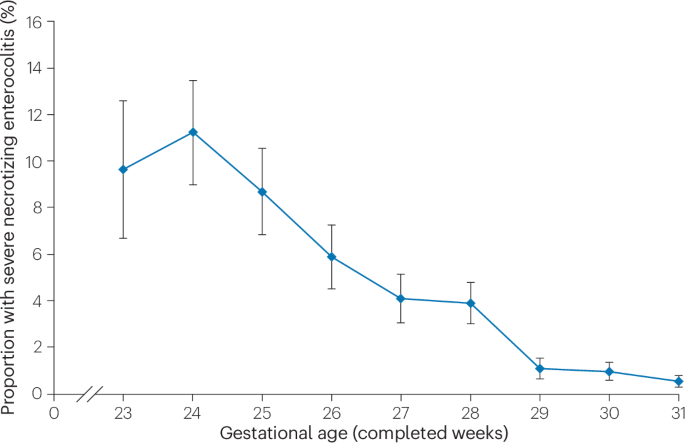
Battersby, C., Santhalingam, T., Costeloe, K. & Modi, N. Incidence of neonatal necrotising enterocolitis in high-income countries: a systematic review. Arch. Dis. Child. Fetal Neonatal Ed. 103, F182–F189 (2018). This paper is a systematic review of NEC incidence in high-income countries, including 14 studies from 12 countries in the final analysis, which found a difference in the reported rate of NEC ranging from 2% to 7% among babies born before 32 weeks’ gestation and from 5% to 22% in those with a birth weight below 1,000 g.
Article
PubMed
Google Scholar
Battersby, C., Longford, N., Mandalia, S., Costeloe, K. & Modi, N. Incidence and enteral feed antecedents of severe neonatal necrotising enterocolitis across neonatal networks in England, 2012–13: a whole-population surveillance study. Lancet Gastroenterol. Hepatol. 2, 43–51 (2017).
Article
PubMed
Google Scholar
Alsaied, A., Islam, N. & Thalib, L. Global incidence of necrotizing enterocolitis: a systematic review and meta-analysis. BMC Pediatr. 20, 344 (2020).
Article
PubMed
PubMed Central
Google Scholar
Tsigkos, S. et al. Establishing rarity in the context of orphan medicinal product designation in the European Union. Drug Discov. Today 23, 681–686 (2018).
Article
PubMed
Google Scholar
Ahle, M., Drott, P. & Andersson, R. E. Epidemiology and trends of necrotizing enterocolitis in Sweden: 1987–2009. Pediatrics 132, e443–e451 (2013).
Article
PubMed
Google Scholar
Scheese, D. et al. Cytomegalovirus worsens necrotizing enterocolitis severity in mice via increased Toll-like receptor 4 signaling. Cell Mol. Gastroenterol. Hepatol. 19, 101473 (2025).
Article
CAS
PubMed
PubMed Central
Google Scholar
Mani, S. et al. Viral infections and neonatal necrotizing enterocolitis: a meta-analysis. Pediatrics 152, e2022060876 (2023).
Article
PubMed
Google Scholar
Garg, P. M. et al. Incomplete resection of necrotic bowel may increase mortality in infants with necrotizing enterocolitis. Pediatr. Res. 89, 163–170 (2021).
Article
PubMed
Google Scholar
Garg, P. M., Hitt, M. M., Blackshear, C. & Maheshwari, A. Clinical determinants of postoperative outcomes in surgical necrotizing enterocolitis. J. Perinatol. 40, 1671–1678 (2020).
Article
PubMed
PubMed Central
Google Scholar
Remon, J. et al. Acute drop in blood monocyte count differentiates NEC from other causes of feeding intolerance. J. Perinatol. 34, 549–554 (2014).
Article
CAS
PubMed
PubMed Central
Google Scholar
Remon, J. I. et al. Depth of bacterial invasion in resected intestinal tissue predicts mortality in surgical necrotizing enterocolitis. J. Perinatol. 35, 755–762 (2015).
Article
CAS
PubMed
PubMed Central
Google Scholar
Patel, R. M. et al. Causes and timing of death in extremely premature infants from 2000 through 2011. N. Engl. J. Med. 372, 331–340 (2015).
Article
CAS
PubMed
PubMed Central
Google Scholar
Bernstein, I. M., Horbar, J. D., Badger, G. J., Ohlsson, A. & Golan, A. Morbidity and mortality among very-low-birth-weight neonates with intrauterine growth restriction. Am. J. Obstet. Gynecol. 182, 198–206 (2000).
Article
CAS
PubMed
Google Scholar
Rose, A. T. & Patel, R. M. A critical analysis of risk factors for necrotizing enterocolitis. Semin. Fetal Neonatal Med. 23, 374–379 (2018). This paper reveals that among a number of associations, growth restriction is the most consistent endogenous infant factor reported to affect NEC incidence; that antenatal glucocorticoids, progesterone, postnatal erythropoietin, lactoferrin, fluid restriction, arginine, human milk and probiotics may reduce risk; and that lower oxygen saturation targets and sepsis, and formula may increase risk.
Article
PubMed
PubMed Central
Google Scholar
McGoldrick, E., Stewart, F., Parker, R. & Dalziel, S. R. Antenatal corticosteroids for accelerating fetal lung maturation for women at risk of preterm birth. Cochrane Database Syst. Rev. https://doi.org/10.1002/14651858.CD004454.pub4 (2020).
Article
PubMed
PubMed Central
Google Scholar
Jammeh, M. L. et al. Racial/ethnic differences in necrotizing enterocolitis incidence and outcomes in premature very low birth weight infants. J. Perinatol. 38, 1386–1390 (2018). This paper reveals differences in NEC incidence and severity between racial groups, and identifies a higher incidence in infants of Black African ancestry.
Article
PubMed
Google Scholar
Seeman, S. M., Mehal, J. M., Haberling, D. L., Holman, R. C. & Stoll, B. J. Infant and maternal risk factors related to necrotising enterocolitis-associated infant death in the United States. Acta Paediatr. 105, e240–e246 (2016).
Article
PubMed
Google Scholar
Filias, A. et al. Phagocytic ability of neutrophils and monocytes in neonates. BMC Pediatr. 11, 29 (2011).
Article
PubMed
PubMed Central
Google Scholar
Melvan, J. N., Bagby, G. J., Welsh, D. A., Nelson, S. & Zhang, P. Neonatal sepsis and neutrophil insufficiencies. Int. Rev. Immunol. 29, 315–348 (2010).
Article
CAS
PubMed
PubMed Central
Google Scholar
Nowicki, P. T. Ischemia and necrotizing enterocolitis: where, when, and how. Semin. Pediatr. Surg. 14, 152–158 (2005).
Article
PubMed
Google Scholar
Nankervis, C. A., Giannone, P. J. & Reber, K. M. The neonatal intestinal vasculature: contributing factors to necrotizing enterocolitis. Semin. Perinatol. 32, 83–91 (2008).
Article
PubMed
Google Scholar
Harris, M. C. et al. Cytokine elevations in critically ill infants with sepsis and necrotizing enterocolitis. J. Pediatr. 124, 105–111 (1994).
Article
CAS
PubMed
Google Scholar
Kovler, M. L., Sodhi, C. P. & Hackam, D. J. Precision-based modeling approaches for necrotizing enterocolitis. Dis. Model. Mech. 13, dmm044388 (2020).
Article
PubMed
PubMed Central
Google Scholar
Elgin, T. G., Kern, S. L. & McElroy, S. J. Development of the neonatal intestinal microbiome and its association with necrotizing enterocolitis. Clin. Ther. 38, 706–715 (2016).
Article
CAS
PubMed
Google Scholar
Sampah, M. E. S. & Hackam, D. J. Prenatal immunity and influences on necrotizing enterocolitis and associated neonatal disorders. Front. Immunol. 12, 650709 (2021).
Article
CAS
PubMed
PubMed Central
Google Scholar
Lu, P. et al. Animal models of gastrointestinal and liver diseases. Animal models of necrotizing enterocolitis: pathophysiology, translational relevance, and challenges. Am. J. Physiol. Gastrointest. Liver Physiol. 306, G917–G928 (2014).
Article
CAS
PubMed
PubMed Central
Google Scholar
Warner, B. B. et al. Gut bacteria dysbiosis and necrotising enterocolitis in very low birthweight infants: a prospective case-control study. Lancet 387, 1928–1936 (2016).
Article
PubMed
PubMed Central
Google Scholar
Pammi, M. et al. Intestinal dysbiosis in preterm infants preceding necrotizing enterocolitis: a systematic review and meta-analysis. Microbiome 5, 31 (2017).
Article
PubMed
PubMed Central
Google Scholar
Wala, S. J. et al. Superior performance of biofilm versus planktonic Limosilact

Comments (0)