4.1 Summary of Main Findings
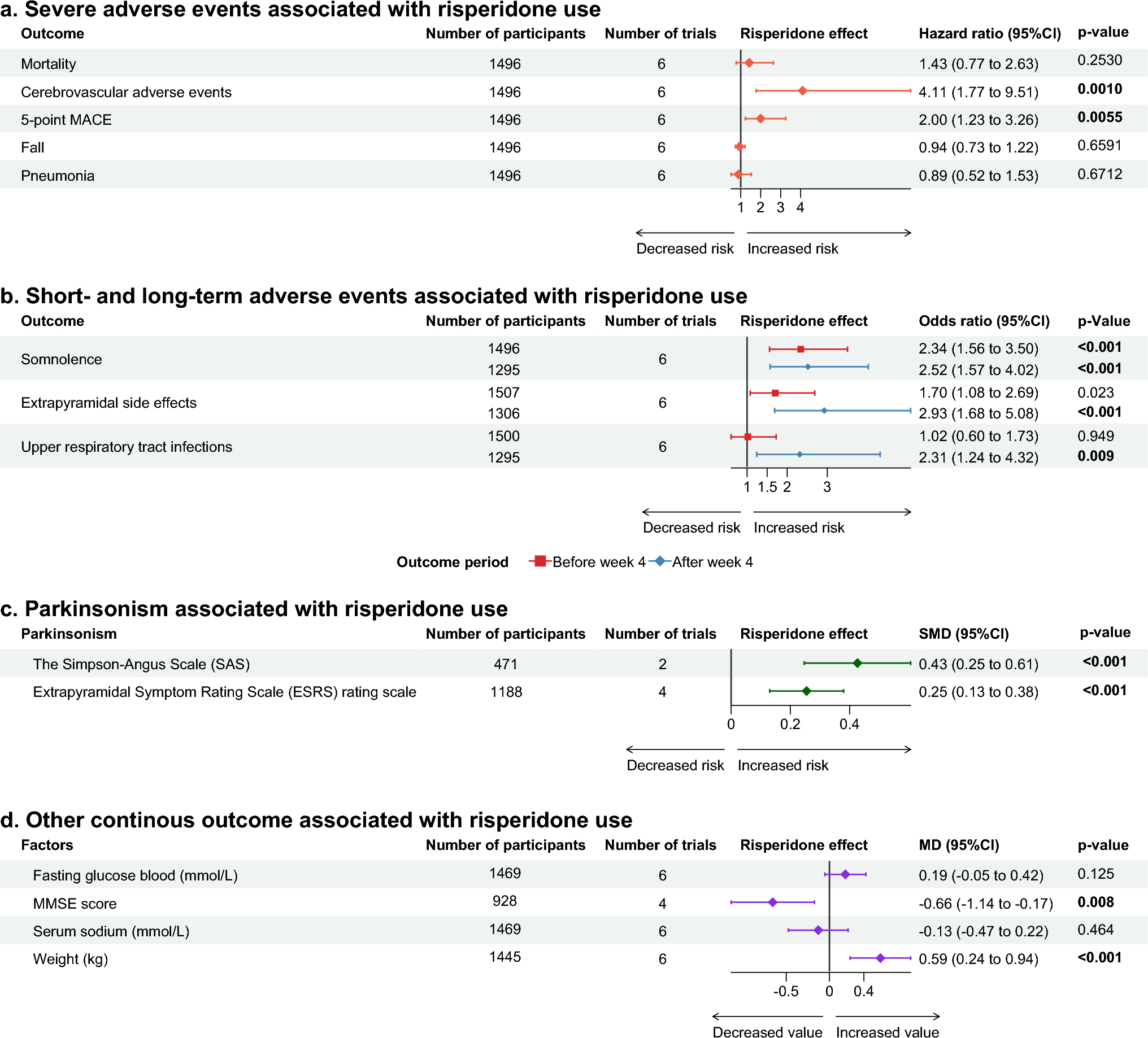
To our knowledge, this is the first IPD-MA of clinical trial data to assess multiple adverse outcomes of risperidone in people with dementia. Risperidone use was associated with an increased risk of CVAE and MACE. The risk of somnolence was elevated both before and after week 4, whereas EPS and URTIs were associated with risperidone use predominantly in the later treatment period. Weight gain and cognitive decline were likewise associated with risperidone use. Baseline use of antidepressants, musculoskeletal medications, and furosemide modified risperidone’s effects, increasing the risks of hyponatraemia, falls, and mortality, respectively.
4.2 Risperidone and Multiple Adverse Outcomes4.2.1 Severe Adverse Outcomes
In this IPD-MA, risperidone use was not associated with a statistically significant increase in all-cause mortality, consistent with findings from several reviews of randomised controlled trials [13, 17, 30], whereas certain cohort studies have reported statistically significant associations [31]. Similarly, no significant associations were observed between risperidone and falls or pneumonia, although prior cohort studies have reported mixed findings [10, 12]. These discrepancies may reflect differences in study populations, follow-up duration, and baseline risk between randomised controlled trials and observational cohorts. Our analysis also identified elevated risks of CVAE and MACE including cardiovascular death, stroke, myocardial infarction, unstable angina, and heart failure in risperidone users compared to placebo. These results are in line with findings from real-world studies [10,11,12,13] and with the Food and Drug Administration (FDA) “black box” warning regarding antipsychotic-related cardiovascular events [32]. Although the median onset of these adverse events in our study occurred more than 4 weeks after initiation, one cohort study reported that the risk of stroke and other serious cardiovascular events was highest shortly after antipsychotic initiation and remained elevated for a 2-year period [10]. Differences in patient characteristics such as the severity of BPSD at baseline between randomised controlled trials and observational cohorts, as well as potential unobserved bias, may partly explain these patterns; nevertheless, risperidone use should be limited to the shortest duration necessary.
4.2.2 Effects on Central and Peripheral Nervous System
Somnolence was consistently associated with risperidone use, both early and late in treatment, while EPS and URTIs emerged after week 4. The mechanism of antipsychotic-induced EPS is well-understood, which is mainly due to the blockage of dopamine D2 receptors [4], whereas the link with URTI is still unknown. Although these events are generally not life-threatening, they can impair comfort, function, social engagement, and quality of life, which may exacerbate BPSD—potentially undermining treatment goals [12, 33].
4.2.3 Metabolic Changes and Cognitive Function
Weight gain was associated with risperidone use, consistent with previous reports [8]. In contrast, no significant changes were observed in serum sodium or fasting glucose, which aligns with evidence that hyponatraemia [34] and glucose abnormalities [35] are relatively uncommon with risperidone compared with other antipsychotics. Cognitive decline was also linked to risperidone, which is clinically relevant given its potential to exacerbate BPSD manifestations such as wandering and psychosis [36, 37].
4.3 Risk Stratification
Baseline use of cardiac therapy was identified as a predictor of all-cause mortality and MACE, including cardiovascular death. Real-world evidence similarly indicates that individuals with dementia and pre-existing cardiovascular disease are at a substantially increased risk of stroke, a risk further amplified with risperidone use [11]. These findings reinforce current recommendations to exercise caution when initiating risperidone in individuals with a history of cardiac disease, given their elevated risk of stroke or transient ischaemic attack [13, 38]. Conversely, we found that individuals with psychosis had lower risks of stroke and MACE, independent of risperidone use, which is consistent with prior reports [18]. Considering our earlier study showing risperidone’s efficacy in psychosis [16], these symptoms may represent an important treatment target.
In our subgroup analysis, no BPSD domains were identified as risk modifiers. However, one real-world study suggested that psychosis and aggression may modify stroke risk, although it examined multiple antipsychotics rather than risperidone alone and did not adjust for concomitant medications or comorbidities [25]. As our cohort primarily comprised individuals with agitation, further studies are needed to clarify whether risks differ across specific BPSD symptoms.
There was a trend towards higher all-cause mortality with risperidone compared to placebo among participants using furosemide at baseline in our study. Although statistical significance was not reached, this pattern was previously noted [17]. One possible explanation is that furosemide users may be more susceptible to hypovolaemia [39], a condition in which risperidone use warrants caution [13, 38], as it may predispose to severe outcomes such as hypovolaemic shock or sudden death—events previously reported with antipsychotic use [12, 13].
Additionally, a reduction in serum sodium was observed among participants taking antidepressants at baseline when treated with risperidone compared to placebo. While risperidone itself is not strongly associated with hyponatraemia [34], the combined effect of multiple psychotropic medications may increase this risk [40]. Greater weight gain was also observed among participants with baseline affective disturbances, who tended to have more severe behavioural symptoms and cognitive impairment. This may reflect increased appetite in those with pre-existing mood disorders or greater nutritional support provided to those with more advanced disease. It should be noted that these subgroup analyses lack statistical power and should be interpreted with caution, serving primarily as hypothesis-generating findings [41].
4.4 Strengths and Limitations
This IPD-MA combined trial data from multiple regions, allowing examination of a broad spectrum of adverse outcomes and improving the applicability of results across diverse clinical settings. By using a one-stage, centred modelling approach, we minimised ecological bias between studies, and the random-intercept S-learner method followed current best practice for estimating individualised treatment effects in IPD-MA [14, 15].
Several limitations should be considered. First, because the dataset was limited to YODA risperidone trials, relevant external studies were not captured, potentially constraining generalisability across populations and settings. Second, race/ethnicity was not included in the analyses because the low incidence of outcomes within non-Caucasian groups made model estimation unreliable. As a result, the findings may not be generalisable to Asian, African, or other underrepresented populations. Third, detailed comorbidity data were not consistently reported across trials, which may have introduced residual confounding; however, baseline medication categories were used as proxies for underlying conditions to mitigate this issue. In addition, the analysis assumed data were MAR, which could bias pooled estimates if the assumption does not hold. Inclusion of unpublished trials (BEL-14 and INT-83) may reduce publication bias; however, the absence of peer review for these datasets introduces potential for other biases. Statistical power for subgroup and predictor analyses was limited as this is not predefined, and these findings should be regarded as exploratory. Finally, because most included trials used flexible titration schedules, we did not evaluate dose–response relationships for other adverse events.
4.5 Implications for Research and Clinical Practice
First, current clinical guidelines recommend limiting risperidone use for psychosis and agitation in dementia to no longer than 12–16 weeks [38, 42, 43]. However, the current population-based study shows that antipsychotic prescribing often deviates from guideline recommendations, with a median treatment duration of 28 weeks [44]. Given the observed associations between risperidone and multiple adverse outcomes in our study, its use may ideally be limited to no longer than 4 weeks.
This recommendation is supported by our finding that the time to first severe adverse event often occurs after week 4. Furthermore, some of the events have the potential to exacerbate BPSD, such as URTIs, EPS, or cognitive decline, thereby contradicting the intended therapeutic purpose. Our previous analysis also showed that treatment response at week 2 can predict response at week 4 [16]. Therefore, an early evaluation at 2 weeks is also recommended. If no benefit is observed, discontinuation may be considered [42].
Second, considering the FDA “black box” warning on antipsychotic use in dementia [32] and our observed association between risperidone and cardiovascular and cerebrovascular events, there is a clear need for a validated risk calculator to estimate individual likelihood of these outcomes. Prediction models developed in psychiatric populations have shown promise and could be adapted for dementia care to support shared decision-making and more precise risk–benefit assessment [45,46,47]. Additionally, although a previous study reported no association between risperidone dose and mortality [17], the dose–response relationship for other severe adverse events remains unexplored. More cohort studies are needed to evaluate the impact of dosing patterns on these risks. Finally, future studies should further investigate the hypotheses generated from our subgroup analyses, particularly the potential interaction between baseline furosemide use and risperidone, to clarify whether certain patient groups are at heightened risk.

Comments (0)