
Remember me
This is the first 2026 volume of Reviews in Endocrine and Metabolic Disorders (REMD). After 8 years serving as Editor-in-Chief of this prestigious Springer journal, I feel that it is important to comment on the grounds we are working on, as well as some glances about our common future.
When years ago, my friend Professor Andrea Giustina and Springer staff persuaded me to take over the direction of the journal, I was honored and somehow afraid. Despite my previous experience as External Reviewer, Associate Editor and Continental Editor of other international journals, the offer was quite challenging. I understood that the field of high-level science international publications have changed dramatically in the last times. The proliferation of the so called predatory journals, and the massive incorporation of contributions from Asia and the advent of AI and its associate risk have modified the field. When I finally accepted the offer, I was sure that only with the close collaboration of the authors, editors and publishers, the new problems may be overcome, and nowadays I feel the outcome is largely satisfactory.
At the beginning, Springer used to publish four REMD issues per year, all of them focused on specific topics. The topic of interest plus several short reviews developing that topic, these issues were called “Thematic Reviews Issues”. My initial consideration was that this rigid frame may be no capable of absorbing the exponential growth of the field and based on that I propose to the publisher to change to a mix of “Thematic Review Issues” plus Issues, composed by short reviews not focused on any specific topic that we called “Isolated Reviews Issues”. The response by the authors was so positive that after a few years we ask the publisher to increase from 4 to 6 issues per year with a mix of the two different formats, that change would force to redraw the agreements with the learned libraries in the world. Thanks to the publisher, the idea was accepted and REMD now publishes 6 issues per year, three are Thematic Reviews and the other three of Isolated Reviews.
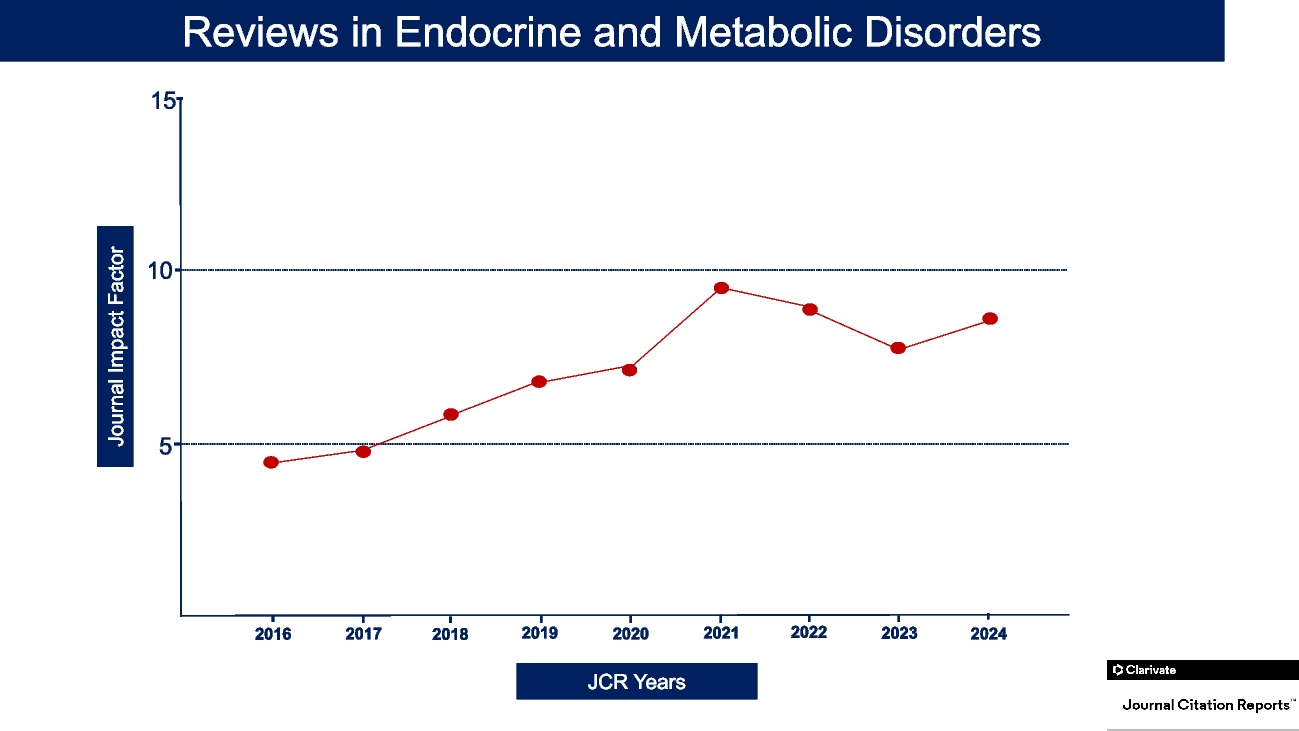
With that format, the interest and overall influence of REMD grew up becoming a very useful instrument for clinicians and scientists active in the field. Despite the change in methods of the evaluation of impact, the Impact Factor of REMD was never lower than 6 (Fig. 1) and in the last 2024 evaluation was 8.0. Therefore, REMD is the 15th in the list of 193 journals grouped under the category of “Endocrinology and Nutrition” in the ISI Web of Science – Clarivate Analytics, being in the top 10% of all journals. The 5 years impact factor is 9.0 with 712,700 downloads (2024), a fact that increases the attraction for young scientists to use the journal. But besides the impact factor we take care of other metrics very relevant in the present times as the time from reception of a manuscript to first decision, time from acceptance to publication and metrics alike are carefully monitored to reduce them. The manuscripts are received by authors from all Continents in the world. If at the initial time REMD publishes 250 pages per year nowadays it publishes 1,500 per year. That such an increase was not accompanied by a parallel reduction in the impact factor was a very surprising fact.
Fig. 1 The alternative text for this image may have been generated using AI.
Evolution of the Impact Factor of Reviews in Endocrine & Metabolic Disorders along the years
This positive and encouraging evolution was only possible due to the excellent work of the REMD Associate Editors, as they appear in the enclosed (Fig. 2). This Board is inclusive and diverse not only in geographical location but also in expertise because it is composed of young and conscientious endocrinologists of different interest and preferred topics. They receive the different manuscripts and manage them with the external reviewers to maintain the quality demanded by Springer. The number of received paper is very high and to facilitate their work an initial evaluation is performed by the Editor-in-Chief office that reject some manuscripts due to the fact of being out of the scope of the journal or simply unready for peer-review due to the ineffective presentation, study shortcomings or quality of the writing. In addition, the REMD Editorial Board, a well-balanced international group of scientists, are continuously contributing by advice, proposing new topics as well as reviewing manuscripts. The use of the very friendly SNAPP as electronic manager has facilitated our work, because it is shown to be very effective in preventing important problems for the journal such as plagiarism, duplicate publications or incorrect authorship.
Fig. 2 The alternative text for this image may have been generated using AI.
Current board of Associate Editors for Reviews in Endocrine & Metabolic Disorders
However, the most relevant problem that REMD faces is external peer reviews of the manuscripts. Ideally any REMD paper should have at least the evaluation of two external reviewers, but to get a qualified external reviewer is nowadays a nightmare. Top level scientists are over busy, and producing a solid review is a time-consuming task therefore after sending the invitations the associate editors have difficulty obtaining an acceptance. We understand this is a problem that plagued all international journals and is not an easy to solve problem.
For the Thematic Review issues is not a great problem because each issue has two Guest Editors selected by the large experience in the topic.
These Guest Editors select around 20 experts for writing their reviews and each author must be also an expert on the topic. In that context, finding external reviewers is easier than for the isolated reviews.
Least but not less we need to comment on the high relevance of the typography quality of Springer production. In fact, when a paper is finally accepted by the editors it passes to the Production Department that produces superior work with figures, tables and flow charts that greatly enhance the attraction and readability afterwards it is immediately published “OnLine” to avoid delay, when all the manuscripts of a given issue are ready, they are finally published “OnPaper”. That, together with the fact, that REMD does not charge fees for publication of figures, made our journal very attractive.
An international journal is never the result of a one-man-show, and the outcome is the result of the high collaboration of editors and, readers but also the Springer staff that takes care of the journal. I must acknowledge the superb work of Anna Lockhart, Senior Publisher Medicine and Life Sciences of Springer Nature and her staff (Bebe Gadingan and Jaybert Arellado) are doing, always deeply involved and caring of the high quality and regularity of the publications. As a journal does not exist without readers, I encourage all you to consider REMD as a part of your scientific work and of your scientific world and keep contributing to maintaining and increasing its quality.
Comments (0)