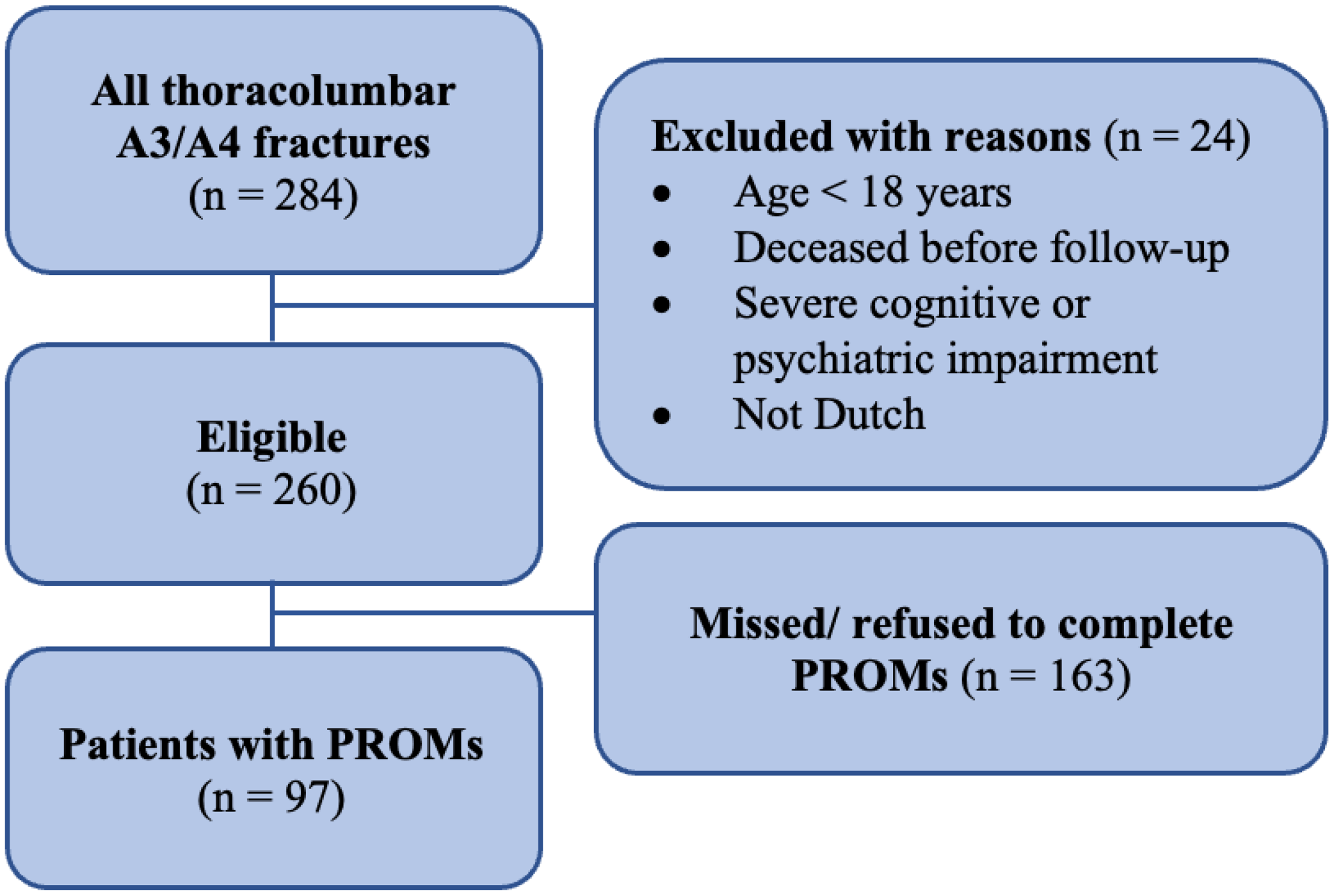
This study presents patient-reported outcomes on physical functioning and health-related quality of life (QoL) in individuals treated for thoracolumbar A3/A4 fractures, either conservatively or surgically, at a median follow-up of 4.5 (IQR = 5.6) years. No statistically significant differences were observed between the conservative and surgical treatment groups in levels of physical functioning or health-related quality of life. These findings suggest that, despite differences in treatment approach, long-term patient-reported outcomes are comparable across both groups.
Compared with normative data from the Dutch population, patients in both treatment groups reported significantly lower levels of physical functioning and QoL. Specifically, impairments were noted in daily activities, lower extremity function, mental and emotional well-being, and overall QoL. On the EQ-5D, 47% of patients failed to reach the normative threshold. In comparison, non-recovery rates on the SMFA subscales were even higher: 76% for lower extremity, 63% for upper extremity, 71% for mental and emotional problems and 74% for ADL. No significant differences in non-recovery rates were observed between the two treatment groups, although these results should be interpreted with caution because of the small sample sizes.
A significant difference in complication rates was observed between the treatment groups: patients treated conservatively experienced notably fewer minor and major complications than those who underwent surgical treatment. This finding aligns with expectations, as surgical treatment is inherently more invasive, which may increase the risk of complications. However, it is essential to note that conservative treatment is not suitable for all patients, particularly those with neurological deficits or unstable fracture patterns, where surgical management remains necessary.
Patient-reported physical functioning
Several studies have compared surgical and conservative treatment approaches for A3/A4 thoracolumbar fractures using patient-reported outcome measures (PROMs), consistently showing that long-term outcomes are broadly comparable between the two strategies. The systematic review by Chou et al. [11] reported no significant differences in physical functioning between surgical and conservative treatments after 6 months of follow-up, based on scores from the patient-reported Roland-Morris Disability Questionnaire (RMDQ) and Oswestry Disability Index (ODI) [11]. Although these results are in line with our findings, they included all thoracolumbar burst fractures and not only the A3/A4 fractures. The extensive international AO Spine cohort study by Dvorak et al. [19] further confirmed that both treatment modalities for thoracolumbar A3/A4 fractures result in comparable long-term disability, as assessed using standardized instruments such as the Oswestry Disability Index (ODI). However, their sample size was relatively small. Moreover, both the RMDQ and ODI lack adequate reliability and validity [12].
In contrast, our study utilized the SMFA, offering a broader and more detailed assessment of physical functioning. The SMFA demonstrates sufficient measurement properties. It captures a wider range of musculoskeletal limitations and daily activity impairments than the ODI or RMDQ, providing a more comprehensive view of long-term recovery in this patient population. Collectively, these studies underscore that thoracolumbar A3/A4 fractures have a lasting impact on patients’ physical and emotional functioning, reinforcing the notion that full functional recovery to pre-injury levels is uncommon, irrespective of treatment modality.
Health-related quality of life
To date, limited research has explored the impact of thoracolumbar A3/A4 fractures on quality of life, particularly when comparing outcomes between surgical and conservative treatment approaches. Vialle et al. [20] reported similar outcomes comparing conservative treatment to surgical treatment in patients with thoracolumbar A3/A4 fractures as in our study. However, this study reports a low sample size of 16 patients with a 2.5-year follow-up. They also presented raw EQ-5D scores rather than utility index conversions in their primary analysis. Failing to convert EQ-5D scores to utility indices results in less standardized comparisons across patient groups or interventions. In comparison, our study included a relatively larger sample size and utilized EQ-5D utility scores, thereby enhancing the standardization and clinical relevance of the findings.
Comparison with normative data of the general Dutch population
The present study is, to our knowledge, the first to assess recovery following A3/A4 thoracolumbar fractures using normative data from a general population as a reference point. This approach provides a more objective benchmark for evaluating outcomes and highlights the extent to which patients fall short of population norms, regardless of treatment strategy. Our findings further demonstrate that most patients fail to reach even the lower limit of the 95% confidence interval of the normative data of their peers. Moreover, previous work by De Graaf et al. [21] showed that pre-injury PROM scores in trauma patients are generally higher than normative population values, suggesting that our findings likely represent a conservative estimate of incomplete recovery. This highlights the need for continued research to optimize treatment strategies and better understand why patients fail to reach this point, enabling the development of more effective treatments.
Complication rate
This study showed significantly higher complication rates after surgical treatment of thoracolumbar A3/A4 fractures, compared to conservative treatment. These findings correspond with recent evidence reporting a higher incidence of procedure-related morbidity following operative stabilization of thoracolumbar burst fractures. A retrospective multicenter analysis by Wang et al. [22] demonstrated that postoperative complications occurred in 10–14% of surgically treated patients, most commonly wound infections, hardware loosening, and pulmonary complications, while conservatively managed patients experienced fewer adverse events overall. Similarly, a population-based registry study by Aono et al. [23] found that although surgery provided superior radiological correction, it was associated with a twofold higher risk of perioperative complications and prolonged hospital stay. More recently, Chen et al. [24] reported comparable findings in a prospective cohort, noting that 12% of surgical patients developed procedure-related complications compared to only 5% in the nonoperative group.
Overall, these findings confirm that while modern surgical techniques have improved safety, complication rates remain higher compared to conservative treatment. This reinforces the need for careful consideration when opting for surgery, balancing potential risks with the comparable long-term outcomes of conservative management. In conclusion, patients who sustained a thoracolumbar A3/A4 fracture and were treated conservatively or surgically have similar outcomes in terms of physical functioning and quality of life. Most patients do not recover to the level of their peers from the general population and the choice for surgical treatment should be made carefully because of the higher incidence of complications.


Comments (0)