
Remember me

During the study period, 1794 patients with an ISS of ≥ 16 as well as age of ≥ 16 were treated at our institution. 57 cases (3.2%) revealed hollow organ injuries and/or mesenteric injuries and received surgical treatment. These patients were divided into groups, as mentioned earlier. The following table contains demographic data as well as parameters describing their overall clinical course Table 1.
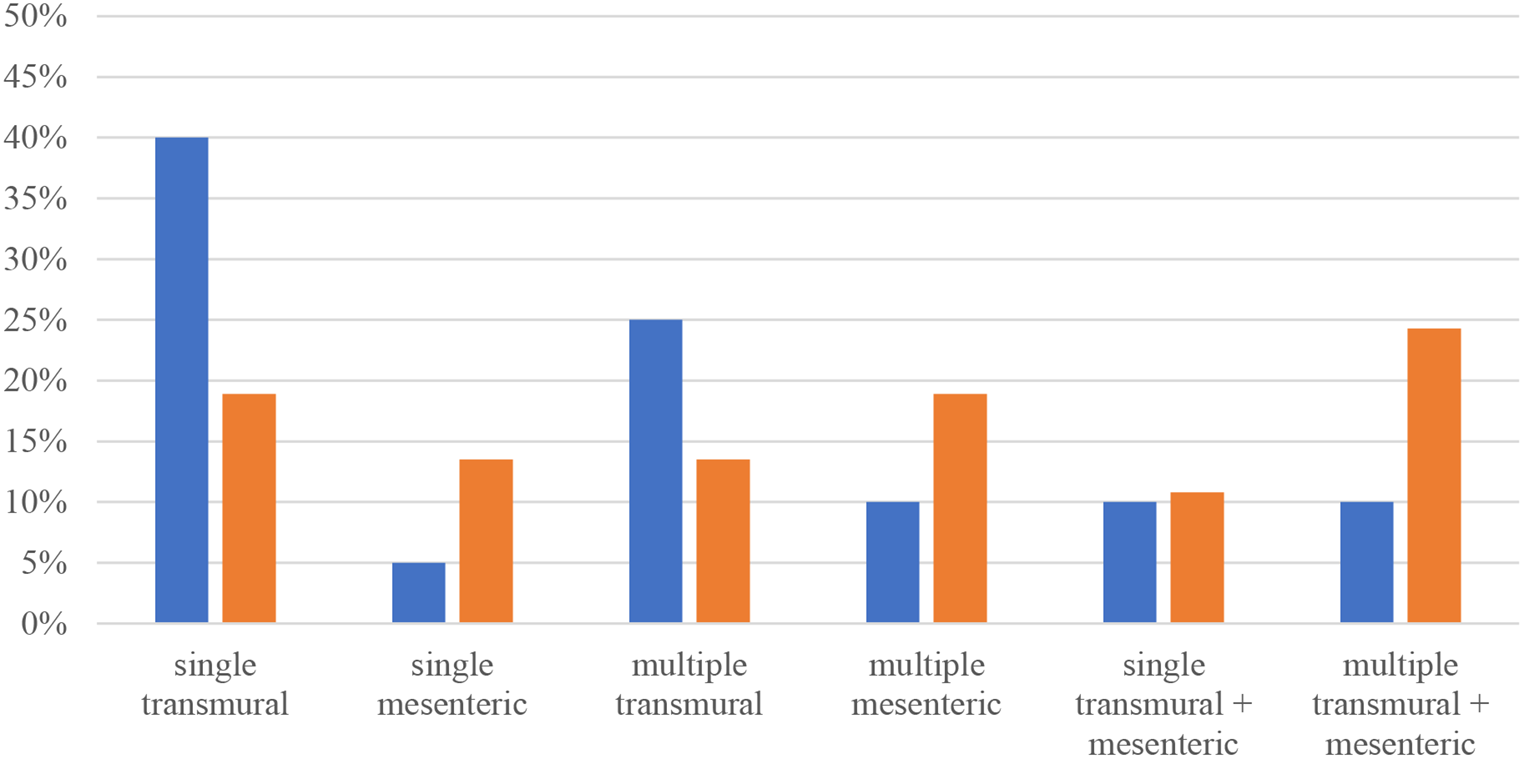
Table 1 Demographic and clinical parametersNo significant differences in age or sex ratio could be detected, all groups showed similar male predominance. Median ISS was significantly higher in group 2 compared to group 1 (p=0.002). Furthermore, patients in group 2 had undergone prehospital intubation significantly more often (p=0.014) and presented with lower systolic BP on admission (p=0.007). During initial resuscitation in the trauma bay and the initial operation patients in group 1 had significantly lower transfusion requirements regarding pRBCs as well as FFPs (p<0.001, respectively). Postoperatively patients in group 2 required longer ventilation times (p=0.017). 30 day-mortality in group 1 was 0%, significantly less than 27% in group 2 (p=0.01).Overall, 50 patients (87.7%) sustained blunt trauma, predominantly due to motor vehicle accidents. There was no significant difference between groups 1 and 2 regarding the trauma mechanism (80% vs. 91.9%, p=0.187). A total of 51 patients (89.5%) were directly transferred to the operating room after initial treatment in the trauma bay, with no significant difference between groups 1 and 2 (85.0% vs. 91.9%, p=0.35). The mean time from arrival to the start of abdominal surgery was 89.7 ± 33.3 minutes (range 38–162) in group 1 and 60.4 ± 34.1 minutes (range 10–150) in group 2, which was significantly shorter in group 2 (p=0.025). The types of injuries found intraoperatively are depicted in the following Fig. 1,2,3,4.
Fig. 1 The alternative text for this image may have been generated using AI.
Types of injuries in groups 1 (blue) and 2 (orange)
Patients in group 1 predominantly suffered from single or, second most frequently, multiple transmural injuries that could be managed by a single operation. Patients in group 2, who require at least one second look, most commonly showed a pattern of multiple mesenteric as well as transmural bowel injuries. Abbreviated Injury Scale (AIS) severity levels ranged from 2 to 5, with an overall mean value of 3.75 and no significant differences between the groups.
Fig. 2 The alternative text for this image may have been generated using AI.
Injury sites in groups 1 (blue) and 2 (orange)
The following figure depicts percentages of patients in each group that revealed injuries to the corresponding organ. Combination injuries commonly occurred, as mentioned above. Patients in group 1 were mostly treated for small bowel injuries (70%), in group 2 mesenteric injuries (48.6%) were followed closely by damaged small bowel (43.2%) and colon (43.2%).
Fig. 3 The alternative text for this image may have been generated using AI.
Surgical procedures in group 1
Surgical management of the patients’ injuries was analyzed and categorized in bowel repair by direct suture, anastomosis, formation of an ostomy or a combination of different procedures. As the following figure shows, patients with early total care (group 1) received a single anastomosis as the most common procedure. After that, direct bowel suture, multiple anastomoses, formation of an ostomy and combination of different techniques were performed in descending frequency.
Patients in group 2 received a variety of different procedures, as depicted in the figure above. Among all solutions the secondary formation of an ostomy was most frequently chosen, followed by multiple secondary anastomoses.
Fig. 4 The alternative text for this image may have been generated using AI.
Surgical procedures in group 2
Groups 1 and 2 were compared regarding the occurrence of unplanned reoperations. Revision-rates were similar in both groups: 6 patients (30%) in group 1 and 13 patients (35.1%) in group 2 were taken back to the operating room, the difference was not statistically significant (p=0.417).
The rate of postoperative bowel leakage was investigated in both groups. None of the cases in group 1 and 4 patients (10.8%) in group 2 developed a leak, which was significant (p=0.016). 2 leaks corresponded to multiple insufficient anastomoses, one was a single leaking anastomosis and in one case multiple anastomosis as well as an ostomy failed to heal in a particularly complex case. 3 out of the 4 cases occurred in subgroup 2b, meaning that definitive treatment was delayed after initial DCS.
Other frequent reasons for revision surgery besides bowel leakage were surgical site infections, fascial dehiscence, hematoma or abdominal compartment syndrome.
Comments (0)