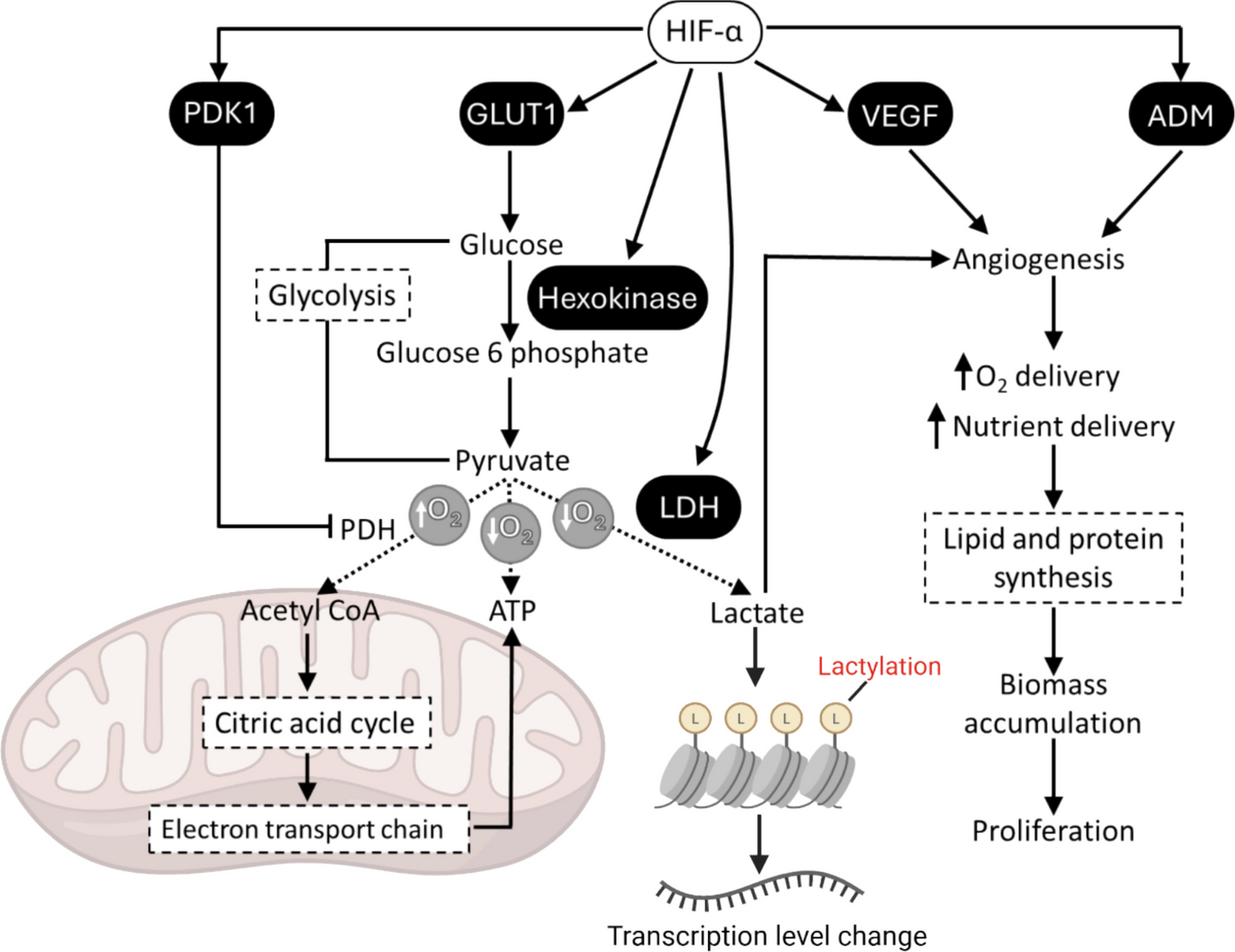
In this study, we demonstrate that the U251 chick CAM model recapitulates several clinically relevant hallmark features of GBM. Hypoxic tumour cells within the xenograft core may be activating HIF-α signalling to promote angiogenesis and metabolic reprogramming. These phenotypes can be assessed using a range of complementary techniques, highlighting the versatility of the model for investigating both cellular and microenvironmental processes. Collectively, these attributes establish the CAM model as a physiologically relevant platform for studying tumour metabolism and vascular remodelling in GBM.
U251 xenografts remodelled the CAM vasculature (Figs. 3 and 4), in concordance with recent reports describing radial remodelling of blood vessels around mesothelioma cell line-derived CAM xenografts [32]. Relative vessel thickness was significantly higher in tumour-bearing CAMs compared to control CAMs. However, no significant difference was noted between control CAMs or tumour bearing CAMs vessel length, area or volume. In addition, no significant difference was observed between normoxia- and hypoxia-preconditioned tumours with regards to vessel thickness, vascular volume or tumour volume. This may suggest that 72 h hypoxic preconditioning does not exert an effect on the tumour-host angiogenic response beyond that of tumour grafting alone, although the 72 h hypoxic preconditioning did suggest ‘cellular hypoxic memory’ in GBM-CAM xenografts, as evidenced histologically (Fig. 6), whereby normoxic tumours showed a gradient of CAIX staining with a necrotic core, while the hypoxic tumours demonstrated a heterogenous CAIX staining throughout the tumour. Herrmann et al. (2015) [36] reported that the 72 h hypoxic preconditioning significantly increased the metastatic potential of neuroblastoma-CAM tumours. In addition, Al-Mutawa et al. (2018) [37] reported significant changes in the tumour cell metabolome, including high levels of ketones (3-hydroxybutyrate), lactate, and phosphocholine in neuroblastoma CAM tumours preconditioned in 72 h hypoxia in comparison to normoxic CAM tumours. These studies along with our findings suggest that the 72 h hypoxic conditioning retains the “hypoxic memory” even though such differences may not be observed macroscopically using the imaging methods used in our study. Future studies could benefit from exploring the effects of different durations of hypoxic preconditioning to ascertain the optimal timing for lasting epigenetic effects. [18F]FDG uptake and lactate signal demonstrated that GBM-CAM xenografts exhibited a glycolytic phenotype (Fig. 5). No significant correlation between these two measures was observed. However, the sample size following the exclusion of zero values (n = 8) may be too low to draw robust conclusions and should be regarded as exploratory data. Nevertheless, these findings challenge the assumption that higher [18F]FDG uptake would correspond with increased lactate production and provide grounds for future investigation with a larger sample size. Previous studies have investigated the relationship between [18F]FDG uptake and lactate levels, yielding varied results. In one study, Herholz et al. reported a significant positive correlation between lactate concentration and [18F]FDG uptake in patients with gliomas [38]. However, their study included a heterogeneous mix of glioma subtypes and grades and, in many instances, regions of elevated [18F]FDG uptake did not spatially coincide with areas of increased lactate, suggesting a lack of direct correspondence between [18F]FDG uptake and lactate production. Moreover, as the patients were undergoing variable treatments during imaging including corticosteroids or radiotherapy, the treatment itself could have confounded the observed correlation between FDG uptake and lactate concentration. On the other hand, Guo et al. reported no significant correlation between [18F]FDG uptake and relative lactate in patients with lung adenocarcinoma [39]. Here again, ongoing treatment at the time of imaging may have confounded the assessment of tumour-intrinsic metabolic activity. More recently, Van Heijster et al., using hyperpolarised [1-13C]pyruvate MRS in murine xenografted human prostate cancer cell lines, reported a significant negative correlation between [18F]FDG uptake and lactate production (measured as the pyruvate-to-lactate conversion rate) [40]. Collectively, these varied findings align with our results, indicating that increased [18F]FDG uptake may not necessarily be a predictor of elevated lactate production, but that the two modalities reflect distinct, partially overlapping facets of tumour glycolytic metabolism.
Several technical and biological factors could explain the lack of correlation between FDG uptake and lactate in our GBM-CAM xenografts. Firstly, [18F]FDG-PET and lactate MRS have very different sensitivities and detection limits. In the case of lactate, non-detectable signals may not necessarily reflect an absence of production, but rather the limited sensitivity of MRS combined with rapid vascular clearance or metabolic reutilisation of lactate. The ISIS pulse sequence is also particularly sensitive to motion, further contributing to apparent zero values. Secondly, [18F]FDG uptake is strongly dependent on tumour vascularisation, which determines both tracer delivery and clearance. Heterogenous vascular recruitment across xenografts may therefore underlie some of the variability in [18F]FDG signal, with poorly vascularised tumours showing minimal or no [18F]FDG uptake despite active glycolysis. Indeed, histological assessment of tumours in which no FDG uptake was observed, but in which lactate was detected, demonstrated poor overall engraftment, both in terms of attachment to the CAM and of vascular supply (Figure S2). Thirdly, [18F]FDG uptake itself is limited by the expression and activity of GLUT, as well as by hexokinase activity, meaning that high [18F]FDG accumulation may not necessarily equate to high glycolytic metabolism.
Furthermore, lactate is not merely a terminal byproduct influenced by glycolytic flux; its concentration is also influenced by downstream metabolic and microenvironmental processes. Lactate can be rapidly exported and cleared from the tumour via the vasculature or be metabolised through conversion back to pyruvate in order to fuel the TCA cycle [41, 42]. In addition, lactate may be diverted into alternative pathways such as histone lactylation [11, 43]. Thus, while both [18F]FDG uptake and lactate signal are indicative of glycolytic activity, they capture different aspects of tumour metabolism—glucose transport and phosphorylation versus steady-state lactate metabolism and clearance. The absence of a correlation between FDG uptake and lactate signal in our model may be reflective of such complexities.
Notably, in our dataset, the inclusion of samples with non-detectable lactate signal as well as non-detectable [18F]FDG uptake resulted in no correlation between [18F]FDG uptake and lactate. In contrast, exclusion of these apparent zero values produced a negative trend. The correlation plots highlight that the apparent relationship is strongly influenced by zero-inflated data from both modalities: for FDG-PET, zeros can arise from variable vascular delivery or transporter activity, while for lactate they may reflect MRS sensitivity, clearance, or reutilisation. Thus, the correlation outcome appears highly sensitive to methodological and detection thresholds across both readouts, rather than purely reflecting biological differences. Fundamentally, the exclusion of zero values reflects biological phenomena, while inclusion of zeros may incorporate technical artifacts related to variable vascular access.
Immunoreactivity of hypoxia-inducible molecular marker CAIX was localised to the centre of the tumour, demonstrating that GBM-CAM tumours develop a hypoxic core driven by an oxygen gradient similar to that observed in spheroid, rodent, and patient-derived GBM models (Fig. 6) [44,45,46]. The colocalization of GLUT1 and CAIX staining suggests a hypoxia-driven shift towards glycolytic metabolism. Furthermore, the absence of CAIX with correspondingly low levels of GLUT1 staining in tumour cells on the periphery of the tumour, or close to intratumoural vessels, suggests an oxygen supply adequate to support aerobic respiration thereby preventing activation of the hypoxic response. This reasoning is corroborated by hypoxia-preconditioned tumours displaying reduced expression of GLUT1 and CAIX staining at the site in which the tumour appears integrated with the vascularised CAM (Fig. 6, G&H). GBM-CAM tumours also exhibited elevated mRNA levels of canonical pro-angiogenic HIF-α targets (VEGFA and ADM) compared with cultured cells, supporting the hypothesised hypoxia-induced transcriptional reprogramming within GBM-CAM tumours (Fig. 7). However, the mRNA expression of key glycolytic genes (GLUT1, LDHA, and PDK1) was not significantly higher in CAM xenografts than in cultured cells. Given the major role HIF plays in the transcriptional upregulation of glycolytic proteins [46], together with our positive immunohistochemical staining for GLUT1 and CAIX, this may indicate additional HIF-mediated post-transcriptional control of glycolytic enzyme expression [47]. Future work could investigate non-canonical HIF pathways of regulation in GBM-CAM tumours to clearly delineate the role of hypoxia in this model.
While the chick CAM offers a partial solution to the cost, husbandry, timescale and ethical issues posed by rodent models, it imposes some unique constraints. In the UK for example, the CAM tumour model can persist until E14 before legal restrictions from the Animal (Scientific Procedure) Act apply. This imposes a restricted timeframe, presenting challenges for studying tumour progression, vascular remodelling, and treatment responses, which can be followed over extended periods in mammalian models. Additionally, seasonal changes and temperature extremes, particularly in the winter and summer, can negatively affect embryo viability leading to inconsistent survival rates. Such limitations can partially be mitigated by starting experiments with larger numbers of eggs.
Beyond egg viability, intra- and inter-batch variability presents another challenge. Even within the same shipment, embryos may develop at slightly different rates, affecting tumour engraftment, vascularization, and response to experimental conditions. To account for this, experimental design should be kept simple to avoid additional variables and be powered accordingly to account for survival and engraftment rates. Standardized protocols for egg handling, incubation, and tumour implantation improve reproducibility, but some degree of biological variability remains inevitable. By accounting for these challenges through careful experimental design, the CAM model remains a powerful tool for preclinical research, particularly for rapid screening of tumour-host dynamics and therapeutic interventions.
In order to reduce egg mortality and minimise motion artefacts associated with warming during prolonged scan times, the MR-derived vascular volume measurements were obtained in a cohort distinct from the eggs imaged by MRS and PET. Future work should ideally implement faster, integrated vascular imaging protocols to acquire all modalities in a single cohort, enabling direct pairing of vascular volume with metabolic readouts. Furthermore, methodological refinement to reduce motion could strengthen CAM MR imaging studies. MRI was performed following 90 min of cooling, as previously described [33]. However, recent work demonstrated that anaesthetising eggs with isoflurane in a sealed plastic bag can rapidly and effectively suppress motion artefacts [47]. Isoflurane anaesthetisation is widely used in rodent models, and, while associated with vasodilation [48, 49] and slowed metabolic rate [50], it may offer a preferable alternative to cooling, which could induce CAM vasoconstriction, hypothermic shock, stress signalling, and altered intratumoural metabolism. However, as cooling was applied consistently across all eggs, comparisons between conditions remain valid. While the impact of pre-cooling on embryonic stress responses or tumour biology has not been formally assessed, such effects are plausible. Future studies directly comparing cooled versus anaesthetised embryos could quantify the degree to which thermal stress influences metabolic and vascular metrics, as well as downstream mRNA and IHC readouts.
In summary, this study demonstrates the utility of the GBM-CAM model for investigating hypoxia-driven metabolic reprogramming and tumour-induced vascular remodelling using molecular imaging techniques. The integration of [18F]FDG-PET, lactate MRS, brightfield vascular imaging, histology, and measurement of gene expression provides a comprehensive assessment of GBM cell xenografts in a physiologically relevant, cost-effective, and imaging-compatible model. These findings highlight the potential of the CAM for preclinical evaluation of metabolic imaging biomarkers and therapeutic strategies targeting the hypoxic tumour microenvironment.

Comments (0)