Study Design
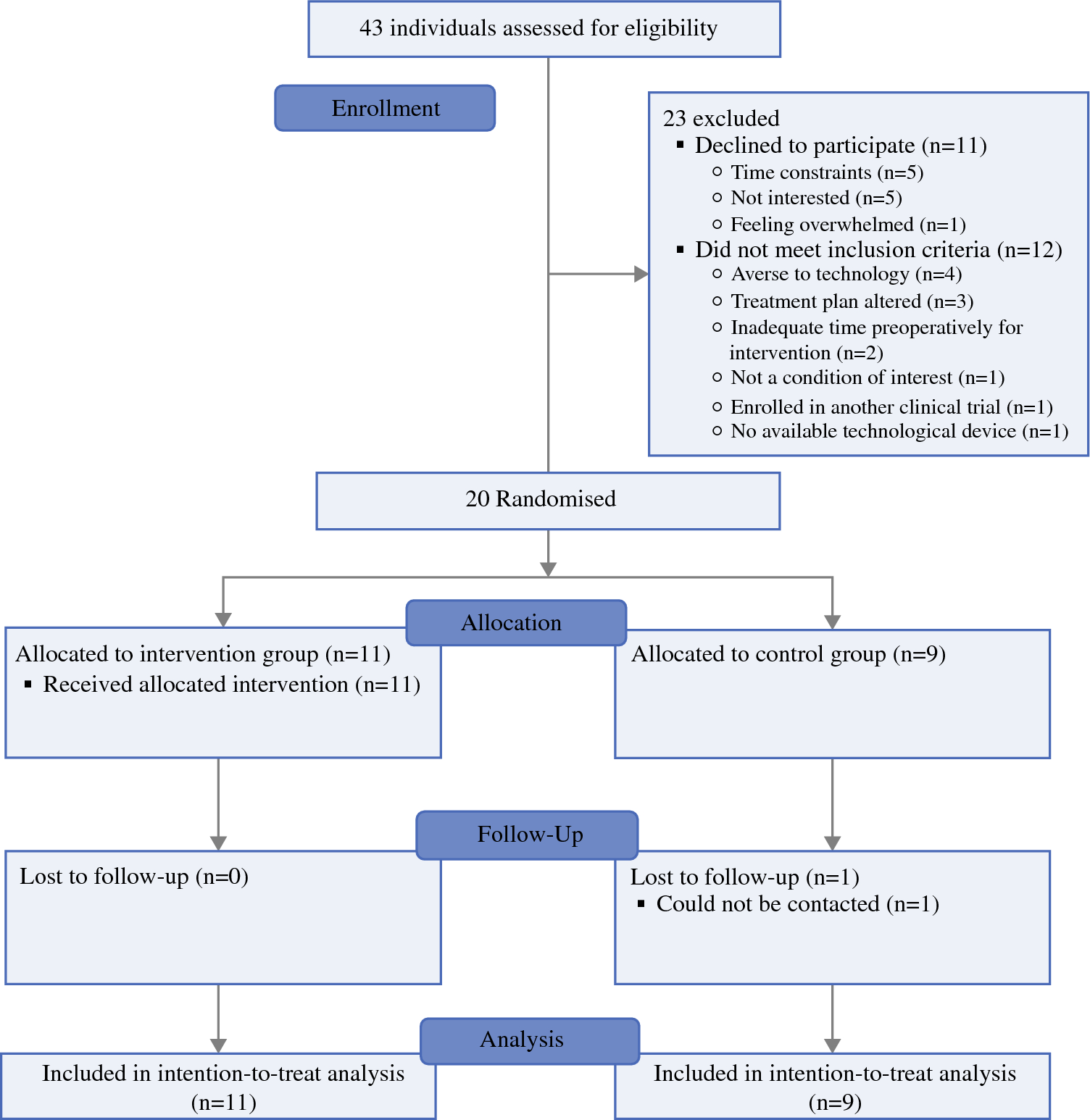
The PRIORITY-CONNECT 2 Pilot trial was a multicentre, assessor-blinded, randomised controlled feasibility trial. This pilot trial report adheres to the Consolidated Standards for Reporting Trials (CONSORT) Guidelines and the previously published protocol.9,10 This article focuses on feasibility, acceptability, and preliminary clinical outcomes. Qualitative and healthcare expenditure outcomes described in the published protocol will be reported in subsequent articles. Participating sites included two hospitals in Sydney, Australia, which are nationally recognised for surgical management of patients with gastrointestinal cancer: Royal Prince Alfred (lead site) and Chris O’Brien Lifehouse (satellite site). This pilot trial was prospectively registered with the National Library of Medicine (ClinicalTrials.gov) Registry (NCT06212700). The study obtained ethical approval from the Sydney Local Health District Human Research and Ethics Committee – Royal Prince Alfred Hospital (2023/ETH02359).
Participants
Participants were undergoing major gastrointestinal cancer surgery. To be included, participants had to be adults ≥18 years of age, scheduled for either liver, pancreas, oesophagus, gastric, or colorectal cancer resection with curative intent. Participants were also required to have a consultation with a gastrointestinal cancer surgeon at least 1 week in advance of surgery to be eligible. Exclusion criteria were cognitive impairment rendering people unable to provide informed consent as well as inability to access a smart device (including mobile phone, tablet, laptop, or desk computer with camera) or no internet connection. Those undergoing neoadjuvant therapy (such as chemo-/radiation therapy) were included. Patients were identified and screened for eligibility by a multidisciplinary team which included surgeons, anaesthetists, clinical nurse consultants, and research officers. Those who met the eligibility criteria and provided informed consent were included in the study.
Randomisation and Blinding
Immediately prior to randomisation, eligible and consenting participants underwent baseline assessment. Participants were then randomised (1:1 using blocks of 2 and 4) to either the virtual multimodal hub plus usual care (intervention group) or usual care alone (control group) via a Research Electronic Data Capture (REDCap) database using an a priori central secure randomisation service. This was developed by the trial biostatistician and uploaded to REDCap by an independent research officer not involved in the pilot trial. Randomisation was stratified by hospital to ensure balance of treatment assignments. Treatment allocation was concealed from those involved in undertaking baseline assessment and randomisation of participants. Most trial personnel, including the treating surgeon, participant assessors, and the biostatistician, were blind to which group participants were allocated. Participants receiving, and clinicians delivering, the intervention were unable to be blinded due to the nature of the intervention.
Intervention
Those randomised to the intervention accessed a virtual multimodal hub, which delivered specialised multidisciplinary care by a team, including a physiotherapist, psychologist, dietitian, specialist nurse, social worker, and geriatrician. The geriatrician’s role was to provide comprehensive geriatric assessment to participants ≥75 years of age. The virtual multimodal hub intervention was delivered via videoconferencing (Microsoft Teams) to the participant’s chosen device both preoperatively (within 1–6 weeks prior to surgery) and postoperatively (up to 3 months following surgery). Given that surgery can often be scheduled soon after surgical consultation, a minimum preoperative period of 1 week was chosen to ensure an adequate number of eligible patients could participate in the pilot trial. Included participants who were only able to receive the preoperative aspect of the intervention for a short duration could still benefit from the postoperative aspect.
The purpose of the virtual multimodal hub was to (1) address modifiable risk burden preoperatively (e.g., physical deconditioning, malnutrition); (2) prepare participants for surgery (including expectation setting); and (3) provide support to minimise decline in physiological and psychological function associated with preoperative and postoperative neoadjuvant treatments and surgery. Postoperative rehabilitation focused on interventions to recover activities of daily living, occupational tasks, and recreational activities. Multimodal interventions were individualised in terms of frequency, intensity, time, type, volume, and progression, based on a comprehensive assessment at baseline and postdischarge. This included an assessment of participants’ physical, nutritional, and psychological status as well as their comorbidities and overall health status. Participants in the rehabilitation phase (i.e., postoperative) who met their pretargeted treatment goals (co-developed by healthcare professionals and participants) were discharged, even if they remained within the 3-month postoperative intervention period. A full description of the intervention according to the Template for Intervention Description and Replication Checklist (TIDieR) can be found in the published protocol.10,11
Control
Those randomised to the control group received usual care according to their normal healthcare team. This involved advice on smoking cessation, reduction of alcohol intake, general advice on exercise, nutritional counselling, and medical optimisation during preoperative anaesthetic visits. Those in the control group were asked to maintain their usual daily activities. Any external prehabilitation, rehabilitation, or advanced care services provided outside of the pilot trial were recorded for both groups.
Outcome Measures
The primary aim of the PRIORITY-CONNECT 2 Pilot trial was to assess the feasibility and acceptability of the virtual multimodal hub. Feasibility was determined by three criteria: (1) uptake: the proportion of eligible participants recruited to the trial; (2) retention rate: defined as the percentage of participants who completed the trial; (3) frequency and adherence rates: defined as the number and percentage of planned sessions attended by participants randomised to the intervention. Adherence was monitored using multidisciplinary session attendance records and participant diaries. To assess acceptability, participants were asked to complete a previously used 11-question Acceptability and Satisfaction Survey using a 5-point Likert scale assessing aspects of the programme.12,13
Trial outcomes were assessed at baseline (between 1-6 weeks before scheduled surgery), 1 to 2 days prior to surgery, day of discharge from hospital, and 3 months following index surgery. All outcomes were collected by trained trial personnel blinded to participant group allocation. Secondary outcomes were collected to explore preliminary efficacy signals rather than to evaluate effectiveness. Postoperative complications within 30 days of surgery, defined as any deviation from the normal postoperative course as according to the Clavien-Dindo Classification, were recorded.14 Health-related quality of life (QoL) was assessed using the European Organisation for Research and Treatment of Cancer (EORTC) 30-item QoL in cancer patients questionnaire (QLQ-C30), the 25-item QoL in oesophago-gastric cancer patients (QLQ-OG25), and the 29-item QoL in colorectal cancer patients (QLQ-CR29) scales.15,16,17 Assessment of QoL occurred at timepoints listed above and at 1 month following index surgery. Number of days at home and out of hospital, within 30 (DAH30) and 90 (DAH90) days of surgery were also collected.18
Sample Size
This pilot trial aimed to evaluate feasibility and acceptability, and as such, a sample size calculation to power the study to evaluate effectiveness was not required. A total of 20 participants (aiming for 10 in each arm) was determined based on the feasibility of recruitment within the study timeline.
Statistical Analysis
A blinded intention-to-treat analysis was conducted by using IBM SPSS Version 29 (SPSS Inc., Chicago, IL). Statistical analysis evaluated feasibility and acceptability outcomes by descriptively reporting the number and percentage of participants who engaged with the programme at various stages as well as primary and secondary outcomes.

Comments (0)