
Remember me
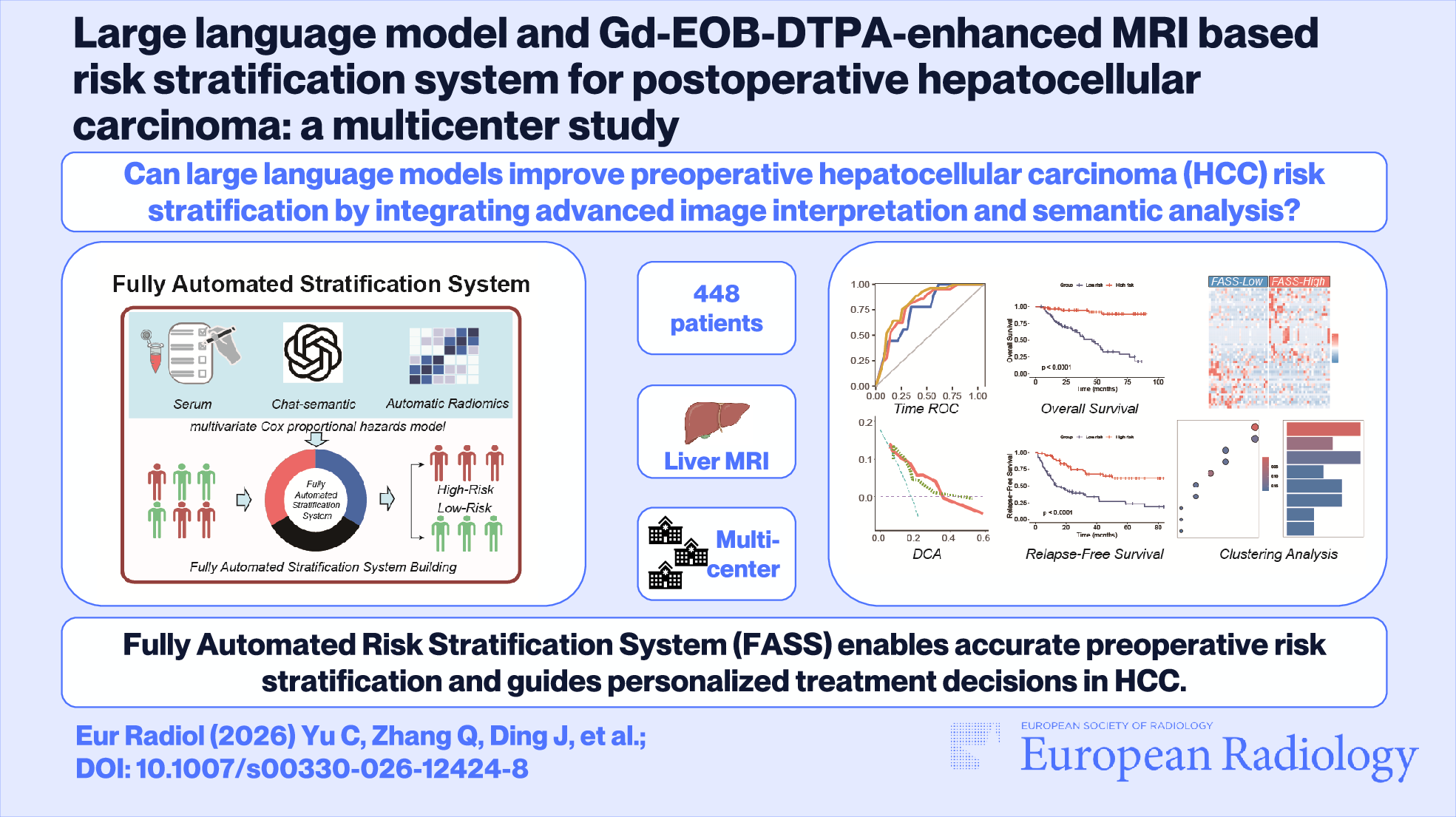
To develop and validate a Fully Automated Stratification System (FASS) integrating serum biomarkers, automated radiomic features, and large language model (LLM)-derived semantic features for prognostic prediction in patients with solitary hepatocellular carcinoma (HCC) after hepatic resection.
Materials and methodsA total of 448 patients with solitary HCC from three centers were retrospectively enrolled. Automated tumor segmentation was performed using a modified MedNeXt-loss framework, and radiomic features were extracted from Gadolinium ethoxybenzyl-diethylenetriamine pentaacetic acid (Gd-EOB-DTPA)–enhanced MRI. Five LLMs were compared for feature-level accuracy and completeness, and the best-performing model was incorporated into the FASS. Prognostic models based on serum, radiomic, and LLM-semantic features were integrated and evaluated using concordance index, time-dependent ROC, and decision curve analyses. Biological relevance was explored through RNA sequencing and pathway enrichment analyses.
ResultsThe MedNeXt-loss framework achieved robust segmentation (Dice = 0.77). ChatGPT-4o demonstrated the best balance between predictive accuracy and completeness and was used for subsequent modeling. In multivariate analysis, AFP, AST, and the ChatGPT-4o–derived irregular margin were independent predictors of overall survival. The integrated FASS achieved high prognostic performance (C-index 0.78 and 0.76 in test and external validation cohorts) and effectively stratified patients into distinct risk groups (log-rank p < 0.05). Transcriptomic analyses revealed inflammatory and cytokine signaling activation in the high-risk group.
ConclusionFASS enables fully automated, interpretable, and biologically informed prognostic assessment in solitary HCC, supporting precision decision-making in hepatobiliary oncology.
Key PointsQuestionCan large language models improve preoperative hepatocellular carcinoma risk stratification by integrating advanced image interpretation and semantic analysis?
FindingsThe system enabled fully automated analysis, identified AFP, AST and LLM-derived irregular margin as independent predictors, and effectively stratified postoperative risk across cohorts.
Clinical relevanceThis fully automated, interpretable platform enables reliable postoperative risk stratification, helping identify high-risk patients early and potentially improving outcomes after resection of solitary hepatocellular carcinoma.
Graphical Abstract
Comments (0)