
Remember me
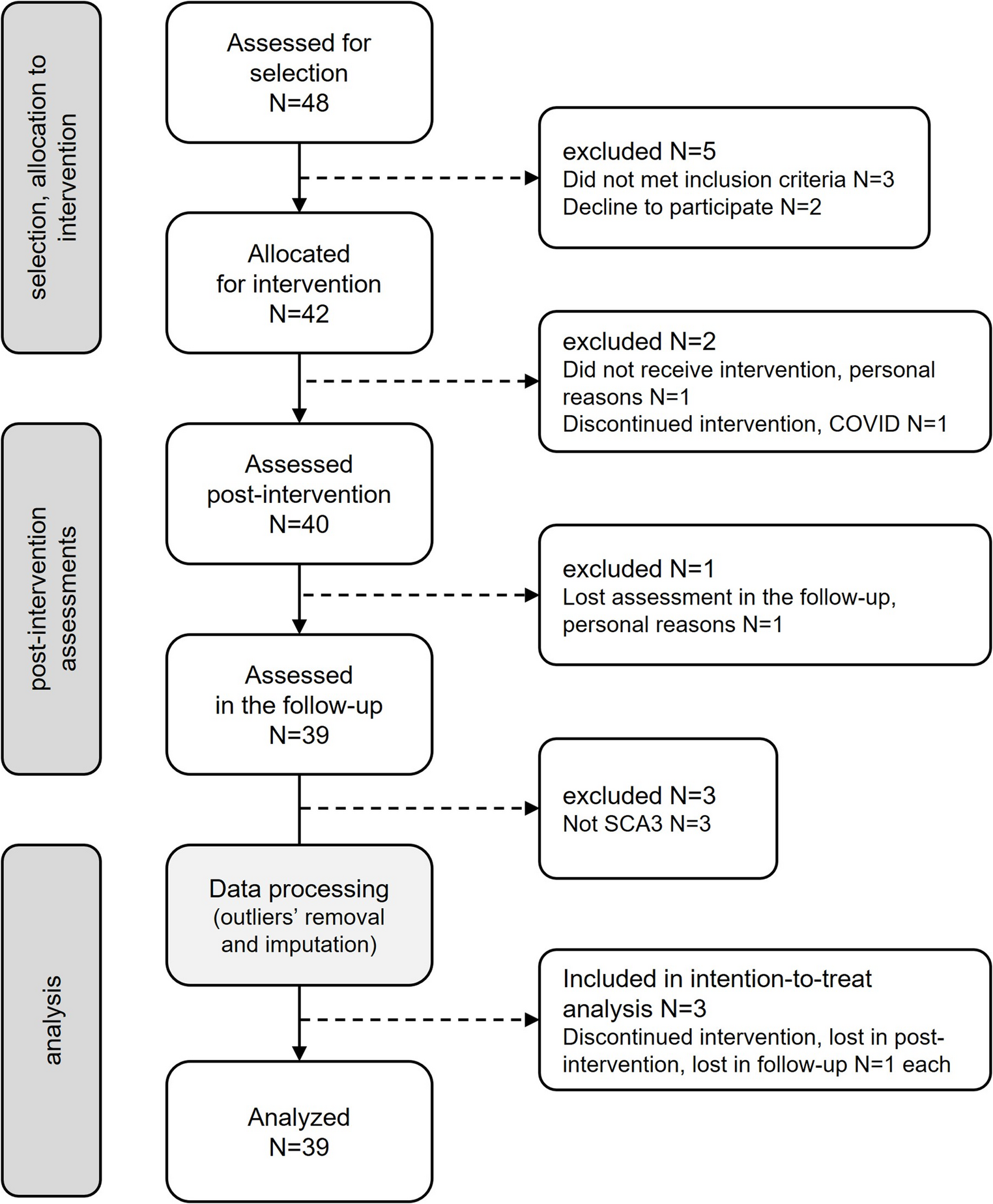
A total of 42 patients were included in the study. However, 39 of them had SCA3 and three had SCA2, SCA5 and SCA7, respectively. To homogenize the data, only the individuals with SCA3 were included in the analyses. The general characteristics of the sample are shown in Table 1. The patients were classified as being in Klockgether stages 1 (N=18) and 2 (N=21). Thirteen patients reported using a walking device, and fourteen patients reported experiencing pain. Additionally, a few patients reported systemic arterial hypertension (N=8), labyrinthitis (N=2), and diabetes (N=1). As a convenience sample was used, a post-hoc analysis was performed based on the findings reported below (G*Power 3.1.9.7, University of Kiel, Germany). Considering the sample size and effect sizes found, the statistical power was always above 82%.
Table 1 Sample characteristicsFeasibility and Safety of InterventionAcross 780 planned sessions (39×20), there were 21 initial absences (2.7%), yielding a mean presence rate of 97.3%. Make-up sessions were offered for missed sessions; however, determining which participants completed make-up sessions was not possible given the session-level logging. Given 21 missed sessions among 39 participants, the median sessions attended per participant must lie between 19 and 20, the proportion achieving ≥90% adherence (≥18/20 sessions) between 97.4% and 100%, and 18–37 participants completed all 20 sessions. Two participants took part in the first evaluation session, however, one of them dropped out due to a COVID-19 infection, and another because of personal issues.
Relative to safety, no episodes of adverse events such as abnormal pressure response to exercise, fatigue, muscle pain of long duration or syncope occurred during the implementation of the intervention. Regarding falls, 8 episodes of imbalance occurred when the individuals were in a semi-kneeling position and 3 when the patient was in the standing position. The falls occurred during the semi-kneeling position. The participants went to this position to sitting on the heel of the leg resting behind. And in the case of falls from their own height, the individuals were supported during the descent to the ground. There were no adverse consequences of these falls. Most of the patients felt itching around the electrodes, which improved with the addition of saline, or which passed spontaneously with the accommodation of the stimulus. No serious or unexpected effects related to the 20 tDCS sessions occurred.
Changes in Outcomes After the InterventionComparison between outcomes’ SIDs and zero-value reference revealed significant differences for SARA, BBS, and TUG (Fig. 2, white circle markers). The results indicate that the intervention promotes significant decreases in SARA scores (Fig. 2A), increases in BBS scores (Fig. 2B), as well as decreases in time spent on TUG (Fig. 2C). Descriptive statistics for these outcomes are presented in Supplementary Table 1.
Fig. 2
Comparison between the standardized individual differences (SID) with zero-reference (dotted gray horizontal lines) for SARA (A), BBS (B) and TUG (C). Comparisons were performed for post minus pre-intervention (white circles) and follow-up (flw) minus pre-intervention (gray triangles) SIDs. Data are shown as mean ± SD. P-values and Cohen’s d from a one-sample t test are shown as inset. a.u., arbitrary units
Results from the multiple linear regression analysis for post-intervention period were shown in (Table 2). A significant model was found only for SID-TUG (R2adj=0.271, P=0.001). Specifically, the baseline SARA scores emerged as predictors of changes in TUG performance after interventions (P=0.027), with a negative association between them, i.e., higher baseline SARA scores correspond to reduced changes in TUG after intervention (Fig. 3A).
Table 2 Linear regression models with post minus pre-intervention SIDsFig. 3
Association between the standardized individual differences (SID, adjusted for baseline) and baseline clinical measures, for (A-B) TUG performance, and (C) BBS scores. Data are shown for post minus-pre-intervention (circle markers) and follow-up (flw) minus pre-intervention (triangle markers). For illustrative purposes, the linear regression line and the corresponding 95% confidence interval were also shown (gray lines)
Follow-up AnalysisThe SIDs from follow-up minus pre-intervention values were also computed and compared with zero-value. The SIDs from all outcomes assessed in the follow-up were significantly different from zero (Fig.2, gray triangle markers), suggesting that the decreases in SARA scores and TUG duration, along with increases in BBS scores, persists in the follow-up assessment.
Additionally, follow-up SIDs were compared to those obtained post-intervention through paired t test, and no significant difference between SIDs from post-intervention and those from follow-up was found (all P>0.171).
The multiple linear regression analysis results (Table 1) were like those observed for post- minus pre-intervention SIDs: considering follow-up SIDs, the baseline SARA scores also emerged as predictor of changes in follow-up TUG performance (P=0.004; Fig. 3B). Moreover, a significant, positive coefficient was found between baseline SARA scores and changes in BBS scores (P=0.025; Fig. 3C), despite the lack of significance in this model.
Overall, along the three evaluations, a progressive reduction can be observed in the SARA scores, which is accompanied by increases in BBS scores and a smaller meantime spent on TUG.
SARA Subscales AnalysisDescriptive statistics for SARA subscales are presented in Supplementary Table 2. The Friedman test revealed significant differences across time points for several SARA subitems (Fig. 4). Gait, posture, finger chase, diadochokinesia, heel-shin, and the total SARA score exhibited highly significant changes (P< 0.001), with moderate effect sizes (Kendall’s W ranging from 0.176 to 0.410). Post hoc analysis with Holm correction showed that gait, heel-shin, and the total score differed significantly between pre-intervention and post-intervention, as well as between pre-intervention and follow-up (Fig. 4A, H, I). Posture and speech exhibited reduced scores after intervention, with no difference between post-intervention and follow-up, suggesting sustained improvement (Fig. 4B, D).
Fig. 4
Boxplots depicting group-level changes in SARA subscale scores across pre-intervention, post-intervention, and follow-up (flw). Horizontal dotted lines indicate statistically significant pairwise comparisons between time points. Cross markers represent outlier values
In contrast, finger chase and diadochokinesia displayed a delayed response, with significant differences only between pre-intervention and follow-up but not between pre- and post-intervention (Fig.4E, G). Sitting remained stable across assessments (P=0.301; Fig. 4C), while nose-finger test showed differences only between pre-intervention and follow-up, with post-intervention not differing from either time point (Fig.4F). These findings highlight differential responsiveness of SARA subitems to intervention over time, with some domains showing persistent improvements and others exhibiting delayed or no significant changes.
DiscussionAs an open-label, single-arm pragmatic feasibility study, our main objective was to assess the feasibility and safetyof a long-duration protocol combining cerebello-spinal tDCS with progressively challenging gait and balance exercises in individuals with SCA3 in real-world conditions. Secondary objectives included evaluating the potential clinical benefits on disease severity, balance, and mobility, as well as verifying the retention of these effects one month after the intervention. The results showed high feasibility (attendance > 97 %, minimal adverse events) and good tolerability under routine conditions. Furthermore, participants showed improvements in ataxia severity, postural control, and functional mobility, which were maintained at one-month follow-up. Given its single-arm, uncontrolled design, the observed clinical improvements should be interpreted as preliminary signals and not as definitive evidence of efficacy.Although recruitment initially included individuals with different subtypes of spinocerebellar ataxia due to convenience sampling in a public rehabilitation service, we restricted the final analysis to participants with genetically confirmed SCA3. This decision reflected the higher prevalence of SCA3 in Brazil and its relatively more homogeneous clinical course compared with other SCA subtypes, thereby reducing heterogeneity in disease severity and progression. Nevertheless, this choice may limit the generalizability of our findings to other forms of SCA.
Feasibility OutcomesTo our knowledge, this is the first study to examine the feasibility of combining 20 sessions of cerebello‑spinal tDCS with progressively challenging gait and balance exercises in individuals with SCA3. The high adherence rate (97.3%) and minimal rescheduling (21 of 780 planned sessions) suggest that the protocol is feasible in a real‑world outpatient rehabilitation setting. Notably, this adherence was achieved without financial incentives or transportation assistance, reinforcing the practical applicability of this protocol. In terms of safety, no serious adverse events occurred; mild skin irritation or itching under the electrodes were transient and easily managed. The few falls observed were minor and resulted in no injuries. These findings indicate that the protocol is safe and well tolerated by people with SCA3. Nonetheless, larger studies with control conditions are needed to confirm these observations and fully establish integration into clinical neurorehabilitation programs.
Changes in Clinical ScoresWe analyzed both the SARA total score and its sub‑items. SARA total scores showed a significant reduction after the intervention, indicating a decrease in ataxia severity. A study [9] investigated the effects of 10 sessions of ctDCS (2 mA, 20 min) in a homogeneous sample of SCA3 individuals and found no significant changes in SARA scores. On the other hand, another study [8] applied cerebellar-tDCS (2 mA, 20 min) in patients with various cerebellar ataxia syndromes and reported significant improvements in SARA scores, lasting up to three months. The efficacy of 5 consecutive sessions of cerebello-spinal tDCS (2 mA, 20 min, cathode below the 11th thoracic vertebra) [14] in the same patients from their previous study [8] and found reductions in SARA scores. To our knowledge, few studies have examined homogeneous SCA3 cohorts; our findings therefore provide preliminary evidence that longer protocols combined with exercise may produce measurable improvements. These findings suggest that, given the progressive nature of SCA3, protocols longer than 10 sessions, especially when combined with exercise, may be necessary to observe measurable improvements.
The SARA sub‑items showed differential responses: gait and heel‑shin improved immediately post‑intervention and were maintained at follow‑up; finger chase and diadochokinesia improved only at follow‑up, suggesting a slower recovery of fine coordination; speech improved early and was maintained; sitting and the nose–finger test showed little change. Our intervention protocol was primarily designed to target balance and gait rather than upper-limb coordination, which may partly explain why SARA subscales related to finger chase and diadochokinesia showed delayed improvement. Neurophysiologically, distal upper-limb cerebellar representations may require more task-specific stimulation or a longer duration to induce neuroplastic changes, leading to slower or less pronounced gains in these domains [32].
Improvements in BBS Scores and TUG PerformancePostural instability is considered the initial and the most frequently reported symptom of SCA [28, 33]. In the present study, BBS scores increased significantly after the intervention, indicating potential benefits in functional balance. The studies that used BBS to assess the impact of tDCS on postural control showed varying results depending on the number of sessions and the protocols applied [10, 14, 15]. A comparison of these studies suggests that short protocols, such as those [10, 14], produce immediate but transient benefits; in contrast, studies with 10 or more sessions [15] and the present study show more lasting improvements. However, differences between protocols (electrode placement, current intensity, exercises applied) make causal attributions difficult.
The time required to complete the Timed Up and Go (TUG) test was significantly reduced, reflecting potential improvements in functional mobility. In comparison, significant changes in TUG performance after 10 sessions of cerebellar tDCS alone were not found (9), suggesting the relevance of combining stimulation with progressive exercises.
Follow-up OutcomesThe follow-up analysis showed that the benefits of the intervention, including reductions in SARA scores, decreased TUG time, and increased BBS scores, were maintained one month after the protocol. No significant differences were found between post-intervention and follow-up outcomes, suggesting the gains were sustained. A study [15] also reported benefit retention after three months of interventions with 10 sessions of cerebello-spinal tDCS, though in a heterogeneous sample. Despite the small sample and absence of a control group, the present study is the first to demonstrate benefit retention in a homogeneous sample of patients with SCA3.
Baseline Features Influence on OutcomesRegression analysis showed that baseline SARA scores, but not INAS scores or symptom‑onset time, emerged as significant predictors of changes in TUG both post‑intervention and at follow‑up (Tables 2 and 3). Higher baseline ataxia severity was associated with smaller improvements in TUG, suggesting that more severe ataxia may limit gains in functional mobility. Conversely, baseline SARA scores were positively associated with improvements in BBS at follow‑up, indicating that participants with more severe ataxia may exhibit delayed balance gains. These findings corroborate observations [9] that baseline severity influences tDCS outcomes; individuals with severe ataxia may improve balance yet show limited capacity to modify complex behaviors such as walking and turning. Additionally, because the intervention emphasized static balance exercises, this could have biased improvements toward balance measures.
Table 3 Linear regression models with follow-up minus pre-intervention SIDsThe lack of association between INAS scores or symptom onset and outcomes probably reflect the small sample size, which limited statistical power. Larger studies are needed to identify predictors of tDCS efficacy in ataxia. Because no prior studies have explored these predictors with cerebello‑spinal tDCS, direct comparisons are not available.
Study LimitationsBecause the study lacked a sham or control arm, we cannot exclude the possibility that improvements in SARA, BBS, and TUG scores were partly due to placebo effects or to patient and therapist expectations. Although we attempted to minimize bias by using standardized assessments conducted by trained assessors, the open-label nature of the intervention may still have inflated perceived or actual performance gains. Future randomized, sham-controlled trials are needed to establish the true efficacy of the intervention. The pragmatic design deliberately mirrored real‑world rehabilitation conditions to maximize applicability, but this approach affords less experimental control than explanatory trials conducted in highly standardized environments. Another limitation is the wide age range of participants. Although the severity of SCA3 does not necessarily correlate with age (some younger individuals may be more severely affected than older ones) age‑related differences in disability and responsiveness could have influenced the outcomes. This heterogeneity may limit the generalizability of the findings yet provides an opportunity to explore how different age groups respond to the protocol. Participants were recruited through a convenience sample, which further restricts generalizability even though it reflects typical clinical practice. Additionally, because outcome assessors were aware of both the active intervention and the assessment timepoints (baseline, post-intervention, and follow-up), we cannot rule out the possibility of measurement bias influencing the observed changes in SARA, BBS, and TUG scores. Finally, the short follow-up period (one month), precludes conclusions about the long-term sustainability of the observed benefits. Future studies with extended follow-up periods of at least 3–6 months are needed to determine whether the improvements in SARA, BBS, and TUG scores persist over time and to assess potential delayed effects of the intervention.
Comments (0)