Study selection
Initial database searches yielded 748 records after duplicates were removed. In the first screening phase, 684 titles/abstracts were excluded for not meeting eligibility (e.g., pediatric populations, unrelated to IE complications). Forty-two full-text articles were then reviewed in detail. Of these, 35 were excluded due to insufficient outcome reporting, lack of shock definition, or presenting only single-patient case findings. The remaining seven studies met all inclusion criteria and proceeded to quality assessment. The PRISMA flow is illustrated in the PRISMA flow diagram (Supplementary Fig. 1).
Quality assessment
All seven included studies attained at least a medium rating using our adapted NOS. The detailed results of the Newcastle–Ottawa Scale assessment for each study are summarized in Supplementary Table 3. Five were high-quality, showing clear IE and shock definitions plus robust statistical controls for potential confounders. Two retrospective studies were rated as medium-quality, primarily due to limited adjustment for key variables or insufficient follow-up details. Nonetheless, their data on shock prevalence and clinical outcomes remained sufficiently credible for inclusion in the synthesis, as summarized in Supplementary Table 4. No studies were excluded for low methodological quality.
Characteristics of included studies
Seven observational studies were analyzed, with individual sample sizes varying from 183 to 255,838 patients. The range of shock patients per study varied from 28 to 29,671 (Table 1; see footnote for denominator and overlap details and Supplementary Table 5 for additional study-level data). Five studies adopted a prospective design, while two were retrospective cohorts. Patient populations varied widely, ranging from focused surgical cohorts in tertiary hospitals to large national registry datasets. The modified Duke criteria were consistently applied across studies to establish the diagnosis of IE. Shock definitions also varied slightly, but most studies adhered to internationally accepted criteria for septic or cardiogenic shock, such as the Sepsis-3 consensus or objective hemodynamic parameters. The study-level characteristics, including contrasts entered into pooled analyses, patient counts, shock definitions, and overlap assessment, are summarized in Table 1.
Table 1 Study-level characteristics, contrasts included in pooled analyses, patient counts, shock definitions, and overlap assessmentThe proportion of patients presenting with shock at diagnosis ranged substantially, reflecting differences in study settings and definitions [4, 7, 8, 10, 15, 29, 30]. While septic shock was more frequently reported, cardiogenic shock was also a major complication, particularly among patients with acute valvular dysfunction or large vegetations [7, 8, 10, 15]. Across studies, Staphylococcus aureus emerged as the predominant pathogen associated with shock and worse outcomes [4, 7, 10, 29, 30]. Additionally, native valve involvement predominated, although prosthetic valve endocarditis accounted for 5–20% of cases in several cohorts [4, 8, 10, 15].
A more detailed extraction of study design elements, definitions used, patient populations, outcomes measured, and key findings is provided in Supplementary Table 5. This comprehensive synthesis highlights the incidence of septic and cardiogenic shock among IE patients, identifies major predictors of mortality and complications, and underscores the impact of cardiac surgery on improving survival outcomes across diverse clinical settings [4, 7, 8, 10, 15, 29, 30].
Across the seven [4, 7, 8, 10, 15, 29, 30] included studies, the total sample encompassed more than 260,000 patients with IE; of these, a total of 30,639 participants were included in the pooled mortality analyses following the exclusion of the single-arm Saad et al. (2025) [30] cohort and the separation of overlapping registry subgroups to prevent double counting.
Most studies reported that native valve involvement predominated [8, 10], while prosthetic valve endocarditis accounted for 5–20% of cases in different cohorts [4, 15]. In terms of microbiological etiology, Staphylococcus aureus emerged as the most frequently cited pathogen [7, 29, 30]. Fungal infections were less common but carried high mortality rates, as indicated by Mir et al. (2022) [4] who found that only 1–2% of complicated IE cases were fungal but predicted severe outcomes (Table 2).
Table 2 Patient characteristics, outcomes, and operative metricsShock incidence and complications
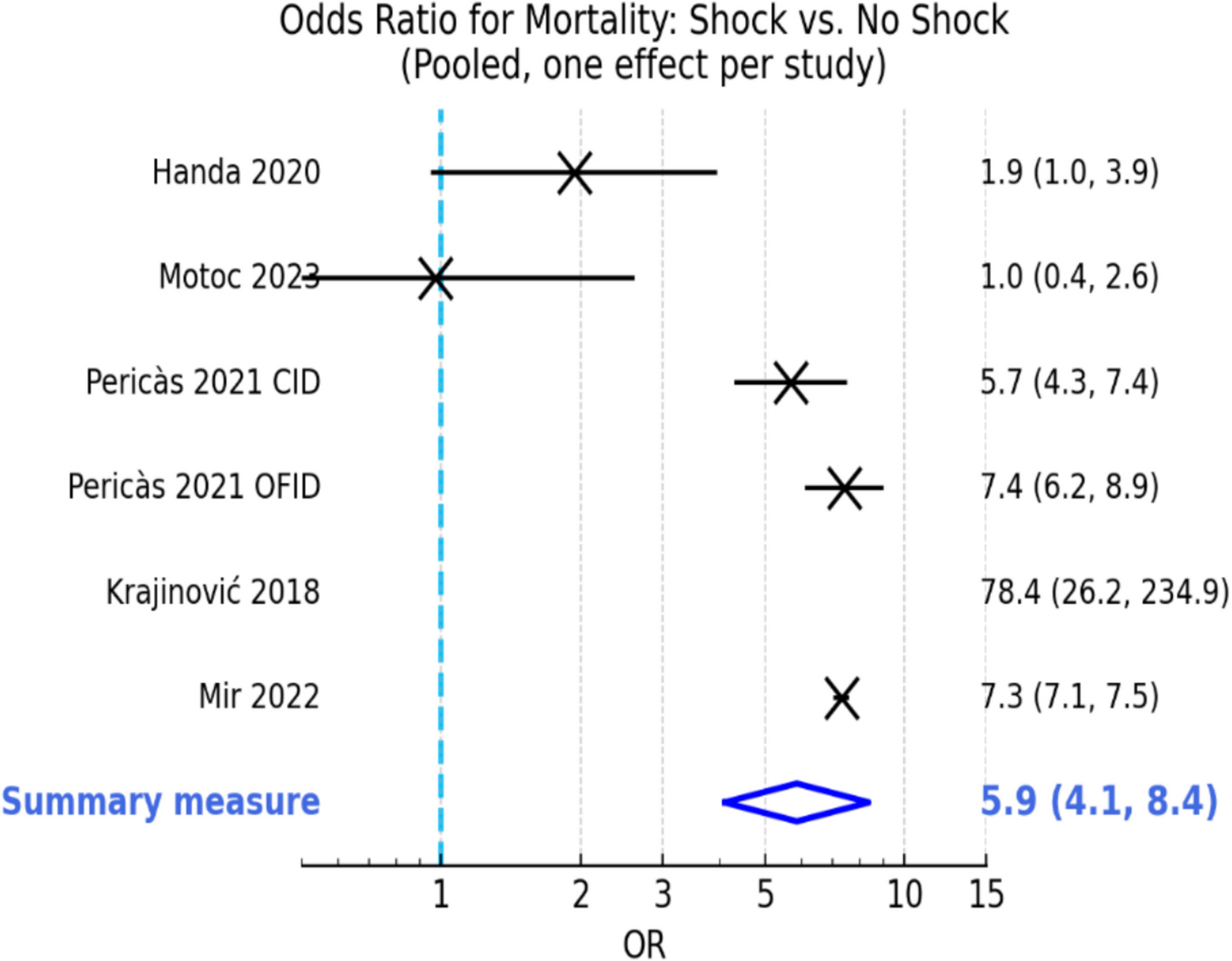
A meta-analysis encompassing six contemporary cohorts [4, 7, 8, 10, 15, 29] showed a pooled shock prevalence of 10.8% (95% CI, 8.0–13.9%) in infective endocarditis, with individual study rates of 5.0–15.3%. Only mixed cohorts were included; single-arm shock studies [30] were excluded to avoid biased incidence estimates. Across six comparative cohorts [4, 7, 8, 10, 15, 29] (n = 30,639), in-hospital mortality was markedly higher with shock (pooled OR, 5.83; 95% CI, 1.35–25.23; 95% PI, 0.26–129.69; I2 = 90.3%; τ2 = 0.924 on the log OR scale). Influence diagnostics (leave-one-out, DFBETAS, and Cook’s distance) identified Krajinović et al. (2018) [7] as an outlier; an influence-robust model excluding this study yielded a pooled OR of 4.30 (95% CI, 1.55–11.95), consistent in direction and significance. The pooled risk difference was + 0.320 (95% CI, + 0.047 to + 0.593), corresponding to ~ 32 additional deaths per 100 patients with shock.
Shock was consistently associated with acute kidney injury (often requiring renal replacement therapy), neurological complications (stroke or encephalopathy), respiratory failure requiring mechanical ventilation, and increased arrhythmias, heart block, and multiorgan dysfunction [4, 7, 8, 10, 15, 29, 30]. Patients with shock more often required advanced ICU support and had a higher likelihood of urgent or emergent cardiac surgery, underscoring the need for prompt identification and assertive management in this high-risk subgroup.
Microbiological spectrum
A descriptive synthesis of comparative multicenter cohorts [4, 7, 8, 10, 29] involving more than 35,000 patients with IE indicated that Staphylococcus species were the predominant pathogens, responsible for approximately 50% of cases (95% CI: 47.5%–52.7%). Streptococcus species constituted 21.3%, whereas Enterococcus species accounted for 9.3%. Culture-negative IE represented approximately 12%, reflecting ongoing diagnostic challenges and the influence of prior antimicrobial therapy. Fungi and HACEK organisms, categorized as less common or mixed pathogens, accounted for 7.5% of cases. These values are weighted descriptive proportions primarily derived from large registry datasets, as not all included studies reported complete microbiological breakdowns; therefore, they should be interpreted as illustrative of distribution trends rather than precise pooled estimates.
The single-arm septic shock cohort reported by Saad et al. (2025) [30] (Cureus, https://doi.org/10.7759/cureus.78927) as indexed in PubMed, correcting the provisional “LNU” placeholder used during drafting, was omitted from the descriptive synthesis to avoid bias from combining case-only and comparative data. Its microbiological profile (Staphylococcus aureus 50%, Streptococcus spp. 30%, Enterococcus spp. 9%) closely mirrored the descriptive distribution, with slight differences likely reflecting referral patterns and selection criteria.
Mortality
In-hospital mortality ranged widely: from about 6.5% in large registry data [4] to upwards of 62–80% in subsets with septic or cardiogenic shock [7, 8]. The presence of shock, whether septic or cardiogenic, consistently emerged as a prime prognostic factor for adverse outcomes [29, 30]. As an example, in Krajinovic et al. (2018) [7], septic shock conferred an adjusted odds ratio (OR) of 35.9 for mortality compared to no sepsis, underlining the extreme lethality. Similarly, in cardiogenic shock cohorts, mortality rates hovered between 22 and 37% depending on whether surgery was performed [10, 15]. Supporting these findings, a proportion of 12% of patients with cardiogenic shock from the RO-AHFS registry had documented infective endocarditis, and in-hospital mortality in this group was 70%, as compared to 58% in cardiogenic shock patients without IE [31].
Long-term survival was also impacted. Pericàs et al. (2021b) [10] reported significantly higher 1-year mortality in cardiogenic shock patients compared to those with no heart failure or mild heart failure. Meanwhile, Handa et al. (2020) [15] found that 5-year survival post-valve surgery for refractory cardiogenic shock, while lower than non-shock groups, was not as catastrophic as might be expected, reaching nearly 69%.
Impact of surgery
All but one study (Saad et al., 2025 [30]) evaluated surgical intervention (valve repair or replacement), with most reporting a survival benefit, particularly in high-risk or shock-complicated cases. In prospective Spanish cohorts, Pericàs et al. (2021a) [10] and Pericàs et al. (2021b) [8] found improved outcomes with early surgery (adjusted analyses), although emergent operations were less frequently performed in patients with shock. In a prospective Croatian study, Krajinović et al. (2018) [7] reported that surgery was associated with a substantially higher probability of survival (adjusted risk ratio [RR] for survival = 5.16; p < 0.001), corresponding to a marked reduction in in-hospital mortality; most shock patients underwent urgent surgery (within 24–48 h), with elective procedures reserved for partial stabilization.
Across studies, adjusted estimates generally showed greater benefit than crude comparisons, reflecting confounding by indication [7, 8, 10]. Interpretation is limited by immortal-time bias, as patients must survive long enough to undergo surgery, and by selection bias, as the most unstable patients are often excluded from operative management. In contrast, Saad et al. (2025) [30] observed only a non-significant trend toward lower mortality among septic shock patients undergoing valve surgery, likely due to limited sample size.
Table 3 presents a summary of mortality rates linked to IE, categorized by shock type and surgical intervention status. Patients undergoing surgery exhibited consistently lower mortality rates compared to those not receiving surgical intervention, especially evident in the groups experiencing septic and cardiogenic shock. The mortality rates observed ranged from 22 to 37% in patients who underwent surgical treatment, while non-operated cases exhibited rates as high as 62 to 80%. The findings underscore the importance of prompt surgical intervention in decreasing mortality associated with infective endocarditis complicated by shock (overall comparison, p < 0.001).
Table 3 Mortality in infective endocarditis by shock type and surgery statusOther predictors
Across the included studies, several predictors of poor outcomes were consistently identified. Advanced age, renal dysfunction, and Staphylococcus aureus infection were strongly associated with increased mortality rates in patients with infective endocarditis complicated by shock [4, 7, 30]. Pre-existing heart failure, higher comorbidity burden, and nosocomial (hospital-acquired) infections also emerged as significant contributors to adverse outcomes [4]. Additionally, several studies highlighted that larger vegetations (≥ 10 mm) were independently associated with a higher risk of systemic embolization and mortality [15]. These findings underline the multifactorial nature of risk in IE complicated by shock, where both microbiological and host-related factors substantially impact prognosis.
Meta-analysisShock and in-hospital mortality in patients with infective endocarditis
A meta-analysis of six studies [4,

Comments (0)