Nearly all WHO/Europe countries have adopted age-based vaccination recommendations for older adults. While WHO/Europe reports a high proportion of countries with such policies in 2023 [17], disparities remain in recommendations, funding, delivery, and coverage. For example, heterogeneity exists across the WHO European Region by pathogens covered (Table 2). On the basis of WHO/United Nations Children’s Fund (UNICEF) electronic Joint Reporting Form on Immunization (eJRF) data (last update: end of 2023), 94% and 92% of countries reported policies for COVID-19 and influenza, respectively, but only 30% for pneumococcal disease, 13% for herpes zoster, and 9% for RSV [17]. These figures were presented in a European context, while the remainder of this section focused on EU/EEA recommendations, coverage, and financing.
Table 2 Status of immunization policies for older adults in the WHO European Region (including non-EU/EEA countries) by pathogen (contextual overview; last update end of 2023; data source: WHO/UNICEF electronic Joint Reporting Form on Immunization [eJRF]), adapted from [17]To examine how European Union/European Economic Area (EU/EEA) countries are addressing vaccination for older adults, differences in national recommendations, coverage levels, and financing were presented and discussed. In addition, scientific advances and practical considerations related to vaccine implementation among older adults were reviewed. Collectively, these insights reflect the varying stages of progress toward a coherent, life-course immunization strategy for ageing populations in Europe.
2.1 Seasonal Influenza
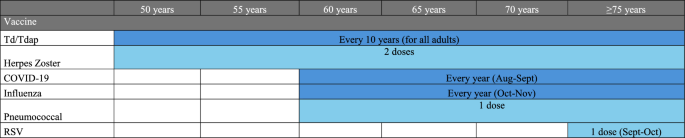
All EU/EEA countries reported seasonal influenza recommendations for older adults for the 2023–2024 season (Table 3). However, the lower age limit varies across countries, ranging from 50 to 65 years, as reported in the 2023–2024 European Centre for Disease Prevention and Control (ECDC) survey, with some countries applying broader adult recommendations [18]. A decline in the vaccine coverage rates for older adults was observed in 2023–2024 compared with the previous two seasons, with decreases ranging from 3% to 10% among the 17 countries reporting data across all three seasons [18]. The median EU/EEA vaccination coverage rate for older adults in 2023–2024 was 45.7%, compared with 59% in the 2020–2021 season. Although these figures should be interpreted with caution, they suggest a possible decline in seasonal influenza vaccination uptake among older adults, following years of plateaued uptake prior to the COVID-19 pandemic. This trend warrants rigorous monitoring and validation, and there is a pressing need for further research to evaluate the effectiveness of various interventions aimed at increasing influenza vaccination uptake among older adults [19]. In almost all EU/EEA countries, the influenza vaccine and administration of the vaccine are free of charge for older adults [18].
Table 3 Age-based vaccination recommendations in older adults, EU/EEA countriesNumerous factors influence seasonal influenza vaccine effectiveness, including individual factors such as immunosenescence, pathogen-specific factors such as antigenic drift, and vaccine-specific factors such as mismatches between vaccine and circulating strains. To address these challenges, a variety of approaches have emerged, including new vaccine platforms, alternate administration routes, and even the longer-term goal of universal or “broadly protective” influenza vaccines. The most utilized approach today is the use of enhanced vaccines, including adjuvanted trivalent influenza vaccine (aTIV; 15 µg hemagglutinin [HA] per strain, as for standard dose), recombinant influenza vaccine (RIV; 45 µg HA per strain), and high-dose (HD; 60 µg HA per strain) formulations. Enhanced influenza vaccines have demonstrated notable advantages, including a stronger antibody response [20], a broader antibody response against heterologous strains (especially A/H3N2) [21], and a longer duration of protection against influenza throughout the season [22]. Among older adults specifically, clinical trials and observational studies have demonstrated that HD influenza vaccines induce significantly higher antibody responses and provide better protection against both laboratory-confirmed influenza illness and laboratory-confirmed influenza hospitalizations compared with standard-dose formulations [23,24,25,26]. Similarly, adjuvanted (ADJ) influenza vaccines have been shown to be more effective than non-adjuvanted in preventing laboratory-confirmed severe acute respiratory infection among older adults [27]. However, a recent systematic review and meta-analysis demonstrated that while enhanced vaccines, including HD, ADJ, and RIV, offer higher protection against influenza hospitalizations in older adults compared with the standard-dose formulations, no consistent differences in effectiveness were observed between the enhanced vaccine types. This suggests that the specific type of enhanced vaccine administered may be less important than ensuring that an enhanced formulation of any kind is used [28], while recognizing that comparative effectiveness can differ between enhanced vaccine types and may vary by season and setting. During the 2023–2024 season, influenza vaccination as a whole prevented 9.8 million flu-related illnesses, 4.8 million medical visits, 120,000 hospitalizations and 7900 deaths in the USA [29]. Although, specific to the USA, this figure highlights that, regardless of formulation, enhanced or not, any influenza vaccine is better than none, especially for older adults who remain more susceptible to seasonal influenza-associated morbidity and mortality. The WHO Strategic Advisory Group of Experts (SAGE) recommends the use of all currently available inactivated and recombinant seasonal influenza vaccines for older adults [30].
2.2 COVID-19
As of March 2025, all EU/EEA countries recommend an annual booster of COVID-19 vaccination for older adults. The exact lower age limit varies across countries, ranging from 60 to 65 years [31]. However, these lower age limits remain subject to change in response to COVID-19; for example, in Finland the minimum age limit will be set at 75 years for the 2025–2026 season. Median COVID-19 vaccination coverage in the EU/EEA during the 2024–2025 season was 8.7% (range < 0.1–52.8%) and 8.5% (range 0.9–83.5%) for adults aged ≥ 60 years and ≥ 80 years, respectively, with high variation in coverage observed between countries [31]. This is despite the fact that in almost all EU/EEA countries, the COVID-19 vaccine and its administration are free of charge. Since most EU countries participated in the EU Commission-led negotiations on Joint Procurement of COVID-19 vaccines with multiple manufacturers, they continue to have access to country-specific quotas of vaccines ordered, secured, and purchased for national programs via this arrangement until early 2026. Vaccine uptake of COVID-19 booster doses remains a challenge owing to risk perception, vaccination fatigue, safety concerns, and communication barriers [32, 33]. Promoting continued vaccination through education and simplifying logistics (e.g., co-administration with influenza vaccines) is recommended.
The messenger RNA (mRNA) vaccine platform, central to most COVID-19 booster campaigns in EU/EEA countries, has proven highly effective in reducing severe acute respiratory syndrome coronavirus 2 (SARS-CoV-2) infection, hospitalization, and mortality in older adults [34, 35].
2.3 Pneumococcal Disease
Current WHO guidance recommends the introduction of pneumococcal conjugate vaccines (PCV) into national childhood immunization programs with measures to sustain high coverage in children prioritized over initiating pneumococcal vaccination programs for older adults. In countries with well-established childhood PCV programs, adult vaccination should be considered on the basis of local disease burden and cost-effectiveness [36]. In EU/EEA, 30% of countries have no age-based recommendations for pneumococcal vaccination in older adults (Table 3). Among those that do, most (40%) recommend it for adults aged ≥ 65 years, with funding policies varying widely [37]. In many EU/EEA countries, older adults pay out of pocket for pneumococcal vaccination, with a single-dose PCV regimen costing > 60 € (different between countries) [38]. These funding gaps indicate a broader disconnect between public health objectives and individual access, and present an underlying equity issue, potentially hindering vaccine uptake among older adults. Existing European vaccine coverage data reflect this, demonstrating disparities in pneumococcal vaccination across the life course. For example, average European pneumococcal vaccine coverage for children is 88%, while the average coverage in adults is just 18% among high-risk groups and 24% in older adults [37].
Despite the success of PCV vaccines in reducing invasive pneumococcal disease (IPD) and non-bacteremic pneumococcal pneumonia, a substantial proportion of adult cases continue to be caused by serotypes not included in “older” vaccines, driving the development of newer higher-valency vaccines (e.g., PCV20, PCV21) [39]. These newer vaccines cover additional serotypes responsible for significant disease burden, including those associated with antibiotic resistance, outbreaks, and high case fatality rates (notably, serotypes 8, 12F, and 22F).
Both PCV20 and PCV21 have demonstrated favorable safety profiles and durability in adults. Clinical trials have shown that PCV20 elicits robust immune responses to all 20 vaccine serotypes across age groups, with immunogenicity comparable to that of PCV13 and PPSV23 [40]. Similarly, PCV21 has demonstrated strong IgG and functional immune responses across all 21 vaccine serotypes in adults aged ≥ 50 years [41]. PCV21 has also demonstrated noninferiority to PCV20 for the 10 shared serotypes and superiority for the 11 unique serotypes (except for serotype 15C) [42].
For countries to implement effective pneumococcal vaccination strategies, it is crucial to understand the local epidemiology of circulating serotypes in older adults. This information can be used to inform future vaccine strategies, such as expanding serotype coverage in PCVs for pediatric and/or adult populations. As vaccine valency increases, ongoing monitoring and evaluation in older adult populations will be essential to identify effectiveness to specific serotypes as more continue to be added.
2.4 Herpes Zoster
Despite the considerable impact of herpes zoster (HZ) on functional decline and long-term morbidity in older adults, 43% of EU/EEA countries lack national recommendation for HZ vaccination in older adults (Table 3) [43]. The recent WHO position paper released in July 2025 on the use of the recombinant HZ vaccine emphasizes that vaccination should be considered in the context of a life-course approach to immunization. It also highlights the importance of establishing vaccination programs for older adults as a means to contribute to healthy ageing [44]. However, many EU/EEA countries have not included the vaccine in their vaccination program for older adults, and hence, in most EU/EEA countries, HZ vaccines are only available at the request of the people/healthcare providers and, in most cases, at their own expense [43]. The cost of the recombinant HZ vaccine may vary depending on the region; however, it is administered as a two-dose series, with the price per dose typically exceeding 100 € [45].
An identified research priority regarding HZ vaccination for older adults is understanding the duration of protection in relation to age at administration and potential need for booster doses following the primary series [44]. After the withdrawal of the market authorization for the live attenuated vaccine Zostavax (Merck), the adjuvanted recombinant zoster vaccine (RZV), Shingrix®, is the recommended HZ vaccine in Europe [43], requiring a two-dose schedule administered 2–6 months apart. Recent long-term follow-up data confirm that Shingrix® maintains high efficacy against HZ for over 10 years. At year 11, vaccine efficacy remained at 82.0% (95% confidence interval [CI] 63.0–92.2) and 72.0% (95% CI 33.4–89.8) in adults aged ≥ 50 years and ≥ 70 years, respectively [46]. Cellular immunity also remains stable, with minimal decline observed up to 11 years post-vaccination; this evidence suggests that protection of older adults is of long duration.
2.5 Respiratory Syncytial Virus (RSV)
As a relatively new vaccination, recommendations for RSV vaccination in older adults are still emerging. There are currently no WHO recommendations on use of the RSV vaccine in older adults. Nevertheless, seven EU/EEA countries have age-based recommendations for RSV vaccination in older adults (last update December 2024) [47]. In most of these countries, the recommendation applies to individuals aged ≥ 75 years, although Austria recommends RSV vaccination starting at age 60 years [48]. However, as with pneumococcal and HZ vaccines, many older adults are currently required to pay for RSV vaccination. The current price of the RSV vaccines is around 200 € [49]. This landscape is expected to change as more data become available on the duration of vaccine-induced immunity and the effectiveness of current RSV vaccines in preventing severe disease among older adults in Europe.
As of May 2025, three single-dose RSV vaccines (Arexvy® Abrysvo®, and mRESVIA®) have received marketing authorization in Europe for use in older adults. Arexvy® was authorized first for adults aged ≥ 60 years, in August 2024, this authorization was then extended to include adults aged 50–59 years at increased risk [50]. Abrysvo® was authorized for use in adults in adults aged ≥ 60 years and during pregnancy to provide passive protection for infants [51]. In April 2025, the European Commission extended the indication to include adults aged 18–59 years, following a positive opinion from the Committee for Medicinal Products for Human Use (CHMP) [52]. mRESVIA® received EU marketing authorization in August 2024 for adults aged ≥ 60 years, and in September 2025, the European Commission extended the indication to include adults aged 18–59 years at increased risk [53].
These vaccines have demonstrated efficacy against RSV-associated outcomes, including lower respiratory tract infection (LRTI) [54,55,56]. Both Arexvy® and Abrysvo® have also demonstrated real-world effectiveness in preventing RSV hospitalizations [57, 58]. Evidence on the duration of vaccine-induced immunity against RSV-related outcomes remains limited. Ongoing clinical trials are evaluating the long-term immune persistence and potential need for revaccination across all currently licensed RSV vaccines, including Arexvy®, mRESVIA®, and Abrysvo®, each showing sustained immune responses beyond the first year following vaccination [59,60,61].
Revaccination with RSV vaccines is expected to be necessary; however, the optimal timing for booster doses remains unknown. It also remains unclear whether revaccination schedules will be standardized across all currently licensed RSV vaccines, a scenario that would simplify administration for healthcare providers. Although the optimal revaccination schedule remains unknown (probably not yearly), aligning RSV vaccine administration with other routinely recommended seasonal vaccines for older adults could enhance uptake. RSV revaccination should be recommended, and to further promote vaccine coverage among older adults, several strategies were identified as potentially beneficial. These include coadministration with other vaccines recommended in older people, establishing a centralized vaccine registry to track doses delivered, and developing decision aids to help healthcare providers assess vaccination needs, particularly for patients under 75 years of age, where vaccination is more often based on risk factors rather than universal age-based recommendations.
2.6 Tetanus, Diphtheria, and Acellular Pertussis (Tdap)
While most EU/EEA countries recommend booster doses of Td or Tdap throughout adulthood, these recommendations are rarely emphasized for older adult populations. As with pneumococcal vaccination, the WHO’s position paper emphasizes that high coverage of routine infant immunization should be established before extending vaccination to adolescents and adults [62]. However, given the increased risk of pertussis-related complications in older adults [62, 63], the inclusion of Tdap boosters in a comprehensive adult immunization schedule warrants serious consideration. In adults, pertussis immunity wanes over time, and infection is frequently under-recognized, yet adults can contribute to transmission, including to infants, who are at highest risk of severe outcomes. Integrating a pertussis-containing booster within routine decennial tetanus/diphtheria boosting provides a pragmatic life-course opportunity to reduce pertussis circulation while maintaining protection against tetanus and diphtheria. Therefore, the discussion on Tdap vaccination is focused on pertussis, given the significant burden of pertussis among older adults in Europe, particularly among those with comorbidities or weakened immune systems [64]. Pertussis incidence also increased substantially across Europe in 2024, the exact reason for which remains unknown. Currently, booster vaccination is recommended for adults aged ≥ 18 years across EU/EEA countries; however, booster recommendations for older adults vary by national guidelines, ranging from every 5 years (e.g., Austria) to every 10 years (most EU countries). Given the increased risk of hospitalization from pertussis among older adults, booster vaccination should be considered, especially for individuals with underlying cardiorespiratory or immunological conditions. Even older adults without comorbidities may act as sources of transmission to infants and young children within families, especially where maternal vaccination coverage is suboptimal, highlighting the importance of including them in booster vaccination programs.

Comments (0)