
Remember me

Obesity remains a major public health challenge worldwide, and to date no country has successfully curbed the rising prevalence of adult obesity [1]. The situation also applies to pregnant women with 16% globally entering gestation with obesity [2]. This is a matter of serious concern considering that pre-pregnancy obesity is associated with increased risks of many adverse maternal and neonatal outcomes including gestational diabetes mellitus (GDM), pre-eclampsia, large-for-gestational age (LGA) infants, and breastfeeding initiation challenges [3]. Long-term consequences encompass higher maternal cardiometabolic risk and increased risk of childhood obesity [4, 5].
Management of obesity during pregnancy (i.e., gestational obesity) in maternity healthcare typically includes interventions to improve diet and physical activity and to prevent excessive gestational weight gain (GWG) through individual or group counselling. Lifestyle interventions have been shown to reduce excessive GWG and improve diet quality during pregnancy [6], also in women with obesity [7]. However, effect sizes have been relatively small [6, 7], and most programs follow a “one-size-fits-all” approach. Furthermore, these interventions are resource-intensive and challenging to scale up, motivating further research on more effective interventions that can be integrated into routine maternity healthcare.
Addressing these challenges requires innovative strategies moving beyond standardized interventions and accounting for individual differences in physiology, lifestyle, and context. One emerging concept that aligns with this need is precision nutrition, which offers a framework for risk stratification and tailoring dietary interventions based on multidimensional data. While the term has been used inconsistently, often referring broadly to personalized dietary advice, Da Silva et al. [8] propose a conceptual framework integrating multidimensional data such as phenotype, behavioral, clinical, tissue-specific and molecular information to enable biologically meaningful stratification or guide individualized dietary recommendations. It builds on the understanding that variations in clinical characteristics, psychosocial factors, diet, microbiota, and genetics influence nutritional responses. Emerging evidence suggests the potential of precision nutrition also in pregnancy, e.g., based on observed heterogeneity in the association between dietary patterns and adverse outcomes [9]. This review summarizes current evidence on precision nutrition in gestational obesity management and outlines priorities for future research and implementation.
Pathophysiology: Links between Gestational Obesity and Adverse OutcomesUnderstanding the biological mechanisms linking obesity to adverse maternal and fetal outcomes is critical for identifying intervention targets and provides a foundation for precision nutrition strategies to modulate these pathways. These mechanisms are complex and multifactorial, involving three interconnected compartments, mother, fetus and the placenta, and vary across the preconception period and throughout pregnancy. Multiple organ systems and biological pathways contribute to the underlying pathophysiology, including metabolic [10, 11], endocrine [12], inflammatory [13, 14] and vascular [15] processes. The placenta has a key role by facilitating maternal-fetal nutrient transfer, through hormones that increase insulin resistance and secretion [16]. In women with obesity, pre-existing hyperinsulinism increases nutrient availability, contributing to excessive fetal growth and related short-term maternal and neonatal complications [17]. Additional obesity-associated conditions such as inflammation, dyslipidemia, impaired endothelial function, hypertension, and oxidative stress may also impair placental function [11, 15, 17] although the precise biological mechanisms remain unclear.
Potential of Precision Nutrition in Gestational Obesity ManagementThe goal of precision nutrition is to deliver more accurate and scalable dietary interventions by combining mechanistic insights with practical applicability. Da Silva et al. [8] presents a structured framework of data required to implement precision nutrition strategies, organized into different levels with each reflecting increasing biological granularity.
Specifically:
Macro-level data encompasses observable traits such as age and BMI.
Between macro and micro level data comprises data on behavior and lifestyle.
Micro-level data includes clinical biomarkers and tissue-specific characteristics.
Molecular-level data pertains to omics information.
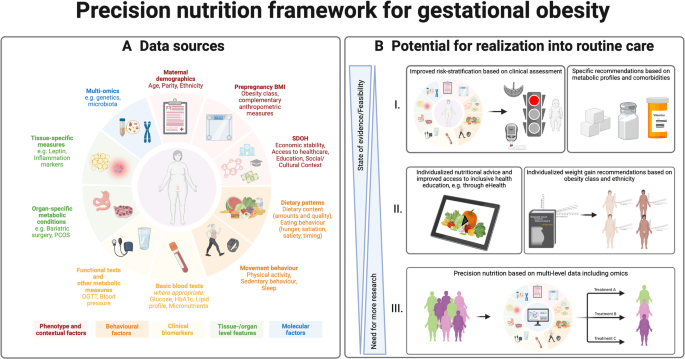
Building on this framework, we outline key factors to assess for applying a potential precision nutrition approach in managing obesity during pregnancy (Fig. 1A). Table 1 summarizes examples from the literature supporting risk stratification and individualized dietary advice, and outlines current implications for precision nutrition. Below, we comment on each data level, discussing potential, supporting evidence, and research gaps.
Fig. 1 The alternative text for this image may have been generated using AI.
(A) Proposed data sources to assess in order to apply a potential precision nutrition approach for managing obesity during pregnancy based on the framework and data level categorization published by Da Silva et al. [18]. (B) Potential for realization into routine care, with progression illustrated across levels I–III according to feasibility and state of evidence
Table 1 Examples of data to be collected for a precision nutrition approach for gestational obesity managementMaternal Observational Traits and Social Determinants of HealthAge and ParityMaternal age and parity are important risk stratification factors in pregnancy and may be particularly relevant among women with obesity. Positive interaction effects between advanced maternal age and pre-pregnancy overweight/obesity have been demonstrated for e.g., preeclampsia and GDM risk [18]. Compared with normal-weight women < 35 years, GDM risk was 1.8-fold higher in women < 35 years with overweight/obesity and 2.8-fold higher in those > 35 years with overweight/obesity [19]. Additionally, parity has been linked to insulin resistance and type 2 diabetes, with overweight and obesity aggravating these associations [20, 21]. However, most evidence stems from retrospective or small observational cohorts, and a large individual participant data meta-analysis concluded that neither age nor parity modified the effectiveness of lifestyle interventions in reducing GWG [22]. Within a precision nutrition framework, age and parity are therefore more appropriately considered stratification variables rather than direct targets for dietary tailoring, likely reflecting underlying metabolic and behavioral heterogeneity.
Pre-pregnancy Body Mass Index (BMI)Pre-pregnancy BMI is currently used in clinical guidelines to set GWG targets [23]. However, these recommendations only distinguish between overweight and obesity, without considering obesity severity across established classes, and there is also a lack of energy intake recommendations for these groups [24]. This lack of granularity limits personalization and highlights an opportunity for developing precision nutrition approaches. Obesity class is a strong predictor of pregnancy risks: higher BMI categories are linked to progressively elevated risk for GDM, hypertensive complications, cesarean delivery, LGA infants [25], stillbirths, and congenital anomalies [26]. Furthermore, a systematic review and meta-analysis (54 studies, 30.2 million pregnancies) found that GWG below current recommendations had more favorable obstetrical and neonatal outcomes across all obesity classes [27]. In addition, population-based cohort data indicate that GWG below guidelines or weight loss does not increase risks for adverse maternal and neonatal outcomes in women with obesity class I or II. Moreover, in women with obesity class III, GWG below current recommendations was associated with reduced risk of a composite outcome of adverse maternal and infant events (adjusted RR 0.81, 95% CI 0.71–0.89) [5]. Indeed, revised recommendations that incorporate obesity class [5, 27,28,29], aligning with precision nutrition principles of stratification and personalization are called for. However, it is important to note that new approaches to diagnosing and defining obesity are emerging. The 2025 Lancet Diabetes & Endocrinology Commission [30] argued that BMI frequently leads to misclassification and should not be used as a surrogate marker of an individual’s health. Excess adiposity should instead be confirmed through body fat assessment or complementary anthropometric measures, interpreted together with clinical data and tests indicating tissue or organ alterations, to classify clinical, preclinical or non-clinical obesity [30]. This new definition is important although more research is required to reveal whether adverse pregnancy outcomes differ between women with clinical, pre-clinical and non-clinical obesity. These developments may inform future stratified dietary approaches in gestational obesity, although interventional evidence remains limited.
Ethnicity and Social Determinants of HealthMaternal ethnicity is associated with distinct risk profiles for adverse gestational outcomes. For example, population-based data suggests that excessive GWG is a stronger predictor of LGA than pre-pregnancy BMI in White and Asian women, while their effects are similar in Black women [31]. A large meta-analysis further emphasized the use of region-specific BMI classifications in Asian populations to assess excessive GWG according to the National Academy of Medicine’s guidelines as it will affect the prevalence of excessive GWG substantially (51% vs. 37% for regional versus the universal WHO BMI categories) [32]. While these findings support ethnicity-tailored BMI categorization and corresponding adjustments to GWG recommendations, more research is needed to determine how country of residence and migration status may modify these differences.
Social determinants of health (SDOH) are also important to consider as they contribute to disparities in pre-pregnancy obesity [33], modify the risk of adverse pregnancy outcomes [34, 35], and pose challenges for the implementation and effectiveness of lifestyle interventions. Factors such as food insecurity have been linked to higher rates of pre-pregnancy obesity and increased risk of perinatal complications, while food provision assistance during pregnancy has been shown to mitigate these risks [36]. Other SDOH also warrant exploration, for instance migrant women may face language barriers and limited access to traditional foods, potentially hindering adherence to dietary and GWG recommendations [37, 38]. These determinants vary across countries and regions, underscoring the need for context specific approaches. In practice, ethnicity and SDOH primarily support culturally and context-adapted delivery of guideline-based dietary advice, rather than individualized interventions.
Behavioral FactorsDietDietary patterns are key components within the precision nutrition framework, influencing metabolic states and interacting with biological mechanisms [8]. Assessing dietary behavior early in pregnancy can provide a practical starting point for risk stratification and may complement molecular profiling to inform targeted strategies. Behavioral-metabolic obesity phenotypes (i.e., hungry brain, emotional hunger, hungry gut, and slow burn) [39] illustrate the heterogeneity of obesity and reinforce the need for subgroup risk stratification. For example, women with a “hungry brain” phenotype may benefit from appetite regulation strategies, whereas those with a “slow burn” phenotype may respond better to timing-based approaches and macronutrient adjustments. Chrononutrition is also gaining attention, with maternal nighttime eating being associated with adverse pregnancy outcomes [40] and identified as a potential target for improving glycemic control in GDM [41]. However, evidence from pregnancy-specific trials evaluating phenotype-guided dietary strategies is currently limited, and these constructs should be considered hypothesis-generating.
Movement BehaviorsMovement behaviors (physical activity, sedentary time, and sleep) are important to consider, with evidence suggesting that specific activity types, patterns, and doses confer distinct metabolic benefits during pregnancy. A meta-analysis in women with overweight and obesity found that moderate‑intensity exercise beyond walking alone reduced gestational hypertension risk by 62% [42]. Similarly, a meta-analysis in women with GDM demonstrated significant improvements in glycemic control, with reduced fasting glucose (−0.47 mmol/L), 2-hour postprandial glucose (−0.62 mmol/L), and HbA1c (−0.39%) with prescribed exercise versus with routine care [43]. Subgroup analyses indicated greater glycemic reductions with shorter-duration and more frequent sessions [43]. Dose-response analyses further indicate that achieving 10 MET‑h/week in early pregnancy reduces GDM risk by 13%, and higher activity volumes (20–50 MET‑h/week) confer further reductions [44]. In addition, other movement‑related behaviors, particularly sleep and sedentary time, are associated with metabolic regulation. In a cohort of pregnant women, sleep duration showed a U‑shaped association with glycemia, and greater sedentary time was associated with higher 1‑hour post‑load glucose (β = 0.132; P = 0.005) [45]. While these data support risk stratification based on physical activity patterns, more research is needed to elucidate how they can guide and complement individualized dietary strategies.
Clinical BiomarkersMetabolic Heterogeneity and Biomarker StratificationThe emerging concept of clinical obesity moves beyond traditional BMI-based definitions and incorporates functional disturbances as part of the illness-defining criteria [30]. This perspective aligns with the growing recognition that metabolic heterogeneity is highly relevant in gestational obesity management [46]. A recent review [47] highlights that maternal obesity is associated with endocrine, metabolic, and inflammatory disturbances, reflected in biomarkers such as leptin, adiponectin, insulin, progesterone, hCG, and CRP. These biomarkers have been proposed as early predictors of e.g., preeclampsia and GDM and may provide a biologically grounded basis for risk stratification. Niclou et al. [46] described an adverse metabolic milieu, marked by elevated glucose, insulin, triglycerides, leptin, and inflammatory markers as a potential basis for stratifying pregnant women with obesity into subgroups. They further suggest that dietary strategies such as time-restricted eating could enhance metabolic flexibility and insulin sensitivity [46], although evidence in pregnancy remains limited [48]. Beyond targeted biomarkers, untargeted multiplatform metabolomics combined with machine learning has also been used in obesity research to identify metabolites predictive of dietary intervention responses. For example, reduced urinary adipic acid and argininic acid levels have been associated with greater responsiveness to a New Nordic Diet in non-pregnant populations [49]. However, these approaches remain largely unexplored in pregnancy, and their translation into actionable dietary strategies for gestational obesity is not yet supported by interventional evidence. The following section provides a more detailed examination of already routinely measured clinical biomarkers.
Glucose ParametersGlucose assessment is particularly important among women with gestational overweight or obesity, given their elevated risk of glucose dysregulation. Therefore, the American Diabetes Association recommends screening for undiagnosed prediabetes or diabetes in women with overweight or obesity who are planning a pregnancy or who are < 15 weeks’ gestation and have one or more additional risk factors (e.g. first-degree relative with diabetes, hypertension, polycystic ovary syndrome [PCOS], physical inactivity), or even considering testing all women [50]. For women who have not been diagnosed earlier, screening for GDM in gestational week 24–28 is recommended. Identifying hyperglycemia early is essential, given that it is associated with maternal and neonatal complications [51,52,53] with excessive fetal growth being one of the main underlying mechanisms. Medical nutrition therapy is the first-line therapy for GDM [54] and has been shown to improve maternal glycemic control, reduce the risk for medical treatment by 35%, and lower infant birth weight [55]. The need for insulin therapy, which indirectly reflects an insufficient response to nutritional therapy, can be predicted by several factors, including a history of prior GDM, higher BMI, chronic hypertension, or elevated glucose values [56]. However, data on the optimal and potential subgroup-specific dietary approach and obesity management for hyperglycemia during pregnancy are lacking, and several questions such as optimal carbohydrate intake and best modification of dietary interventions remain unanswered.
Lipid ProfileObesity strongly predisposes to dyslipidemia also during pregnancy, which is associated with increased risk of complications, such as preeclampsia, GDM, and pre-term delivery, as well as pancreatitis in the presence of severe hypertriglyceridemia [57, 58]. The 2024 European Society of Cardiology guidelines on dyslipidemia management in pregnancy note that there are no tailored dietary directives for this population. Instead, they recommend a similar diet as for non-pregnant individuals, emphasizing an overall healthy dietary pattern with reduced intake of animal derived foods, processed foods and unhealthy fats (saturated- and trans fatty acids), and increased intake of fruit and vegetables and healthy fats (omega-3 and polyunsaturated fats). The guidelines also state that pregnant women should avoid overly restrictive diets [59].
Blood PressureHypertensive disorders of pregnancy (essential hypertension, pregnancy-induced hypertension, and preeclampsia) are strongly associated with adverse maternal and perinatal outcomes, such as preterm birth, fetal growth restriction, and increased maternal morbidity [60]. These conditions are more prevalent among women with obesity, highlighting the need for targeted preventive strategies. Evidence suggests that adherence to the Dietary Approaches to Stop Hypertension (DASH) diet (high intake of fruits, vegetables, wholegrains, low-fat dairy, and low in animal protein, sugar and sodium) in a low-risk pregnant population is associated with lower mid-pregnan
Comments (0)