Geng, L. N. et al. 2024 update of the RECOVER-Adult long COVID research index. JAMA 333, 694–700 (2025).
Article
CAS
PubMed
PubMed Central
Google Scholar
Kuri-Cervantes, L. et al. Comprehensive mapping of immune perturbations associated with severe COVID-19. Sci. Immunol. 5, eabd7114 (2020).
Article
CAS
PubMed
PubMed Central
Google Scholar
Rahimi, R. A. et al. Advancing lung immunology research: an official American Thoracic Society workshop report. Am. J. Respir. Cell Mol. Biol. 67, e1–e18 (2022).
Article
CAS
PubMed
PubMed Central
Google Scholar
Talbot, S., Foster, S. L. & Woolf, C. J. Neuroimmunity: physiology and pathology. Annu. Rev. Immunol. 34, 421–447 (2016).
Article
CAS
PubMed
Google Scholar
Almanzar, N. et al. Vagal TRPV1+ sensory neurons protect against influenza virus infection by regulating lung myeloid cell dynamics. Sci. Immunol. 10, eads6243 (2025). This paper shows that vagal TRPV1-positive sensory neurons protect the host from lung injury during influenza A infection by skewing pulmonary myeloid cell responses, including those of neutrophils and macrophages, towards less tissue-damaging states, revealing a key neuroimmune mechanism that regulates disease severity during viral respiratory infection.
Article
CAS
PubMed
Google Scholar
Hiroki, C. H. et al. Nociceptor neurons suppress alveolar macrophage-induced Siglec-F+ neutrophil-mediated inflammation to protect against pulmonary fibrosis. Immunity 58, 2054–2068.e6 (2025). This paper shows that TRPV1-positive nociceptor sensory neurons protect the host against pulmonary fibrosis by restraining alveolar macrophage-driven VIP/TGFβ signalling and the subsequent recruitment of NET-producing Siglec-F-positive neutrophils, revealing reveal a neuroimmune circuit that limits pathological lung inflammation and fibrotic progression.
Article
CAS
PubMed
Google Scholar
McGovern, A. E., Davis-Poynter, N., Farrell, M. J. & Mazzone, S. B. Transneuronal tracing of airways-related sensory circuitry using herpes simplex virus 1, strain H129. Neuroscience 207, 148–166 (2012).
Article
CAS
PubMed
Google Scholar
Su, Y. et al. Identification of lung innervating sensory neurons and their target specificity. Am. J. Physiol. Lung Cell. Mol. Physiology 322, L50–L63 (2022).
Article
CAS
Google Scholar
Dinh, Q. T. et al. Substance P expression in TRPV1 and trkA-positive dorsal root ganglion neurons innervating the mouse lung. Respir. Physiol. Neurobiol. 144, 15–24 (2004).
Article
CAS
PubMed
Google Scholar
Kim, S.-H. et al. Mapping of the sensory innervation of the mouse lung by specific vagal and dorsal root ganglion neuronal subsets. eNeuro 9, ENEURO.0026-22.2022 (2022).
Article
PubMed
PubMed Central
Google Scholar
Boers, J. E., den Brok, J. L., Koudstaal, J., Arends, J. W. & Thunnissen, F. B. Number and proliferation of neuroendocrine cells in normal human airway epithelium. Am. J. Respir. Crit. Care Med. 154, 758–763 (1996).
Article
CAS
PubMed
Google Scholar
Chang, R. B., Strochlic, D. E., Williams, E. K., Umans, B. D. & Liberles, S. D. Vagal sensory neuron subtypes that differentially control breathing. Cell 161, 622–633 (2015). This paper shows that the vagus nerve contains distinct neuronal populations that define labelled lines with different physiological roles: NPY2R-expressing, slow-conducting C-fibres drive rapid, shallow breathing, whereas P2RY1-expressing, fast-conducting A-fibres suppress respiration.
Article
CAS
PubMed
PubMed Central
Google Scholar
Patil, M. J. et al. Anatomical and functional mapping of vagal nociceptive sensory nerve subsets innervating the mouse lower airways by intersectional genetics. J. Physiol. https://doi.org/10.1113/JP289279 (2025).
Article
PubMed
Google Scholar
Dutschmann, M., Bautista, T. G., Mörschel, M. & Dick, T. E. Learning to breathe: habituation of Hering–Breuer inflation reflex emerges with postnatal brainstem maturation. Respiratory Physiol. Neurobiol. 195, 44–49 (2014).
Article
Google Scholar
Nonomura, K. et al. Piezo2 senses airway stretch and mediates lung inflation-induced apnoea. Nature 541, 176–181 (2017).
Article
CAS
PubMed
Google Scholar
Schappe, M. S. et al. A vagal reflex evoked by airway closure. Nature 627, 830–838 (2024).
Article
CAS
PubMed
PubMed Central
Google Scholar
Dubin, A. E. et al. Inflammatory signals enhance Piezo2-mediated mechanosensitive currents. Cell Rep. 2, 511–517 (2012).
Article
CAS
PubMed
PubMed Central
Google Scholar
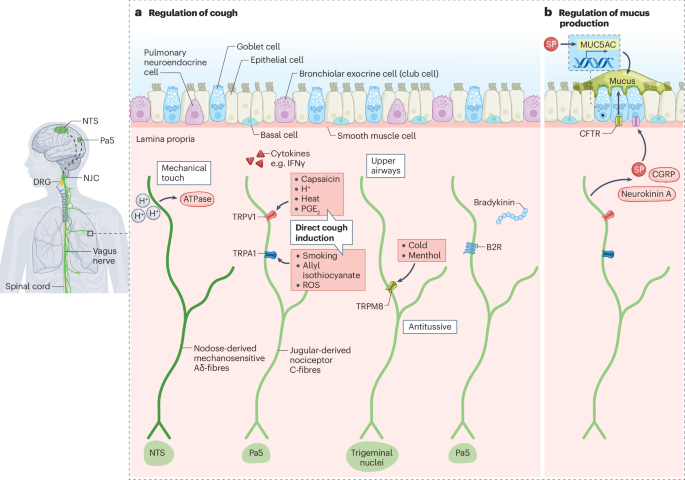
Canning, B. J. & Mori, N. An essential component to brainstem cough gating identified in anesthetized guinea pigs. FASEB J. 24, 3916–3926 (2010).
Article
CAS
PubMed
PubMed Central
Google Scholar
Chou, Y.-L., Scarupa, M. D., Mori, N. & Canning, B. J. Differential effects of airway afferent nerve subtypes on cough and respiration in anesthetized guinea pigs. Am. J. Physiol. Regul. Integr. Comp. Physiol 295, R1572–R1584 (2008).
Article
CAS
PubMed
PubMed Central
Google Scholar
Muroi, Y. et al. Selective inhibition of vagal afferent nerve pathways regulating cough using Nav 1.7 shRNA silencing in guinea pig nodose ganglia. Am. J. Physiol. Regul. Integr. Comp. Physiol 304, R1017–R1023 (2013).
Article
CAS
PubMed
PubMed Central
Google Scholar
Mazzone, S. B. et al. Selective expression of a sodium pump isozyme by cough receptors and evidence for its essential role in regulating cough. J. Neurosci. 29, 13662–13671 (2009).
Article
CAS
PubMed
PubMed Central
Google Scholar
Driessen, A. K., Farrell, M. J., Mazzone, S. B. & McGovern, A. E. The role of the paratrigeminal nucleus in vagal afferent evoked respiratory reflexes: a neuroanatomical and functional study in guinea pigs. Front. Physiol. 6, 378 (2015).
Article
PubMed
PubMed Central
Google Scholar
Brozmanova, M., Mazurova, L., Ru, F., Tatar, M. & Kollarik, M. Comparison of TRPA1-versus TRPV1-mediated cough in guinea pigs. Eur. J. Pharmacol. 689, 211–218 (2012).
Article
CAS
PubMed
PubMed Central
Google Scholar
Grace, M., Birrell, M. A., Dubuis, E., Maher, S. A. & Belvisi, M. G. Transient receptor potential channels mediate the tussive response to prostaglandin E2 and bradykinin. Thorax 67, 891–900 (2012).
Article
PubMed
PubMed Central
Google Scholar
Laude, E. A., Higgins, K. S. & Morice, A. H. A comparative study of the effects of citric acid, capsaicin and resiniferatoxin on the cough challenge in guinea-pig and man. Pulm. Pharmacol. 6, 171–175 (1993).
Article
CAS
PubMed
Google Scholar
Birrell, M. A. et al. TRPA1 agonists evoke coughing in guinea pig and human volunteers. Am. J. Respir. Crit. Care Med. 180, 1042–1047 (2009).
Article
CAS
PubMed
PubMed Central
Google Scholar
Mukhopadhyay, I. et al. Transient receptor potential ankyrin 1 receptor activation in vitro and in vivo by pro-tussive agents: GRC 17536 as a promising anti-tussive therapeutic. PLoS ONE 9, e97005 (2014).
Article
PubMed
PubMed Central
Google Scholar
Chou, Y.-L., Mori, N. & Canning, B. J. Opposing effects of bronchopulmonary C-fiber subtypes on cough in guinea pigs. Am. J. Physiol. Regul. Integr. Comp. Physiol 314, R489–R498 (2018).
Article
PubMed
Google Scholar
Weigand, L. A., Ford, A. P. & Undem, B. J. A role for ATP in bronchoconstriction-induced activation of guinea pig vagal intrapulmonary C-fibres. J. Physiol. 590, 4109–4120 (2012).
Article
CAS
PubMed
PubMed Central
Google Scholar
Deng, Z. et al. IFN-γ enhances the cough reflex sensitivity via calcium influx in vagal sensory neurons. Am. J. Respir. Crit. Care Med. 198, 868–879 (2018).

Comments (0)