
Remember me
Who is afraid of the gallbladder? We are. Many interventional radiologists are as well. Thermal injury to the gallbladder wall may lead to pain, cholecystitis and in rare cases to necrosis and perforation [1, 2]. Other interventional radiologists aren’t. Nothing serious seems to happen [3]. Hence it is a matter of discussion: some authors advocate for the use of adjunctive or alternate techniques while others don’t. In the present issue, Pisano et al. analysed 48 microwave ablations and concluded that protective hydro- or pneumo-dissection was found to be not essential [3]. Let’s debate!
Pisano et al. reported that the incidence of gallbladder injury was low. Low but not zero as 35.4% of the patients had modifications of the gallbladder wall on imaging and 4 patients (8.3%) were readmitted to the hospital for cholecystitis (n = 1) or pain (n =3 ). Although a direct comparison cannot be made, this rate of readmission is higher than one may expect in liver ablation in general. Was it related to injury of the gallbladder? This cannot be excluded and most certainly be suggested. Their hypothesis of transfer of heat to the gallbladder content rather to the wall, and the possible insulation produced by the gas generated by microwave at the liver—gallbladder interface is very theoretical as microwave is known to diffuse among gas without limitation (contrary to radiofrequency). The relatively low rate of complication might be more related to the ablation size itself.
In their series, the 12-month local tumour progression free survival is low (80% considering all histologies), and very low for colorectal metastases (55%) given the size of the lesions (median 22 mm). This is far from the published data reporting outcomes with a minimal 5mm safety margin. Contrary to what the authors claim, it is highly doubtable that a minimal 5mm radial safety margin (and 10 mm for colorectal metastases) was achieved in 100% of the cases. The doubt is further reinforced by the ablation protocols that were applied (whatever the system). The duration of microwave ablation was too short to achieve the pretended margins (none of the presented protocols produces a 4-cm-diameter ablation) [4]. It would be interesting to know if the authors are using the same protocol for an intraparenchymal liver lesion. It feels like they underpowered the ablation because they were actually afraid of the gallbladder, which is totally understandable. Who knows what would have happened if they used a fully powered protocol? Although rare, gallbladder perforation is not a myth.
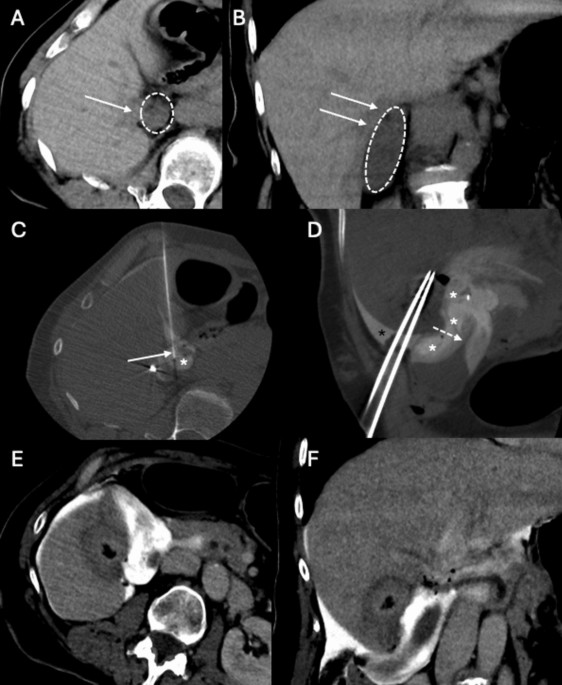
As explained in their paper, there are alternatives such as cryoablation and irreversible electroporation which are less likely to induce structural damages to the gallbladder. If better oncological outcomes can be achieved with these modalities, they should probably be favoured. In our experience, hydrodissection of the gallbladder bare area is an elegant way to displace completely the gallbladder from the liver, thereby allowing to ablate at full power with clear margins and without the risk of injury to the gallbladder wall (Fig. 1) [5]. This is probably worth spending 15 min performing it. And not being afraid anymore.
Fig. 1 The alternative text for this image may have been generated using AI.
Axial A and coronal B CT-scan shows a liver metastasis (arrows) abutting the gallbladder (dashed circle). Axial view C shows a 22 G spinal needle (arrow) advanced with a transhepatic approach next to the cystic duct and hydrodissection with a mixture of saline and contrast (asterisk). Coronal view D demonstrates complete separation of the gallbladder from the liver thanks to the dissection of the gallbladder area (white asterisks) with 250 ml of hydrodissection; Note small contamination of the peritoneal space (black asterisk). Ablation was performed at 65 W for 10 min simultaneously on two microwave antennas (PR probe, Neuwave, Quantum Surgical). Axial E and coronal F contrast-enhanced CT-scan following ablation shows an ablation area with a 10mm radial clear margin
Comments (0)