Klein, L. & Petrozziello, E. Antigen presentation for central tolerance induction. Nat. Rev. Immunol. 25, 57–72 (2025).
Article
CAS
PubMed
Google Scholar
Wolfl, M. et al. Hepatitis C virus immune escape via exploitation of a hole in the T cell repertoire. J. Immunol. 181, 6435–6446 (2008).
Article
CAS
PubMed
PubMed Central
Google Scholar
ElTanbouly, M. A. & Noelle, R. J. Rethinking peripheral T cell tolerance: checkpoints across a T cell’s journey. Nat. Rev. Immunol. 21, 257–267 (2021).
Article
CAS
PubMed
Google Scholar
Brown, C. C. & Rudensky, A. Y. Spatiotemporal regulation of peripheral T cell tolerance. Science 380, 472–478 (2023).
Article
CAS
PubMed
Google Scholar
Vidovic, D. & Matzinger, P. Unresponsiveness to a foreign antigen can be caused by self-tolerance. Nature 336, 222–225 (1988).
Article
CAS
PubMed
Google Scholar
Richards, D. M., Kyewski, B. & Feuerer, M. Re-examining the nature and function of self-reactive T cells. Trends Immunol. 37, 114–125 (2016).
Article
CAS
PubMed
PubMed Central
Google Scholar
Yu, W. et al. Clonal deletion prunes but does not eliminate self-specific alphabeta CD8+ T lymphocytes. Immunity 42, 929–941 (2015).
Article
CAS
PubMed
PubMed Central
Google Scholar
Danke, N. A., Koelle, D. M., Yee, C., Beheray, S. & Kwok, W. W. Autoreactive T cells in healthy individuals. J. Immunol. 172, 5967–5972 (2004).
Article
CAS
PubMed
Google Scholar
Wortel, I. M. N., Kesmir, C., de Boer, R. J., Mandl, J. N. & Textor, J. Is T cell negative selection a learning algorithm? Cells 9, 690 (2020). This paper presents a computational model showing that the choice of thymic self peptides can optimize self–non-self discrimination, drawing parallels between TCR recognition of pMHC and language learning.
Article
CAS
PubMed
PubMed Central
Google Scholar
Huseby, E. S. et al. How the T cell repertoire becomes peptide and MHC specific. Cell 122, 247–260 (2005).
Article
CAS
PubMed
Google Scholar
Chu, H. H. et al. Positive selection optimizes the number and function of MHCII-restricted CD4+ T cell clones in the naive polyclonal repertoire. Proc. Natl Acad. Sci. USA 106, 11241–11245 (2009).
Article
CAS
PubMed
PubMed Central
Google Scholar
Mandl, J. N., Monteiro, J. P., Vrisekoop, N. & Germain, R. N. T cell-positive selection uses self-ligand binding strength to optimize repertoire recognition of foreign antigens. Immunity 38, 263–274 (2013). This study, together with Persaud et al. (2014) and Fulton et al. (2015), demonstrates that naive CD4+and CD8+T cells with differences in self-reactivity differ in their function upon activation.
Article
CAS
PubMed
PubMed Central
Google Scholar
Fulton, R. B. et al. The TCR’s sensitivity to self peptide-MHC dictates the ability of naive CD8+ T cells to respond to foreign antigens. Nat. Immunol. 16, 107–117 (2015).
Article
CAS
PubMed
Google Scholar
Persaud, S. P., Parker, C. R., Lo, W. L., Weber, K. S. & Allen, P. M. Intrinsic CD4+ T cell sensitivity and response to a pathogen are set and sustained by avidity for thymic and peripheral complexes of self peptide and MHC. Nat. Immunol. 15, 266–274 (2014).
Article
CAS
PubMed
PubMed Central
Google Scholar
Mandl, J. N., Torabi-Parizi, P. & Germain, R. N. Visualization and dynamic analysis of host-pathogen interactions. Curr. Opin. Immunol. 29, 8–15 (2014).
Article
CAS
PubMed
Google Scholar
Shapiro, I. E. & Bassani-Sternberg, M. The impact of immunopeptidomics: from basic research to clinical implementation. Semin. Immunol. 66, 101727 (2023).
Article
CAS
PubMed
Google Scholar
Caron, E. et al. Analysis of major histocompatibility complex (MHC) immunopeptidomes using mass spectrometry. Mol. Cell. Proteom. 14, 3105–3117 (2015).
Article
CAS
Google Scholar
Kubiniok, P. et al. Understanding the constitutive presentation of MHC class I immunopeptidomes in primary tissues. iScience 25, 103768 (2022).
Article
CAS
PubMed
PubMed Central
Google Scholar
Bozzacco, L. et al. Mass spectrometry analysis and quantitation of peptides presented on the MHC II molecules of mouse spleen dendritic cells. J. Proteome Res. 10, 5016–5030 (2011).
Article
CAS
PubMed
PubMed Central
Google Scholar
Ploegh, H. L., Orr, H. T. & Strominger, J. L. Major histocompatibility antigens: the human (HLA-A, -B, -C) and murine (H-2K, H-2D) class I molecules. Cell 24, 287–299 (1981).
Article
CAS
PubMed
Google Scholar
Harding, C. V. & Unanue, E. R. Quantitation of antigen-presenting cell MHC class II/peptide complexes necessary for T-cell stimulation. Nature 346, 574–576 (1990).
Article
CAS
PubMed
Google Scholar
Klein, L., Kyewski, B., Allen, P. M. & Hogquist, K. A. Positive and negative selection of the T cell repertoire: what thymocytes see (and don’t see). Nat. Rev. Immunol. 14, 377–391 (2014).
Article
CAS
PubMed
PubMed Central
Google Scholar
Takada, K., Ohigashi, I., Kasai, M., Nakase, H. & Takahama, Y. Development and function of cortical thymic epithelial cells. Curr. Top. Microbiol. Immunol. 373, 1–17 (2014).
CAS
PubMed
Google Scholar
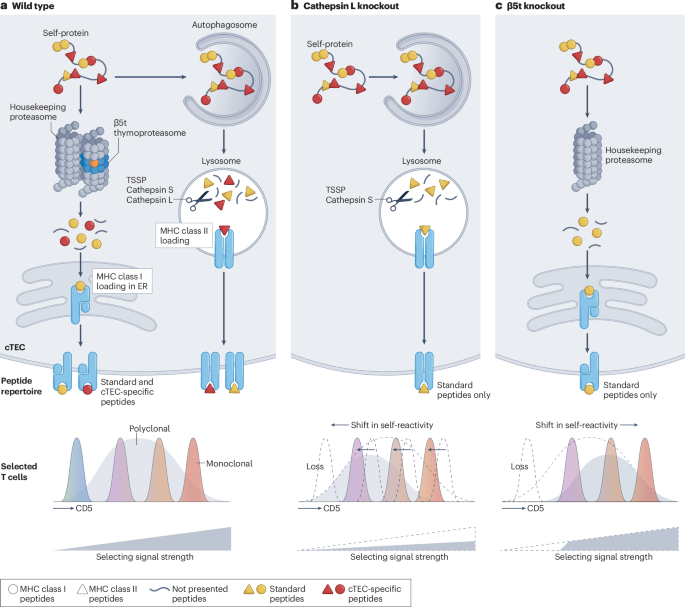
Honey, K. & Rudensky, A. Y. Lysosomal cysteine proteases regulate antigen presentation. Nat. Rev. Immunol. 3, 472–482 (2003).
Article
CAS
PubMed
Google Scholar
Murata, S. et al. Regulation of CD8+ T cell development by thymus-specific proteasomes. Science 316, 1349–1353 (2007).
Article
CAS
PubMed
Google Scholar
Nakagawa, T. et al. Cathepsin L: critical role in Ii degradation and CD4 T cell selection in the thymus. Science 280, 450–453 (1998).
Article
CAS
PubMed
Google Scholar
Honey, K., Nakagawa, T., Peters, C. & Rudensky, A. Cathepsin L regulates CD4+ T cell selection independently of its effect on invariant chain: a role in the generation of positively selecting peptide ligands. J. Exp. Med. 195, 1349–1358 (2002).
Article
CAS
PubMed
PubMed Central
Google Scholar
Gommeaux, J. et al. Thymus-specific serine protease regulates positive selection of a subset of CD4+ thymocytes. Eur. J. Immunol. 39, 956–964 (2009).
Article
CAS
PubMed
Google Scholar
Viret, C. et al. Thymus-specific serine protease contributes to the diversification of the functional endogenous CD4 T cell receptor repertoire. J. Exp. Med. 208, 3–11 (2011).
Article
CAS
PubMed
Google Scholar
Nedjic, J., Aichinger, M., Emmerich, J., Mizushima, N. & Klein, L. Autophagy in thymic epithelium shapes the T-cell repertoire and is essential for tolerance. Nature 455, 396–400 (2008).
Article
CAS
PubMed
Google Scholar
Nedjic, J., Aichinger, M., Mizushima, N. & Klein, L. Macroautophagy, endogenous MHC II loa



Comments (0)