
Remember me
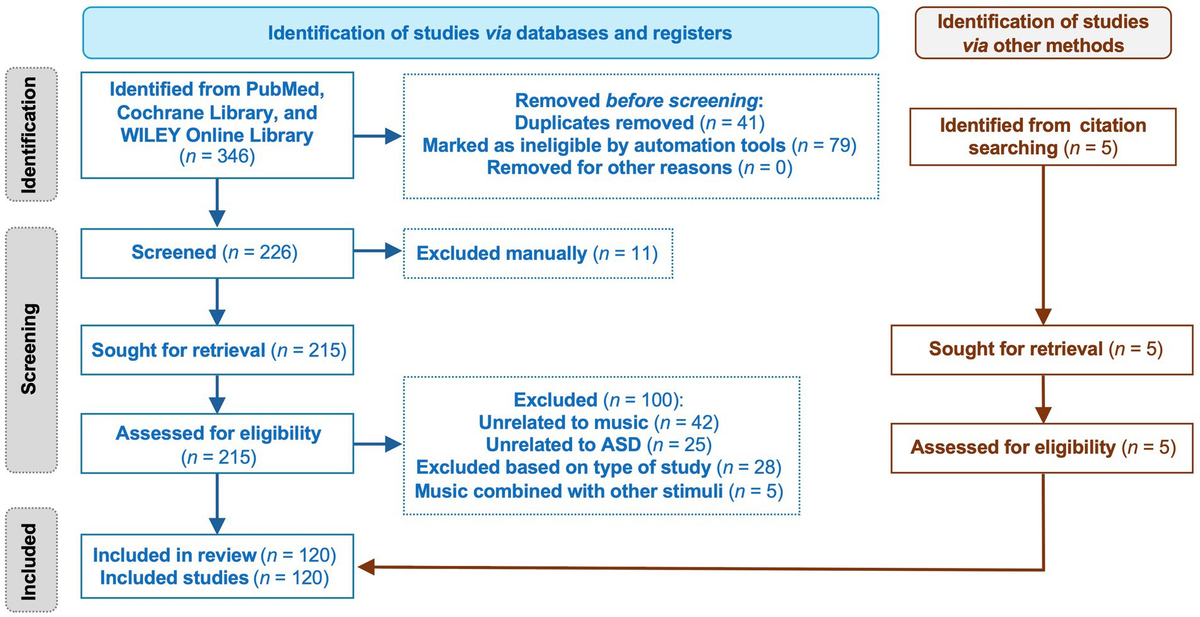
Based on the included studies’ results and our investigation’s goal, the studies were divided into two main categories: (i) synthesis of current research on musical processing in autistic individuals, focusing on their perception and musical abilities and (ii) discovery of benefits and therapeutic effects of music for autistic individuals.
3.1 Musical processing and musical abilities in autistic individuals. A musical phenotype in autism?We analyzed 45 articles on how music’s structural aspects are processed in populations with autism (overall musically untrained), compared to TD children. We aimed at investigating whether specificities exist in the musical brains of autistic individuals, especially in musical perception and emotion processing. The main analyzed categories were pitch processing (pitch discrimination and absolute pitch), auditory pleasantness, emotional processing, other musical domains, and the function of music in their lives.
3.1.1 Pitch discrimination abilitiesThe ability to identify a specific pitch involves cognitive processes such as auditory perception and memory. In this section, we examined the nature of auditory mechanisms underlying musical recognition and assessed whether autistic individuals exhibit distinct abilities or processing patterns. This field is the main corpus of papers corresponding to musical abilities in autism.
The main finding is the special sensitivity of autistic individuals to pitch changes and their enhanced ability to discriminate musical parameters, providing evidence for preserved, or even superior, pitch processing in this population (Bonnel et al., 2003; Heaton, 2003; Heaton, 2005; Jävinen-Pasley and Heaton, 2007; DePape et al., 2012; Chowdhury et al., 2017; Heaton et al., 2018; Wang et al., 2022; Germain et al., 2019). According to Chowdhury et al. (2017), auditory perception is related to non-verbal reasoning rather than verbal abilities in autism and TD. Some studies connect autism’s ability to recognize different pitches to superior memory, including long-term melodic memory (Heaton, 2003; Stanutz et al., 2014) or working memory, and focused attention (Bennett and Heaton, 2012). However, Heaton et al. (2018) affirmed that autistic individuals perform better than TD controls on pitch identification despite being impaired in short-term memory. Some studies detect similar recognition of melodic contour in autism and TD (Mottron et al., 2000), and other research affirmed that auditory imagery is lower in autism than in TD controls (Bacon et al., 2020).
Various studies compared the effect of listening to music with listening to speech. Jävinen-Pasley and Heaton (2007) and Heaton et al. (2007) demonstrated that speech inclusion in perception activities declines the levels of accuracy in pitch discrimination of autistic individuals. Similarly, DePape et al. (2012) demonstrated that autistic individuals are more impaired in speech tasks than in music tasks. In this line, Lai et al. (2012) compared the neural systems and showed that autistic individuals activated the left inferior frontal gyrus more than controls in song stimulation; however, the opposite happened with speech stimulation. Sharda et al. (2015) found that functional frontotemporal connectivity was preserved during sung-word listening in autism in contrast to speech-word, enhancing the importance of MI with this population. Other arguments present evidence of how autism mental representations of pitch contours could be across domains, and implications for using music to improve language (Wang et al., 2023).
3.1.2 Absolute pitchAbsolute pitch (AP) is an extreme phenotype associated with naming or producing a musical tone without any reference. Several researchers have suggested that AP is a normally distributed complex trait with a strong genetic component (Baharloo et al., 1998; Gregersen et al., 1999), with a prevalence of <1% in the general population (Profita and Bidder, 1988).
The outstanding study of DePape et al. (2012) measured the prevalence of AP processing in autism using a task that does not require explicit knowledge of musical structure, which can be used by non-musicians with and without autism, estimating a prevalence of 11% in autism, which is remarkable compared to 1 in 10,000 in typical populations.
Autism’s neurocognitive theories might explain this co-occurrence, while some case studies illustrate evidence of AP in autistic individuals who possess extraordinary musical abilities (Heaton et al., 2008; Brenton et al., 2008; Bouvet et al., 2014; Courchesne et al., 2020). Research involving musicians has found autism features in those with AP, suggesting a link between the two conditions (Brown et al., 2003; Dohn et al., 2012; Wenhart et al., 2019a; Wenhart and Altenmuller, 2019; Wenhart et al., 2019b) and highlighting the detail-oriented cognitive style, imagination, perceptual functioning, and hyper-systemizing present in both. A noteworthy study emphasizes a potential connection between autism traits, brain connectivity, and AP ability (Wenhart et al., 2019b), suggesting a less efficient and less small-world-structured functional network in AP, consistent with findings from autism research.
Curiously, one study focusing on pitch production reveals a vocal imitation deficit in autistic individuals that is specific to AP, but not to relative pitch, across both speech and music domains (Wang et al., 2021). This may be related to the fact that autistic individuals often exhibit atypical imitation of actions and gestures.
3.1.3 Other musical abilitiesPitch recognition is related to the ability to produce a determined sound properly. The processing involving human listening, specifically musical discrimination, is inevitably joined to musical production through intonation (Morrison and Fyk, 2002). Regarding the auditory processing that involves pitch production through voice, Wang et al. (2022) found that imitating musical intonation is intact in autistic individuals. Other studies compared this ability of pitch production in musical language with speech production, demonstrating the preservation of pitch production and a prosodic impairment (Jiang et al., 2015; DePriest et al., 2017).
According to Heaton (2003), abilities such as pitch memory and labeling are superior in autism and may facilitate performance in harmonic contexts for autistic individuals. In a subsequent study, Heaton et al. (2007) affirmed that the most striking finding was the absence of significant differences in performance patterns between autism and control participants; both groups were similarly influenced by harmonic context in their perception. DePape et al. (2012) found that musical processing is relatively preserved in autism in many aspects: pitch detection, pitch memory, harmonic and metrical processing. Other minor examinations focused on rhythmic perception and affirmed that the tempo of acuity was preserved (Heaton et al., 2018; Dahary et al., 2024).
3.1.4 Auditory pleasantnessAuditory perception and overall musical pleasantness depend on both the acoustic properties of the stimulus and the cultural experiences that shape individual musical preferences. Six studies have investigated musical preferences in autistic individuals, while others have focused on the benefits of different types of music and the importance of selecting appropriate musical content for therapeutic purposes. While recent research (Michel et al., 2024) shows autistic adults rated instrumental sounds more pleasant than vocal sounds, Kalas (2012) discovered the effectiveness of joint attention of simple music (short melody without syncopation or chromatism, accompanied by I-IV-V chords) for severe autism, in contrast to the function of complex music for mild/moderate autistic individuals. In qualitative research (Sravanti et al., 2023), parents of autistic children reported an active response to music and a preference for rhythmic music. All research compared the auditory pleasantness of autistic individuals with controls, reaching relevant results as autism are more sensitive to consonance and dissonance, appreciating a larger variety of music, from Mozart to Schoenberg (Masataka, 2017). The most compelling study examines functional brain connectivity between specific regions while comparing familiar and unfamiliar songs (Freitas et al., 2022), concluding that there is no difference in how autistic and TD individuals process familiar music. However, this author found significant differences in how the autistic brain processes unfamiliar music compared to the TD, activating the alpha band and increasing connectivity. Also, in this research, autistic children showed no difference in the magnetoencephalography of familiar and unfamiliar music. However, Lanovaz et al. (2012) found that preferred music reduced vocal stereotypy in four autistic children.
3.1.5 Emotional processing of musicLately, processing musical emotions in autistic individuals, such as emotion recognition or emotional expressions, has gained attention. The impairment to identify, recognize, or verbalize emotions is known as alexithymia, but autistic individuals could be affected only in the ability to verbalize or articulate the expression of emotions (Allen et al., 2009; Allen et al., 2013). Music improves emotion recognition in autistic individuals (Wagener et al., 2021; Redondo Pedregal and Heaton, 2021), but many studies contribute deeply to understanding the mechanisms underlying emotional processing.
Some studies demonstrated the physiological effect of music on the autistic population by measuring the emotional response through skin conductance or the autonomic nervous system’s reaction, or evaluating the capability to recognize emotions, demonstrating no notable difference between autism and controls (Quintin et al., 2011; Allen et al., 2013; Whipple et al., 2015; Jarvinen et al., 2016; Leung et al., 2023), and the accuracy in emotional recognition in autistic individuals (Whipple et al., 2015; Leung et al., 2023; Sivathasan et al., 2023).
Moreover, using fMRI, neuroscientific studies found similar neural networks during musical processing in emotion recognition in autism and TD (Caria et al., 2011; Gebauer et al., 2014), considering music as a domain of preserved ability. However, Caria et al. (2011) associated the strong emotional response to happy music in autism with decreased activity in the cerebellum and premotor areas, showing a possibly altered rhythm perception.
However, some studies found an impairment in judging the emotional expressivity of music (Bhatara et al., 2010) or established differences between autism and TD in the emotional response to music. Quintin et al. (2011) studied the recognition of happiness, sadness, scariness, and peacefulness through 20 musical clips, and they only found a difference between autistic and TD adolescents in recognition of the peaceful music, which was the most difficult. Gebauer et al. (2014) showed that autistic individuals demonstrate more arousal activity and cognitive load in happy than in sad music, unlike TD controls.
Leung et al. (2023) found that the processing speed of emotions through music was slower in the autistic group compared to the neurotypical (NT) group, suggesting that autistic individuals may employ different emotion-processing strategies. Furthermore, Wagener et al. (2021) reported higher reaction times in autism. Stephenson et al. (2016) found reduced skin conductance in response to music in autistic adolescents, as well as a decrease in physiological responsiveness with age, contrary to NT controls.
3.1.6 Qualitative role of musicSeveral studies employing qualitative or mixed-method designs have explored the meanings and functions of music in the lives of autistic individuals. To illustrate, Kirby and Burland (2021) identified four primary roles that music plays: emotional, cognitive, identity-related, and social. Notably, they found these roles to be consistent across autistic and TD individuals. Importantly, autistic adults often use music for emotional self-regulation, mood modulation, and emotional states management (Allen et al., 2009; Korošec et al., 2024; Lense et al., 2022). Furthermore, music also serves as a means of fostering social connection and interaction (Korošec et al., 2024; Lense et al., 2022), highlighting its potential as a bridge for communication and social engagement in autistic populations.
3.2 Music-based interventions’ (MI) impact on ASDMI can play a crucial role in improving people’s lives, demonstrating the potential of music as a valuable therapeutic tool for supporting autistic individuals. In the 75 studies included in this systematic review, 34 utilized a Music Therapy (MT) approach and 41 a different MI, of which 17 are based on music listening (ML), 7 on playing musical instruments, 6 on singing and creating songs, 5 on music and movement intervention, and 6 in combining musical activities. All of the musical interventions reported benefits, but especially an active engagement, such as MT, playing instruments, music and movement or a combination of playing, singing and improvisation can effectively minimize core symptoms in autistic children and can help in reducing autism severity, enhancing social engagement, and decreasing repetitive behaviors, among others (Ren et al., 2022).
Many different techniques of MT have been utilized in the 34 studies reviewed, such as Receptive Music Therapy, Improvisational Music Therapy, or Neurological Music Therapy, among others, impacting especially in social engagement and behavioral outcomes [see for example, LaGasse (2014)]. In a comparative study, Rabeyron et al. (2020) found that MT led to greater clinical improvements, measured using the Clinical Global Impression (CGI) scale, and greater reductions in stereotypical behaviors than ML alone. Notably, MT was associated with enhanced social engagement in 27 studies, whereas other MI reported similar benefits in 22 studies. Behavioral improvements were observed across various musical activities, with 11 MT studies and 9 ML interventions specifically highlighting such effects.
Next, we summarize the findings of the 15 studies that fulfilled the inclusion criteria for our meta-analysis, which are drawn from the larger pool of 120 studies identified in the review. To provide context, we also highlight relevant results from the broader review at the beginning of each outcome section, including a narrative on verbal and non-verbal communication, attention, behavior, QoL, and social interaction. Table 1 presents the outcomes and measures for the included studies.
ReferenceParticipantsAgeInterventionDurationComparatorsOutcomesMeasuresBieleninik et al. (2017)EG: 182Overview of studies included in the meta-analysis, including intervention type, duration, comparators, and outcome assessment tools.
Age expressed in years. EG: experimental group; CG: control group; m: months; d: days; s: sessions; w: weeks; SC: Standard Care; PA: ‘Placebo’ activity without music; A: Attention; B: Behavior; GI: Global Improvement; nVC: Non-verbal Communications; QoL: Quality of Life; SI: Social Interaction; VC: Verbal Communication.
3.2.1 AttentionAutism is characterized by differences in attention regulation, which can influence cognitive processing and sensory perception. Music has emerged as a potential tool to manage attention in autistic people. It engages both auditory and emotional networks, which can lead to better focus and less distractibility. A study (Romer et al., 2024) examined how young autistic and non-autistic adult drivers performed while listening to music in various situations, and demonstrated that music might have distinct effects on attention and task performance in autistic individuals compared to TD. Additionally, a study of a single-case experimental multiple baseline design (Vaiouli et al., 2015) investigated how parent–child collaborative MT could benefit autistic children and their mothers, indicating potential improvements in attention for children as well as improved maternal well-being. Moreover, Kim et al. (2008) reported that autistic children who engaged with music demonstrated better attention than those who did not. Also, Pasiali et al. (2014) highlighted the potential of MI in advancing attention in autistic individuals, emphasizing how engaging and motivating music can be. Collectively, these studies highlight the significant role of music in enhancing attention in autism, suggesting that personalized MI might be helpful in both therapeutic and everyday contexts.
Structured MI, like rhythmic entrainment and melodic stimuli, might enhance attentional control and improve task performance in autism population as well. LaGasse (2014) provided evidence that rhythmic training through music can improve joint attention between autistic children. Furthermore, Sa (2020) supported these findings by showing that structured musical activities can facilitate attentional shifts and reduce distractibility in those with autism.
We conducted a meta-analysis to evaluate the impact of MI on attention in autistic individuals, using the Test of Everyday Attention for Children (TEA-Ch), the Red & Blues, Bags & Shoes (RBBS), and Joint Attention tests as primary outcome measures (Figure 2). The analysis included two methodologically sound studies (Sa, 2020; LaGasse et al., 2019) and employed a random-effects model to pool their results. The overall mean difference was 1.2 with a 95% confidence interval (CI) of [−6.09; 8.49], but the test for overall effect was not statistically significant (z = 0.32, p-value = 0.75). Heterogeneity was substantial (I2 = 77%, τ2 = 55.30, p-value < 0.01), indicating considerable variation in findings across studies. The studies in this meta-analysis contributed to comparable statistical weights, ranging from 17.6 to 24.6%. It is important to note the outlier behavior observed in one of the measurements reported by Sa (2020) (Figure 2). When excluding this outlier from the meta-analysis, the overall metrics improve notably (Supplementary Figure S1). Specifically, the pooled mean difference (MD) increases to 3.66 (95% CI: −2.49 to 9.80). Although the overall effect remains statistically non-significant, the test statistic shows a stronger trend (z = 1.17, p-value = 0.24). Additionally, heterogeneity decreases substantially (I2 = 67%, τ2 = 26.60, p-value = 0.03), though considerable variability across studies still persists.

Forest plot illustrating the effect sizes (mean differences) for studies comparing interventions and controls about attention outcomes in autistic individuals. The plot includes each study’s mean difference (MD), 95% confidence interval (95% CI), and statistical weight. Summary estimates were calculated using a random effects model. Heterogeneity statistics (I2, τ2, and p-values), prediction intervals, and tests for subgroup and overall effects are also provided.
Although the overall effect was not statistically significant, the MD of 1.2 suggests a positive trend favoring MI. However, the wide confidence interval and lack of statistical significance indicate that this trend should be interpreted with caution. Therefore, given the limited number of studies and small sample sizes, further research is necessary to clarify the potential of music to improve attentional functioning in this population, particularly concerning specific subtypes of attention.
3.2.2 BehaviorAutism is marked by unique differences in how individuals process sensory information and behave, often showing repetitive patterns and difficulty with managing emotions. Music has been widely explored as an intervention to support behavioral and emotional growth in autistic individuals. Research suggests that MI can boost social engagement, ease anxiety, and improve adaptive behaviors by taking advantage of the structured, predictable, and emotionally expressive nature of music.
Recent studies have investigated how these MI affect behavior in autistic individuals. Williams et al. (2024) examined the use of MT by autistic adolescents and reported improvements in social interactions and a drop in anxiety levels. Moreover, Tahmazian et al. (2023) investigated how rhythmic auditory stimulation impacts repetitive behaviors in autistic children and showed a notable decrease in these behaviors following the intervention. Another piece of research from Liu et al. (2025) examined how musical activities can help autistic adults manage their emotions. It turned out that regularly participating in music-based activities improved emotional control and reduced aggressive behaviors.
Expanding upon the review, Lundqvist et al. (2019) investigated the impact of vibracoustic music on social behaviors in autistic adults and developmental disabilities, where the participants received sessions of low-frequency sound vibrations delivered through a vibroacoustic chair, combined with music. Notably, vibroacoustic music was found to reduce challenging behaviors and lower the incidence of self-injurious actions and stereotyped behaviors. These results highlight the potential of vibroacoustic music as a calming intervention to reduce behavioral challenges in autistic adults and related developmental disabilities. Overall, these insights support the notion that MI may positively influence various behavioral aspects in autistic individuals, including repetitive behaviors, social skills, anxiety, and emotional regulation.
In the meta-analysis of behavioral outcomes, only five studies were included, with pooling data across studies using a random-effects model (Figure 3). The analysis incorporated several behavioral assessment tools, such as the Childhood Autism Rating Scale (CARS), Vineland Adaptive Behavior Scales (VABS), and Repetitive Behavior Scale (RBS). The overall test for effect yielded a MD that was not statistically significant (z = 1.61, p-value = 0.11), suggesting that the impact of music on general behavior, as currently measured, remains inconclusive. Importantly, heterogeneity across studies was extremely high (I2 = 98%, τ2 = 90.41, p-value < 0.01), indicating considerable variability in outcomes, populations, intervention types, and measurement instruments. Subgroup analyses revealed significant differences across behavioral scales (χ2 = 289.04, df = 7, p-value < 0.01), emphasizing that the magnitude and direction of effects may depend heavily on the specific behavioral domain assessed and the tool used. While some individual studies showed large positive effects (e.g., Williams et al., 2024), others reported mixed or null results, reflecting the complexity of measuring behavioral change in autism through MI.

Forest plot depicting comparative mean differences for behavioral outcomes between intervention and control groups in autistic individuals. The plot presents mean differences, 95% confidence intervals, and weights for each study. Summary estimates were calculated using a random effects model, along with heterogeneity measures (I2, τ2, and p-values), prediction intervals, and subgroup/overall test results.
Eliminating the outlier outcome represented by the RBS-R-Sensory measure from Srinivasan et al. (2015) significantly improves the overall metrics (Supplementary Figure S2). The effect estimate becomes more statistically robust, reaching marginal significance (z = 1.92, p-value = 0.06), suggesting a potential positive impact of music on general behavior. However, heterogeneity across studies remains extremely high (I2 = 98%, τ2 = 89.74, p-value < 0.01), indicating substantial variability in study results.
This meta-analysis provides suggestive statistical evidence of behavioral improvements. The observed trends and scale-specific heterogeneity indicate that MI may benefit certain behavioral aspects in autistic individuals. These findings warrant further investigation using standardized protocols, clearly defined behavioral outcomes, and larger sample sizes.
3.2.3 CommunicationCommunication challenges have always been considered a fundamental feature of autism, yet there is a vast range of differences in how autistic individuals communicate and express themselves. This variation not only highlights the unique nature of the condition but also the complexity of communication itself. It involves not just the chosen words and their sequence, but also eye contact, facial expressions, gestures, and other nonverbal signals. Because of this complexity, music has gained attention as a potential means to enhance communication for those with autism. It taps into shared neural pathways that are crucial for emotional processing and social engagement. Studies suggest that MI, such as improvisational MT (Kim et al., 2009; Kim et al., 2008; Porter et al., 2017) and rhythmic entrainment (LaGasse, 2014; Srinivasan et al., 2015; Yoo and Kim, 2018), can enhance expressive abilities in autistic individuals. Moreover, the structured and predictable nature of music can create a comforting environment for communication, reduce anxiety, and encourage participation.
Another important connection between autism and music lies in language and verbal communication. Many autistic individuals face language challenges, such as delayed speech and unusual language development (American Psychiatric Publishing, 2022). Music, especially its rhythmic and melodic elements, has been found to aid in language and development (Bieleninik et al., 2017; Crawford et al., 2017). The rhythmic patterns found in music reflect the natural rhythms of speech, which can improve vocabulary and sentence structure in autistic children, making the learning process more effective and enjoyable.
Based on the previously mentioned findings, both verbal and non-verbal communications were examined in our investigation.
3.2.3.1 Verbal communicationAutism affects cognitive processing and communication, often impacting learning styles and sensory experiences. Music is widely acknowledged as a powerful tool for autistic individuals, offering a structured yet adaptable medium that supports cognitive, emotional, and social development. Research suggests that music enhances learning by improving attention, memory, and language skills while reducing anxiety and sensory overload (Kim et al., 2008; Kaplan and Steele, 2005). The rhythmic and repetitive structure of music appears to align particularly well with the cognitive and sensory profiles of individuals on the autism spectrum, enhancing both engagement and comprehension (Latif et al., 2021; Boso et al., 2007). Furthermore, MI, such as MT and adaptive music education, has shown success in fostering communication and self-expression.
The research by Schwartzberg and Silverman (2016) may inspire music therapists and educators to integrate music-based stories into reading programs to improve comprehension skills in autistic children. Although this study did not reveal significant differences between the singing and reading groups, it highlighted the potential of MI to aid reading comprehension in autistic children. Furthermore, the findings emphasized the necessity of employing diverse instructional methods for teaching reading comprehension, suggesting that music can be a valuable element of a comprehensive educational strategy for autistic children.
Various studies highlighted the effectiveness of music-based approaches in both therapeutic and diagnostic contexts for autistic individuals (Cibrian et al., 2020; Bergmann et al., 2021) and have noted that MI not only improves motor ski
Comments (0)