This study identified early postoperative positive fluid balance (≥ +750 mL/day) as an independent predictor of clazosentan discontinuation in patients with aSAH. Patients with early positive balance were more likely to discontinue because of respiratory deterioration accompanied by pulmonary edema and/or pleural effusion, and this clinical pattern is consistent with fluid-retentive intolerance to therapy. Importantly, our observational data cannot determine whether discontinuation itself contributes causally to worse outcomes; rather, discontinuation likely identifies a subset of patients who develop severe systemic complications early after aSAH. In this context, clazosentan intolerance—and the systemic physiology it reflects—may be associated with poorer short-term functional outcomes at discharge, providing one plausible framework for the long-standing “vasospasm–outcome dissociation” of clazosentan. Because clazosentan was routinely administered in this cohort as part of an aggressive vasospasm-prevention strategy, our analyses address predictors of intolerance among treated patients and may not directly generalize to settings in which clazosentan is selectively used.
Mechanistic Interpretation of Fluid Dynamics
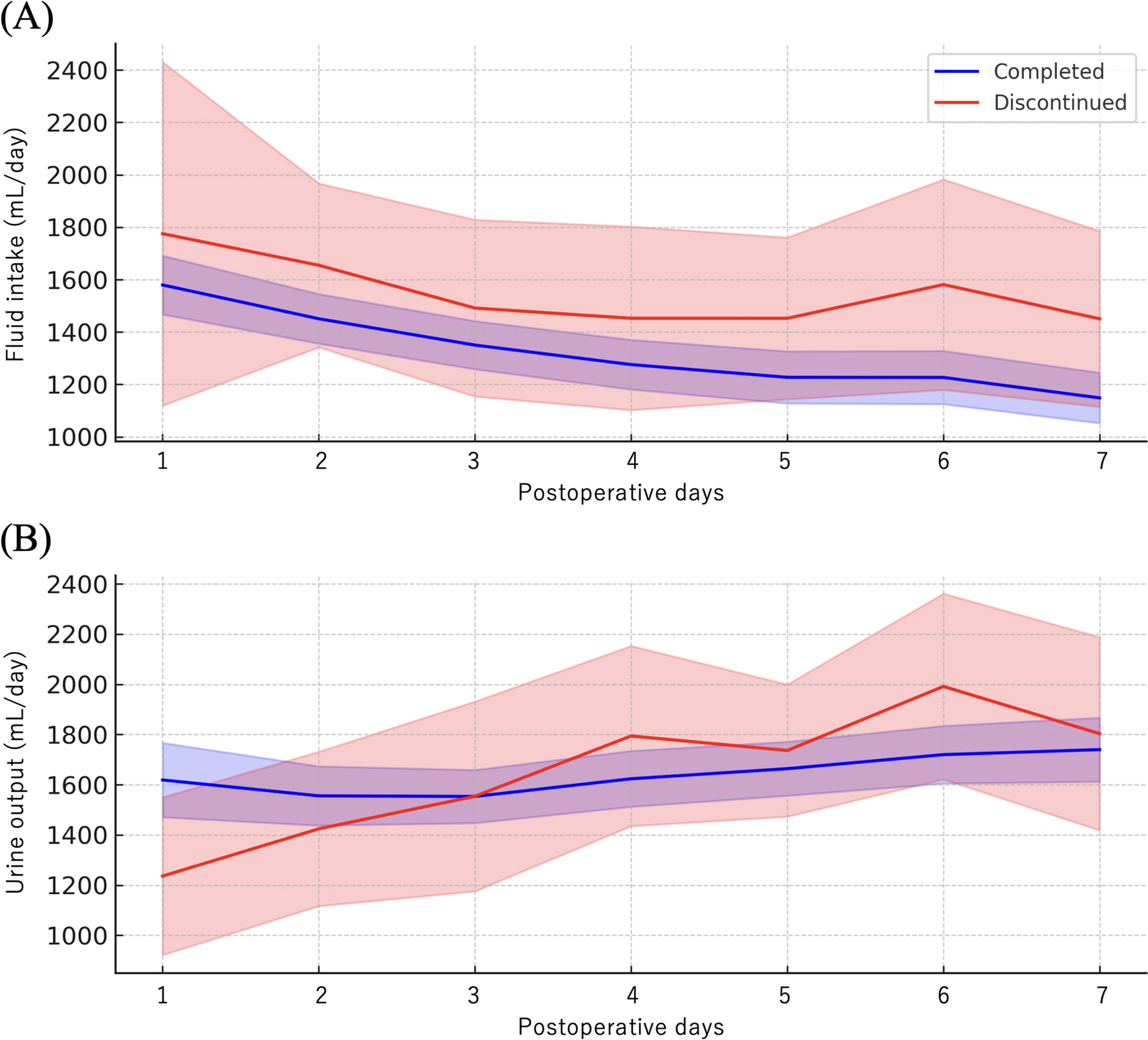
A three-layer analysis of intake, output, and fluid balance revealed that early fluid divergence was primarily driven by reduced output rather than excessive infusion. Despite comparable intake volumes, patients who completed clazosentan therapy demonstrated greater early diuresis and achieved a neutral-to-negative balance, whereas those who discontinued treatment exhibited a more positive balance within the first 72 h. Because urine output is a nonspecific signal that can be influenced by physiologic antidiuresis, diuretic administration, and renal function, these patterns should be interpreted cautiously; nonetheless, they are consistent with impaired early fluid clearance. One plausible interpretation is that early diuretic responsiveness may reflect preserved endothelial and renal integrity under the systemic stress of subarachnoid hemorrhage, mitigating interstitial fluid accumulation and facilitating clazosentan tolerance. Conversely, patients unable to achieve early fluid clearance may transition to a state of capillary leakage and volume overload, precipitating pulmonary edema or pleural effusion that necessitates cessation of treatment. Thus, early postoperative output dynamics, rather than the administered fluid volume, represent the pivotal determinants of clazosentan tolerability. These findings align with those of prior studies that demonstrated that early diuretic responsiveness predicts tolerance to negative fluid balance and favorable outcomes in critically ill patients [11,12,13]. Early postoperative diuresis may serve as a physiological marker of preserved renal and endothelial integrity, enabling safe achievement of a mild negative balance without compromising perfusion. Conversely, a blunted excretory response in the early phase, particularly under inflammatory stress, is associated with systemic capillary leakage, interstitial fluid accumulation, and pulmonary edema [14]. This interpretation is consistent with current models of endothelial permeability regulation, wherein glycocalyx degradation and tight junction disruption promote transudation of plasma fluid even under modest positive balances [15, 16]. Together, these mechanistic insights support our observation that early controlled negative balance reflects a resilient systemic state enabling completion of clazosentan therapy.
Biological Plausibility: The “Two-Hit” Hypothesis
This observed association is grounded in the pharmacological profile of clazosentan and the systemic pathophysiology of aSAH. Clazosentan’s selective blockade of ETA receptors results in the unopposed stimulation of ETB receptors, a pharmacodynamic imbalance hypothesized to increase vascular permeability through multiple pathways, including enhanced nitric oxide production and modulation of tight junction proteins, promoting systemic capillary leak [9].
A “two-hit” hypothesis may explain the heightened vulnerability of patients with aSAH. The initial hemorrhage and subsequent systemic inflammatory response constitute the first hit, inducing baseline endothelial injury and degradation of the endothelial glycocalyx, a critical regulator of vascular permeability [15, 16]. This state renders the vasculature primed for injury. The second hit occurred with clazosentan administration, which further increased vascular permeability via ETB receptor stimulation [17]. In this doubly compromised state, standard fluid administration in the intensive care unit may overwhelm the body’s compensatory mechanisms, leading to rapid fluid extravasation. This manifests clinically as a positive fluid balance that may progress to pulmonary edema or pleural effusion. The observation that even a modest positive balance of a few hundred milliliters per day predicts discontinuation reinforces the model of heightened susceptibility.
Context within Modern aSAH Management Guidelines
These findings should be interpreted in the context of the evolution of fluid management strategies for neurocritical care. The era of prophylactic “Triple-H” therapy, which included hypervolemia, has been abandoned owing to a lack of demonstrated benefit and evidence of harm [18, 19]. Current guidelines from the American Heart Association/American Stroke Association and the Neurocritical Care Society now emphasize the maintenance of euvolemia and explicitly discourage hypervolemia to prevent complications such as pulmonary edema [1, 20]. This principle has been reinforced in recent reviews addressing DCI management [21].
Clazosentan therapy, if not carefully managed, may drive patients toward the very state that contemporary guidelines caution against: positive fluid balance and fluid overload. This underscores the critical clinical tension that the use of a novel agent for vasospasm prevention may inadvertently conflict with the fundamental principles of systemic critical care. The positive fluid balance observed in the discontinuation group represents not only a physiological deviation but also a departure from current standards of care and a potential marker of iatrogenic harm.
Reinterpreting the CONSCIOUS Trials
This framework offers a new perspective on the contradictory findings of the CONSCIOUS-2 and CONSCIOUS-3 trials. Although these studies recommended a minimum fluid intake, they did not mandate a strict, protocolized, goal-directed strategy to maintain euvolemia [4,5,6] Notably, in the major phase III trials (CONSCIOUS-2, CONSCIOUS-3, and REACT), approximately 90% of patients in both the clazosentan and placebo arms received nimodipine as part of standard care [5, 6, 22]. Therefore, these trials did not evaluate clazosentan against a true placebo but rather assessed its additive effect within the framework of established baseline therapy with nimodipine. This context is crucial, as it may have masked a substantial treatment effect or influenced the adverse event profile.
Variations in fluid management across the participating centers may have acted as a significant, unmeasured confounder. This interpretation is supported by real-world data from multicenter cohorts, which also highlight the complexity of outcomes when clazosentan is administered alongside other therapies [23,24,25]. Patients treated at centers employing more liberal fluid strategies may have been driven into a positive fluid balance, precipitating adverse events that offset the therapeutic benefits. Conversely, patients managed with strict euvolemic control may experience clinical improvements. Therefore, the overall neutral effect on functional outcomes may represent an average of the opposing influences. These findings suggest that the full therapeutic potential of clazosentan is likely realized in a tightly regulated physiological environment that maintains euvolemia.
Clazosentan Dose and Endothelin Biology
Clazosentan is generally administered as a fixed dose regardless of body weight. Although this simplifies real-world use, interindividual variability in exposure may be influenced by body size, age, and sex, and could interact with endothelin biology to shape both efficacy and intolerance signals observed in observational cohorts.
Endothelial ETB receptors contribute to nitric oxide-mediated vasodilation and to clearance of circulating ET‑1. Human endothelial cell data suggest that endothelial ETB receptor expression is attenuated after menopause, a change that plausibly shifts the balance toward ETA-mediated vasoconstrictor tone and endothelial dysfunction [27]. Aging-related vascular dysfunction has also been linked to upregulated ET‑1 signaling and reduced nitric oxide bioavailability [28, 29], and venous endothelial ETB receptor protein expression appears to be preserved with aging in men [30], underscoring potentially divergent aging trajectories by sex. Taken together, these observations provide a biologically plausible (but indirect) explanation for the female predominance in the discontinuation group in our cohort and support considering sex- and age-related endothelin biology when interpreting clazosentan-associated fluid retention.
Clinical Implications
These results have important practical implications. Routine, meticulous monitoring of daily fluid balance and body weight is not ancillary but serves as a vital early warning system during clazosentan infusion. An early and persistent positive fluid balance should be considered a red flag, warranting prompt reassessment. The completion group achieved a mean early balance of −150 ± 450 mL/day, setting a critical physiological benchmarking target for safe clazosentan continuation. Clinicians should aim to maintain a neutral or mildly negative balance during the early phase. An early and persistent positive fluid balance ≥ +750 mL/day should be considered as a red flag, warranting prompt reassessment. This may include intensive diuretic therapy or, in high-risk patients, the implementation of advanced hemodynamic monitoring such as transpulmonary thermodilution for quantitative assessment of extravascular lung water (EVLW). EVLW provides an objective, early measure of pulmonary congestion to guide aggressive fluid de-escalation via loop diuretics before overt respiratory failure necessitates clazosentan withdrawal [24,25,26]. If a positive balance cannot be corrected within the first 72 h, the risk–benefit profile of continuing clazosentan should be re-evaluated, particularly before the onset of irreversible pulmonary complications.
Limitations
This study has several limitations. First, fluid balance derived from recorded intake and output did not account for dietary water content, insensible water losses, or day-to-day variation in these components. Although our sensitivity analysis incorporating an assumed insensible loss supported the robustness of the association, future studies should combine intake/output data with serial body weight measurements and, where feasible, objective hemodynamic or pulmonary congestion assessments.
Second, the observational design precludes causal inference. Unmeasured or incompletely measured confounders may have influenced both fluid balance and the decision to discontinue clazosentan, including baseline cardiac function, early postoperative respiratory status, inflammatory burden, detailed renal indices (including baseline creatinine/eGFR), and the dosing and timing of diuretics and vasoactive agents. Because oliguria and positive balance can reflect physiologic antidiuresis, SIADH/CSWS spectrum physiology, or renal dysfunction, our results should be interpreted as hypothesis generating rather than definitive evidence of a single mechanism.
Third, we did not directly measure endothelial permeability, capillary leak biomarkers, echocardiographic indices, lung ultrasound findings, or other physiological markers that could distinguish cardiac from noncardiac causes of pulmonary edema. Therefore, the proposed link between early fluid retention and systemic capillary leak remains indirect.
Finally, outcomes were assessed at discharge only, and longer-term functional status (e.g., 90 days) was not available in this registry. The sample size, particularly of the discontinuation subgroup, limited the number of covariates that could be incorporated without overfitting. Prospective studies with standardized monitoring and long-term follow-up are warranted to validate these findings and define clinically actionable thresholds.



Comments (0)