
Remember me

The study protocol is reported in accordance with the Standard Protocol Items: Recommendations for Interventional Trials guidelines [13, 14].
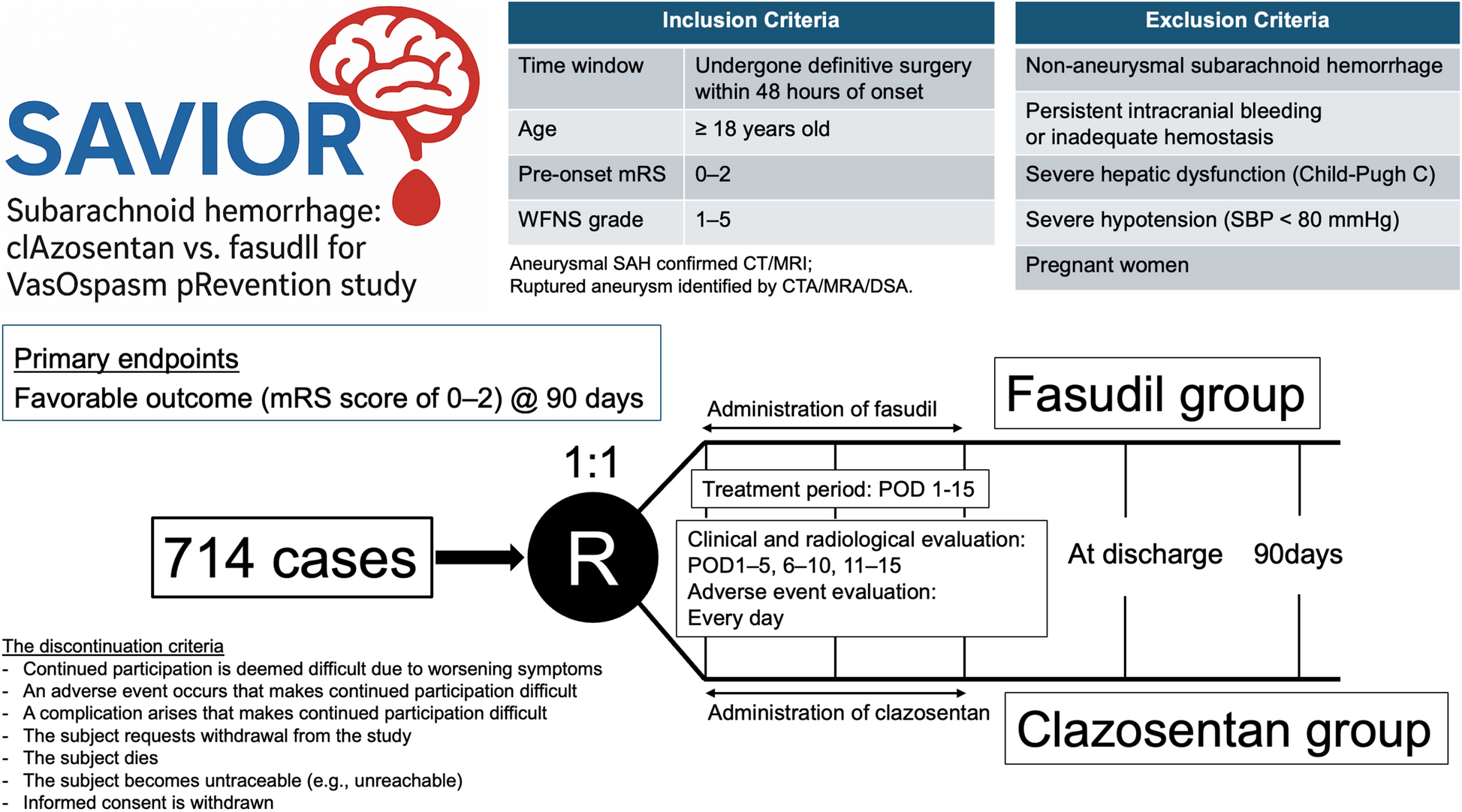
DesignThis is a multicenter, open-label, randomized, parallel-group superiority trial conducted across 21 high-volume stroke centers in Japan. As shown in Fig. 1, Patients will be randomly allocated in a 1:1 ratio to receive either fasudil hydrochloride hydrate (control group) or clazosentan sodium (intervention group). The detailed study schedule is presented in Table 1.
Fig. 1
Study flowchart. This is a multicenter, open-label, randomized, parallel-group superiority trial conducted across 21 high-volume stroke centers in Japan. Patients will be randomly allocated in a 1:1 ratio to receive either fasudil hydrochloride hydrate (control group) or clazosentan sodium (intervention group). The primary outcome is the proportion of patients achieving a favorable functional status, defined as a mRS score of 0–2, at 90 days following aSAH onset
Table 1 Assessment schedule overviewAlthough this trial is open-label, it is designed as a pragmatic head-to-head comparative effectiveness study reflecting routine clinical use in Japan. Blinding of treatment administration was considered; however, it was deemed impractical because the approved regimens require fundamentally different delivery methods (continuous infusion for clazosentan vs. intermittent intravenous dosing two to three times daily for fasudil). A double-dummy approach would require additional infusions/boluses and increased line manipulations, potentially altering fluid/volume exposure and thereby affecting key safety outcomes such as fluid retention. To mitigate bias inherent to open-label administration, the protocol prespecifies standardized co-interventions and rescue-therapy documentation, structured functional outcome assessment by personnel independent of the treating team, and prespecified imaging schedules with adjudication procedures and sensitivity analyses (see “Intervention,” “Outcomes,” and “Statistical analyses”). Because post-SAH circulatory management and avoidance of sustained positive fluid balance are guideline-consistent and prognostically relevant, minimizing protocol-induced differences in fluid/volume exposure was considered essential to preserve interpretability of safety endpoints [15].
Enrollment is ongoing. On the basis of observed recruitment rates and historical caseloads at participating centers, we anticipate a total enrollment period of approximately 2.5–3 years. Recent declining trends in aneurysmal subarachnoid hemorrhage (aSAH) surgical volumes may affect future accrual rates, and projections will be updated if material changes occur.
Patient PopulationInclusion CriteriaEligible participants are adults aged ≥ 18 years diagnosed with aSAH due to a ruptured cerebral aneurysm confirmed by imaging. aSAH was confirmed in all patients with a plain head computed tomography (CT) scan. Patients who had symptoms for several days prior to presentation were excluded from this study to ensure that there were no cases in which the diagnosis was difficult. The identification of the site of ruptured aneurysm used CT angiography or digital subtraction angiography. Participants must have received definitive aneurysm treatment—either surgical clipping or endovascular coiling —within 48 h of hemorrhage onset. Participants must additionally have a pre-morbid modified Rankin Scale (mRS) score of 0–2 and a World Federation of Neurosurgical Societies (WFNS) grade of I–V post-resuscitation.
Exclusion CriteriaPatients will be excluded if they meet any of the following conditions: (1) subarachnoid hemorrhage from a non-aneurysmal cause; (2) known hypersensitivity to either study drug; (3) pregnancy; (4) persistent intracranial bleeding or inadequate hemostasis post-procedure; (5) severe hepatic dysfunction (Child–Pugh class C); (6) severe hypotension (systolic blood pressure < 80 mmHg) refractory to treatment; or (7) any other condition deemed unsuitable for participation by the attending physician. In addition, patients for whom definitive aneurysm securing cannot be performed within 48 h owing to irreversible brain injury and/or a planned immediate withdrawal/withholding of life-sustaining treatment are excluded. Pre-existing do-not-resuscitate (DNR) orders established prior to enrollment, or a planned limitation of care before protocol-defined prophylaxis initiation, render the patient ineligible. Patients presenting at screening with bilateral fixed and dilated pupils accompanied by absent brainstem reflexes, when documented and judged to be irreversible by the treating team, will be considered ineligible. Large territorial infarction identified before initiation of the assigned study drug (on the basis of mandatory early postoperative imaging; see “Outcomes”) is also an exclusion criterion.
Informed ConsentWritten informed consent was obtained from all participants. For adults who were unconscious or lacked decision-making capacity, consent was obtained from legally authorized representatives or guardians. If the patient’s level of consciousness improved during the course of treatment, informed consent was subsequently obtained from the patient themselves.
RandomizationEligible patients will be enrolled through a centralized, web-based system with allocation concealment until enrollment is complete. Treatment assignment will use dynamic allocation by minimization to reduce imbalance across prespecified minimization factors: (1) participating institution, (2) age (< 75 years vs. ≥ 75 years), (3) admission WFNS grade (I–III vs. IV–V), and (4) aneurysm treatment modality (surgical clipping vs. endovascular coiling). The minimization procedure includes a random component to preserve allocation unpredictability. The minimization algorithm and web-based randomization platform are programmed and maintained by an independent statistician at the data center who is not involved in recruitment or clinical care.
Blinding (Masking)Because the approved regimens require fundamentally different delivery methods (continuous infusion for clazosentan vs. intermittent intravenous dosing for fasudil), participants and treating clinicians will not be blinded to treatment allocation. To mitigate bias, the protocol prespecifies standardized co-interventions and rescue-therapy documentation, and the 90-day mRS is assessed by trained personnel independent of inpatient care and blinded to treatment assignment. Imaging-based endpoints will be evaluated using prespecified definitions with sensitivity analyses accounting for imaging modality and clinical indication.
InterventionFasudil group (control): patients will receive fasudil hydrochloride hydrate at a dose of 30 mg, diluted and administered as a 30-min intravenous infusion, two to three times daily.
Clazosentan group (intervention): patients will receive clazosentan sodium via continuous intravenous infusion at a rate of 10 mg/h.
In both groups, the assigned study drug must be initiated within 24 h after aneurysm securing, contingent on confirmation of hemostasis and the absence of new or worsening intracranial hemorrhage on a noncontrast head CT performed within 12 h after the procedure. Written informed consent will be obtained as early as feasible after aneurysm securing and in all cases prior to initiation of the assigned study drug. If these criteria are not met, initiation is deferred; the reason and timing are documented. Treatment will continue for up to postoperative day 15. Clazosentan dose adjustments are permitted in accordance with the manufacturer’s label for hepatic impairment or drug interactions. Fluid balance and blood pressure will be managed in accordance with institutional protocols, accompanied by close monitoring for potential complications. Blood pressure monitoring follows routine care by clinical setting. In mechanically ventilated or otherwise critically ill patients managed in the intensive care unit, continuous blood pressure monitoring (arterial line or equivalent) is standard; in general wards, intermittent blood pressure measurements are performed at least 4–6 times per 24 h, with additional measurements mandated upon neurological change or clinical deterioration. Clinically significant hypotension is defined a priori as systolic blood pressure < 90 mmHg or mean arterial pressure < 65 mmHg sustained for ≥ 15 min or any hypotension requiring vasopressor initiation or escalation. For analytic purposes during the prophylaxis window, the minimum systolic blood pressure (SBP) and mean arterial pressure (MAP) within each 24-h period, along with vasopressor initiation/escalation (agent, dose, timing, and indication), will be systematically captured. Hypotension events and related management are captured as adverse events and graded using the Common Terminology Criteria for Adverse Events v5.0 (CTCAE v5.0) [16]. To account for potential confounding effects of fluid management, comprehensive daily data will be collected for all patients throughout the treatment period. This includes fluid input/output, daily body weight, central venous pressure (if monitored), and the type, dose, and frequency of all administered diuretic agents. These data will enable prespecified exploratory analyses to assess the influence of fluid management strategies on clinical outcomes. Concomitant use of other vasoactive or neuroprotective agents (e.g., cilostazol, statins) is permitted at the discretion of the clinical team. However, concurrent administration of fasudil and clazosentan is prohibited. This restriction is informed by multicenter real-world evidence suggesting that adding fasudil to clazosentan-based regimens did not reduce vasospasm incidence and was associated with cardiopulmonary complications (including pulmonary edema) and worse short-term functional outcomes, potentially mediated by fluid retention [10].
Rescue therapies for suspected delayed cerebral ischemia and/or clinically significant vasospasm are prespecified and systematically captured to reduce performance bias across sites. Recorded rescue measures include: (1) vasopressor use (agent, maximum dose, start/stop date-time, and indication), (2) induced hypertension protocols (target systolic blood pressure/mean arterial pressure, achieved values, and duration), and (3) endovascular rescue therapies (intra-arterial vasodilator infusion and/or balloon angioplasty, timing, and treated vessels). Clinical triggers for escalation and documentation procedures are standardized across participating centers.
Primary OutcomesThe primary outcome is the proportion of patients achieving a favorable functional status, defined as an mRS score of 0–2, at 90 days (± 15 days) following aSAH onset. To minimize assessment bias in this open-label trial, the 90-day mRS evaluation will be conducted through in-person interviews using a standardized structured questionnaire [17, 18]. Assessments will be conducted by trained personnel such as neurosurgeons, nurses, or rehabilitation therapists who are not directly involved in the patient’s routine clinical management. Outcome assessors will be blinded to treatment allocation and will not have access to inpatient medication records; treatment allocation will be stored separately from follow-up materials, and participants/caregivers will be instructed not to disclose the assigned treatment during interviews. The follow-up modality, assessor affiliation, and any suspected unblinding will be recorded prospectively and examined in prespecified sensitivity analyses.
Secondary OutcomesEfficacy OutcomesmRS score at hospital discharge.
Incidence of angiographic cerebral vasospasm, defined as ≥ 50% vessel narrowing on computed tomography or magnetic resonance angiography compared with baseline, assessed at prespecified intervals (days 1–5, 6–10, and 11–15).
To reduce verification bias and support attribution of ischemic lesions, early postoperative noncontrast head CT on postoperative day 1 is mandatory for all participants. Follow-up brain magnetic resonance imaging (MRI)/magnetic resonance angiography (MRA) is scheduled during postoperative days 1–5, 6–10, and 11–15 and serves as the standard modality for protocol-defined assessment of vasospasm and infarction, because it allows the simultaneous evaluation of luminal narrowing and subtle ischemic lesions. CT/CT angiography and/or digital subtraction angiography (DSA) may be performed when clinically indicated and/or as part of routine institutional assessment; the indication (clinical vs. routine) will be prospectively recorded to support prespecified sensitivity analyses addressing verification bias. To address potential outcome misclassification due to modality-specific diagnostic performance and preferential use of DSA in clinically suspicious cases, prespecified sensitivity analyses stratified by imaging modality and by clinical indication for CT angiography (CTA)/DSA will be performed (see “Statistical analyses”). For patients with impaired renal function or iodinated contrast allergy, follow-up evaluation is performed using MRI/MRA without iodinated contrast, and CTA/DSA is avoided unless clinically imperative. Baseline renal function (serum creatinine and estimated glomerular filtration rate) will be recorded for all participants prior to any contrast-enhanced imaging and will inform modality selection in accordance with institutional safety protocols.
The incidence of vasospasm-related cerebral infarction, defined as a new infarct on follow-up imaging (absent at baseline and not attributable to the surgical procedure) located within a vascular territory corresponding to angiographic vasospasm. If necessary, classification of infarcts as vasospasm-related will be determined by an independent, central adjudication committee blinded to treatment allocation, on the basis of a comprehensive review of all clinical and imaging data.
Incidence of all new cerebral infarctions.
Rate of rescue therapies for symptomatic vasospasm (e.g., intra-arterial vasodilator infusion, balloon angioplasty).
All-cause mortality at 90 days.
The definitions of DCI-related clinical and imaging outcomes are aligned with the 2010 multidisciplinary consensus recommendations for outcome events after aSAH [19].
To ensure unbiased interpretation of mortality and functional outcomes, limitation-of-care variables are prospectively collected, including do-not-resuscitate (DNR) orders, decisions to withdraw or withhold life-sustaining treatment, the timing of these decisions, and adjudicated causes of death.
Safety OutcomesIncidence of grade ≥ 3 adverse events (AEs) classified according to the CTCAE v5.0 [16].
Incidence of AEs of special interest, specifically those related to fluid retention (e.g., pulmonary edema, pleural effusion, cerebral edema) and hypotension.
Incidence of hyponatremia and hypoalbuminemia.
Standard-of-care laboratory parameters, including electrolytes (sodium), renal function markers, liver enzymes, hemoglobin, albumin, and cardiac biomarkers (e.g., BNP/NT-proBNP), are systematically collected. A baseline 12-lead ECG is recorded upon admission, with repeat ECGs and echocardiography obtained on the basis of prespecified clinical triggers suggestive of myocardial dysfunction. All laboratory and cardiac abnormalities are graded using CTCAE v5.0.
Data Monitoring BodyAn independent efficacy and safety evaluation committee (ESEC), consisting of neurosurgeons not otherwise involved in trial conduct, will oversee participant safety and provide independent oversight to the coordinating center. The ESEC will review aggregated safety data at prespecified intervals (every 6 months and ad hoc if a safety signal is suspected), including serious adverse events, deaths, and adverse events of special interest (fluid retention-related complications and hypotension), summarized by treatment group. Serious adverse events will be reported by each participating site to the coordinating center without delay, and the coordinating center will notify the relevant institutional review boards/ethics committees and the Japan Registry of Clinical Trials (jRCT) oversight body as required. These reviews are intended for safety surveillance and will not involve formal interim efficacy analyses, interim hypothesis testing, or any alpha-spending procedure; decisions regarding continuation, modification, or discontinuation will be based on clinical safety considerations and the totality of accumulated evidence. In addition, trial conduct (recruitment progress, protocol adherence, and data completeness) will be monitored centrally by the coordinating center through periodic data checks and query resolution.
Interim Efficacy AnalysesNo formal interim efficacy analyses or statistical stopping rules are planned. Safety oversight will be conducted by an independent ESEC, which will review aggregated safety data every 6 months (and ad hoc if a safety signal is suspected); these reviews are for safety surveillance only and are not used for statistical decision-making regarding efficacy. Serious adverse events will be reported without delay from each participating site to the coordinating center, which will notify the relevant institutional review boards/ethics committees and the jRCT oversight body as required. Any recommendation to modify, suspend, or terminate the trial will be based on clinical safety considerations and the totality of accumulated evidence.
Sample Size EstimatesThe sample size calculation is based on institutional retrospective data, which reported a favorable outcome (mRS 0–2) rate of 62.2% for clazosentan and 50.5% for fasudil [20]. To account for potential selection bias in the retrospective data, a conservative estimate was adopted: a favorable outcome rate of 60% for the clazosentan group and 50% for the fasudil group. As the study is designed to evaluate the superiority of clazosentan over fasudil, statistical significance will be declared only if clazosentan demonstrates a better outcome. We selected a superiority framework rather than a noninferiority design because an acceptable noninferiority margin for a patient-centered endpoint (90-day mRS) would be difficult to justify clinically and methodologically, and clazosentan has a distinct adverse-event profile (e.g., fluid retention) that warrants requiring clear net clinical benefit before recommending routine substitution. Accordingly, a nonsignificant result will be interpreted as inconclusive for superiority rather than evidence of equivalence. Sample size was calculated using Fisher’s exact test (one-sided, α = 0.05, power = 0.80). On the basis of these assumptions (p1 = 0.60 vs. p2 = 0.50, with equal allocation), 321 evaluable subjects per group are required to achieve 80% power. Considering a 10% dropout rate, the target enrollment was set at 357 subjects per group, resulting in a total sample size of 714 subjects.
Discontinuation of Study Treatment, Subject Follow-Up, and Trial TerminationFor individual subjects, study treatment will be discontinued if continued participation is deemed difficult owing to worsening symptoms, adverse events, or complications; if the subject requests discontinuation; if the subject dies; if the subject becomes untraceable; if informed consent is withdrawn; or if the investigator determines that continued participation is otherwise inappropriate. Subjects who discontinue study treatment or complete the assigned treatment will, whenever feasible, continue follow-up through the end of the study participation period in accordance with the prespecified schedule, and the assessments specified in the study calendar will be collected within 14 days after treatment discontinuation. At the trial level, the study will be discontinued if the principal investigator determines that discontinuation is appropriate, if the hospital director, certified review board (CRB), or other relevant authority discontinues the trial, or if conduct of the trial at a participating site is deemed difficult. If none of these conditions occur and the final observation is completed as planned, the trial will be considered completed.
Statistical AnalysesThe primary endpoint defined as a mRS score of 0–2 at 90 days will be compared between groups using a one-sided Fisher’s exact test (α = 0.05), consistent with the sample size calculation. To avoid selective reporting and to support interpretation in either direction, the estimated risk difference will be reported with a two-sided 95% confidence interval, and both one-sided (for the prespecified superiority hypothesis) and two-sided P-values will be provided. Superiority will be concluded only if clazosentan yields a significantly higher proportion of favorable outcomes compared with fasudil in the prespecified one-sided test; however, all effect estimates and two-sided inference will be reported irrespective of the direction of the observed effect.
The primary efficacy analysis will be conducted in the intention-to-treat (ITT) population, defined as all randomized participants analyzed according to randomized assignment, regardless of treatment initiation or adherence. Participants will not be excluded from the ITT analysis solely owing to missing post-baseline efficacy assessments. A safety analysis set (SAS) will include all participants who receive any amount of the assigned study drug. Participants with missing 90-day mRS will be retained in the FAS and handled according to the prespecified missing-data strategy (multiple imputation and sensitivity analyses) rather than excluded. Death by day 90 will be treated as an observed outcome and coded as mRS = 6; such cases will not be imputed for the primary endpoint. Multiple imputation will therefore be applied to participants with missing 90-day mRS among those without confirmed death by day 90 (or with unknown vital status), using an imputation model that includes treatment group, stratification/minimization factors, baseline prognostic variables, and early clinical indicators associated with both missingness and outcome. The Per-Protocol Set (PPS) will comprise participants in the FAS excluding those with prespecified major protocol deviations that materially affect treatment exposure or endpoint ascertainment (e.g., use of prohibited vasospasm prophylactic agents or failure to initiate the assigned study drug within the prespecified window without a documented clinical contraindication); PPS analyses will be treated as sensitivity analyses. Missing 90-day mRS data will be minimized by prespecified follow-up procedures. The primary approach for handling missing primary outcome data will use multiple imputation under a missing-at-random assumption, incorporating baseline prognostic variables and early clinical indicators; robustness will be evaluated using prespecified sensitivity analyses (e.g., best–worst and worst–best case scenarios and, if appropriate, tipping-point analyses).
Secondary endpoints will be analyzed using Fisher’s exact test or the chi-squared (χ2) test, as appropriate. Subgroup analyses will be conducted based on factors such as WFNS classification, age, Fisher classification, and other relevant variables. Prespecified age-stratified analyses will be performed using the same cut-point as the randomization stratification (< 75 years vs. ≥ 75 years). In addition to the primary dichotomous analysis, an ordinal (“shift”) analysis of the 90-day mRS (0–6) will be conducted as a key secondary and sensitivity analysis using a proportional odds model; model assumptions will be assessed, and alternative ordinal methods will be applied if the proportional-odds assumption is violated. For endpoints assessed at scheduled time points where death precludes ascertainment, deaths occurring before the scheduled assessment will be handled as a competing risk; cumulative incidence functions will be presented, and Fine–Gray subdistribution hazard models will be used as prespecified sensitivity analyses. Conservative worst-case assignments will also be explored in sensitivity analyses, as appropriate. For imaging-based endpoints (vasospasm and cerebral infarction), sensitivity analyses will be performed stratified by imaging modality (MRI/MRA, CTA, and/or DSA) and by whether CTA/DSA was obtained for clinical indication vs. routine institutional assessment to quantify potential misclassification and verification bias.
Study Organization and FundingThis is an investigator-initiated trial supported by the Nagoya University Hospital Funding for Clinical Research and the Japan Research Foundation for Clinical Pharmacology. The funding bodies have no role in the study design, data collection, analysis, interpretation of results, or manuscript preparation. Data management will be handled by the Data Center at Nagoya University Hospital.
Comments (0)