Complex yet often overlooked in research, our study sought to expand the current understanding of sexual attraction in the lives of sexual minority spouses in mixed-orientation marriages. We discuss what these results may suggest to both mixed-orientation marriages and clinicians serving them.
Is SSA Associated with Greater Relational Insecurity?
On the question of whether SSA is associated with greater relational insecurity, we reported mixed results. Our study examined two dimensions of relational insecurity: avoidance and anxiety. Despite literature suggesting heightened SSA could drive avoidance and tension in mixed-orientation marriages (Dehlin et al., 2019; Legerski et al., 2017), we found no evidence that SSA was associated with relational avoidance. Yet, SSA was significantly associated with relational anxiety. This distinction between the two dimensions of relational insecurity merits careful consideration. The attachment avoidance scale primarily assesses behavioral aspects of relationship functioning–specifically, one’s willingness to seek support, discuss problems, and disclose feelings to a partner. Meanwhile, the attachment anxiety scale captures emotional dimensions of insecurity, including fears of abandonment, worries about a partner’s level of care, and concerns about relationship reciprocity. This pattern suggests that SMs with higher SSA in mixed-orientation marriages may experience heightened emotional vulnerability and uncertainty about the security of their relationship. These individuals may continue participating in expected relationship behaviors while internally harboring significant anxieties about whether their partners truly care for them, perhaps anticipating rejection if their same-sex attractions become more pronounced or acknowledged within the relationship.
These findings suggest clinicians working with SMs in a committed relationship or marriage should explore the role of same-sex attractions as a source of relational anxiety. Even if the SM does not report insecure behaviors, it may be helpful to examine internal worry about abandonment or perceived sense of unlovability, which have been connected to marital satisfaction, conflict resolution, and communication satisfaction (O’Connor et al., 2018). If the SM spouse is religious, some scholars suggest understanding the role of attraction and faith should be a precursor to exploring relational insecurity, which may stem from larger internal conflict within the SM spouse unbeknownst to their spouse (Yarhouse & Kays, 2010).
Is OSA Associated with Lower Relational Insecurity?
We found no association between OSA and relational anxiety but a significant negative association with relational avoidance. This finding aligns with previous scholarship, which suggests that physical attraction can facilitate deeper relational engagement. The negative association between OSA and relational avoidance may suggest that attraction to the sex of one’s spouse may indeed enable easier connection and foster greater relational security. Because physical and sexual attraction likely create opportunities for positive interactions that build trust and openness, sexual attraction can potentially initiate a reciprocal cycle of secure attachment between partners. This interpretation is consistent with previous research demonstrating that sexual security predicts greater love expression and lower relational distress in committed relationships (Edser & Shea, 2002).
For SMs in mixed-orientation marriages, the presence of at least some degree of OSA may serve as an important relational resource that facilitates relational engagement with their spouse. Clinicians in either individual or couples counseling should not only examine SSA, but also seek to explore the level of OSA in either spouse, and its capacity to facilitate relational security. Greater attraction to the opposite-sex may be an indication of lower opposite-sex sexual aversion, previously associated with lower likelihood of divorce or separation in mixed-orientation marriages (Dehlin et al., 2019), and thus may also operate as a unique resource against marital separation. Finally, clinicians should seek to clarify the role of OSA as either an emotional, physical, or sexual attraction, and its relationally promoting role, exploring multiple possible pathways to relational security.
Does Religiousness Moderate the Relationship Between Attraction and Relational Insecurity?
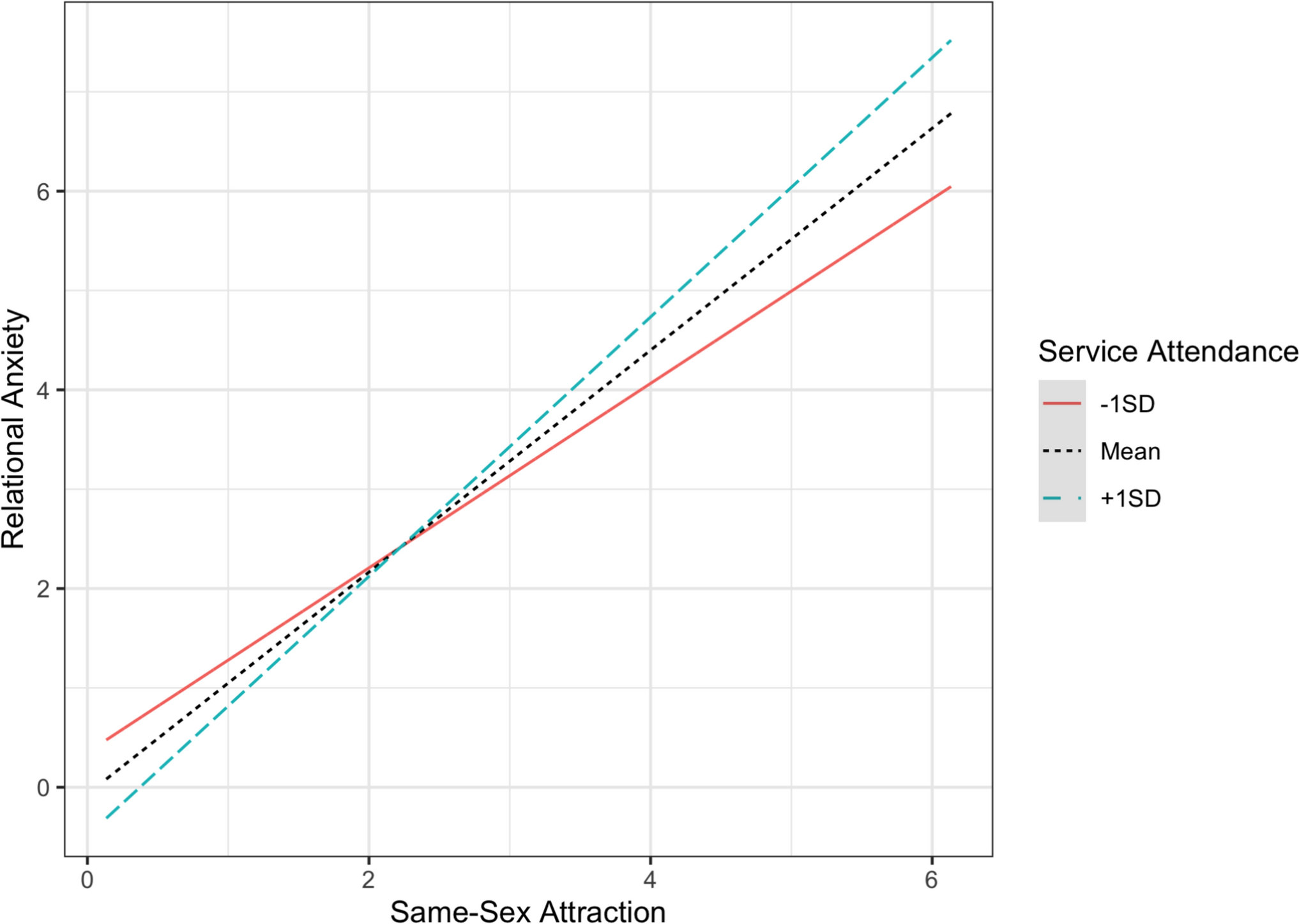
In probing religiousness as a moderator of the relationship between attraction and relational insecurity, exploratory analyses presented nuanced results. Service attendance moderated the relationship between sexual attraction and relational insecurity, while intrinsic religiousness did not. Our findings suggest that at high levels of service attendance, the relationship between SSA and relational anxiety became stronger, likewise the negative relationship between OSA and relational avoidance became stronger. We caution against interpretations of religiousness as a monolithic risk factor, in fact, our findings would suggest the opposite. In this study, we test two dimensions of religiousness: engagement with a religious community (i.e., service attendance) and intrinsic religious commitment. While service attendance was a moderator, intrinsic religious commitment was not. Service attendance may contribute to greater relational insecurity in two ways. First, because most religions hold stigmatizing views of SMs, service attendance may increase exposure to heterosexual norms and concomitant anxiety about living up to those norms. Second, it could be associated with outness, where being with others in religious settings may elevate openness and transparency, which may lead to more relational anxiety about being potentially “discovered” as a mixed-orientation marriage.
In working with mixed-orientation marriages, clinicians should examine the role of religiousness as an internal and interpersonal form of commitment. Even if SMs have “come out” to their spouse, mixed-orientation marriages may still navigate varying levels of disclosure with members of the religious community who are not supportive (e.g., religious leaders, Kim & Xu, 2025). Finding even one or two trustworthy individuals may serve as another resource for mixed-orientation marriages experiencing distress from engaging with their religious community. As noted before, addressing any internal conflict between religious and sexual within SM spouses may be crucial to understanding any relational conflict or insecurity. When SMs struggle with their own religious values and beliefs, they may be more likely to question their motivations for entering into or staying in a mixed-orientation marriage, and thus experience relational anxiety or avoidance. While religiousness can promote well-being in SMs (Lefevor et al., 2024), clinicians should carefully examine how SM spouses engage with religiousness.
Limitations
We highlight several limitations of our study. First, our retrospective sample from 2018 reported an average age of 40, but additional years at the time of this publication. Our study examined internal religiosity at a time when public religiosity was declining (Nadeem, 2022) across all age groups, particularly the young. Thus, the applicability of this study may be limited to younger or non-religious SMs compared to older generations (i.e., more religious).
Second, we acknowledge our study was limited by the fact that the majority (82%) of our sample consisted of White respondents, while SMs of Color made up only a small portion (8%) of the sample; with over 2 million SMs in mixed-orientation marriages, this study likely lacks generalizable results for SMs of Color. Future research should employ more diverse recruitment strategies including partnering with LGBTQ + community centers serving communities of color, utilizing respondent-driven sampling, advertising through non-English media, and ensuring study materials are culturally appropriate and available in multiple languages.
Third, our recruitment through mixed-orientation marriage-specific Facebook groups and therapy listservs likely oversampled individuals who are religiously engaged, seeking therapeutic support, and highly educated (86% with bachelor's degrees or higher). This selection bias may limit generalizability to more isolated, less religious, or non-help-seeking mixed-orientation marriages. The associations we observed between religiousness and attachment should be interpreted cautiously given our sample’s high religious involvement.
Fourth, our study design does not allow us to determine the specific mechanisms through which sexual attraction influences attachment insecurity. While we theorized that attraction directly affects attachment processes through promoting or hindering emotional and physical closeness, it is also plausible that other unmeasured factors—such as experiences of discrimination, internalized stigma, or concealment of sexual orientation—may partially or fully account for the observed associations. These processes were discussed in our introduction as contextual factors affecting mixed-orientation marriages but were not directly assessed.
Fifth, our two-item measure of intrinsic religiousness, while demonstrating acceptable reliability (α = .72), may have limited our ability to capture internalized religious commitment, potentially explaining why it did not moderate attraction-attachment relationships while service attendance did. Future research should employ more comprehensive religiousness measures.
Finally, our cross-sectional design precludes causal inferences about directionality. Attachment insecurity may influence how individuals experience sexual attraction, rather than vice versa, or both may be influenced by third variables. We strongly recommend longitudinal research tracking changes in attraction, attachment, and relationship outcomes over time. Dyadic designs including both partners would be especially valuable for understanding mutual influence processes in mixed-orientation marriages.

Comments (0)