Our study has two principal findings. One, while both stone formers and non-stone formers had similar understanding of the role that fluid, red meat and salt have on recurrent stone disease, stone formers demonstrated significantly better understanding of the role of dietary oxalate. Two, amongst stone formers, receipt of both dietary counseling and a metabolic workup was associated with the best understanding of dietary prevention strategies.
While stone formers demonstrated better understanding of dietary prevention strategies compared to non-stone formers, accuracy rates were poor overall. Amongst all participants, > 60% answered questions surrounding the role of water, salt, lemonade, red meat and clear soda correctly. On the remaining seven questions, however, accuracy ranged widely from 10% to 54%. Stone formers who received both counseling and underwent a metabolic workup, performed significantly better than non-stone formers and stone formers who received either forms of counseling or none on questions surrounding oxalate-containing foods. Given the specialized knowledge this represents, this suggests that dietary counseling is retained and is efficacious. However, it is notable that at least half of patients – including those who have received a metabolic workup and counseling – did not recall this information. These response rates were similar to those reported in a study of 753 participants recruited from a county fair, 35% of whom had a history of prior stone disease [14]. As in this prior study, our cohort was highly educated, with over 80% reporting at least a college degree. However, this finding highlights that kidney stone specific education encompasses specialized concepts not commonly encountered during general education, suggesting that baseline knowledge gaps persist regardless of formal educational attainment. Participants (regardless of prior stone history) identified the role of water and salt in stone formation most accurately. The role of oxalate-containing foods, however, was the most challenging, with less than 50% accuracy rates across all items. These findings suggest that oxalate-specific education could be a high yield target for future patient education interventions though concerns remain regarding the efficacy of such dietary interventions in decreasing stone recurrence.
Both stone-specific quality of life and intensity of counseling were predictors of disease-specific health literacy. In our multivariable model, receipt of both a workup and counseling were associated with increased stone-specific health literacy (Supplementary Table 1). Stone formers who received more counseling also demonstrated worse quality of life, likely because these patients had more severe underlying stone disease as demonstrated by a higher proportion of patients who received more counseling also reporting prior surgery or recurrent stones. To our knowledge, this is the first report of this association amongst stone patients though this is not surprising as health literacy has been shown to be positively correlated with quality of life amongst cancer patients [17] and other chronic diseases.18,19 In addition, low health literacy has been associated with poor health outcomes and up to half of patients are at risk of limited health literacy [20, 21]. Health literacy regarding stone disease may be limited as in a cross-sectional study of 1,018 urologic patients, almost 75% did not believe or did not know diet influenced stone disease risk [15]. Comprehensive counseling and workup can improve patient understanding of their disease and encouragingly, over 70% of participants reported they would be ready to make dietary modifications to decrease their risk of stone formation [15]. However, long-term adherence, patient access to healthy foods, and other social determinants of health remain difficult barriers to overcome [12].
This study has several important limitations to consider. First, while our study participants were drawn from a large, nationwide, diverse population, it was still skewed towards white adults with at least a college education, limiting its generalizability. Patients with more education are less likely to present with severe stone disease 22, therefore, our cohort may be skewed more towards individuals with less advanced stone disease for whom a metabolic workup was not indicated. However, all patients with stone disease should receive at least stone dietary counseling and yet 42% of our respondents did not recall receiving either counseling or a workup. Second, our questionnaire was not validated so there is a risk of measurement bias in our sample. The dietary questionnaire served as a disease-specific proxy for assessing health literacy related to kidney stone prevention. In addition, as a survey-based study, there is a chance of recall bias or response error. However, our survey is based on one used in a community cohort [14] and yielded similar accuracy rates among similar domains. Third, the recommendations tested were not as applicable to non-calcium-based stones (i.e. uric acid or struvite), however, calcium-based stones are by far the most common amongst stone formers [23] We also did not have patients’ stone composition though self-reported stone composition would be prone to recall bias. Future directions could incorporate these data in order to better understand dietary education gaps. Fourth, while we found the largest differences in accuracy amongst oxalate-related questions, many standard stone patients would not be expected to have received this targeted counseling as oxalate is not a component of all stones and hyperoxaluria requires a 24-hour urine test to identify. Fifth, our study did not use a standardized health literacy tool, and instead used a knowledge-based questionnaire as a proxy to assess disease-specific understanding. Finally, our questionnaire may be over-simplified especially with only a binary outcome where there are many nuances to stone dietary management. While this may limit our ability to capture partial understanding, prior research suggests that a good-bad dichotomy may be the most effective for dietary counseling [24].
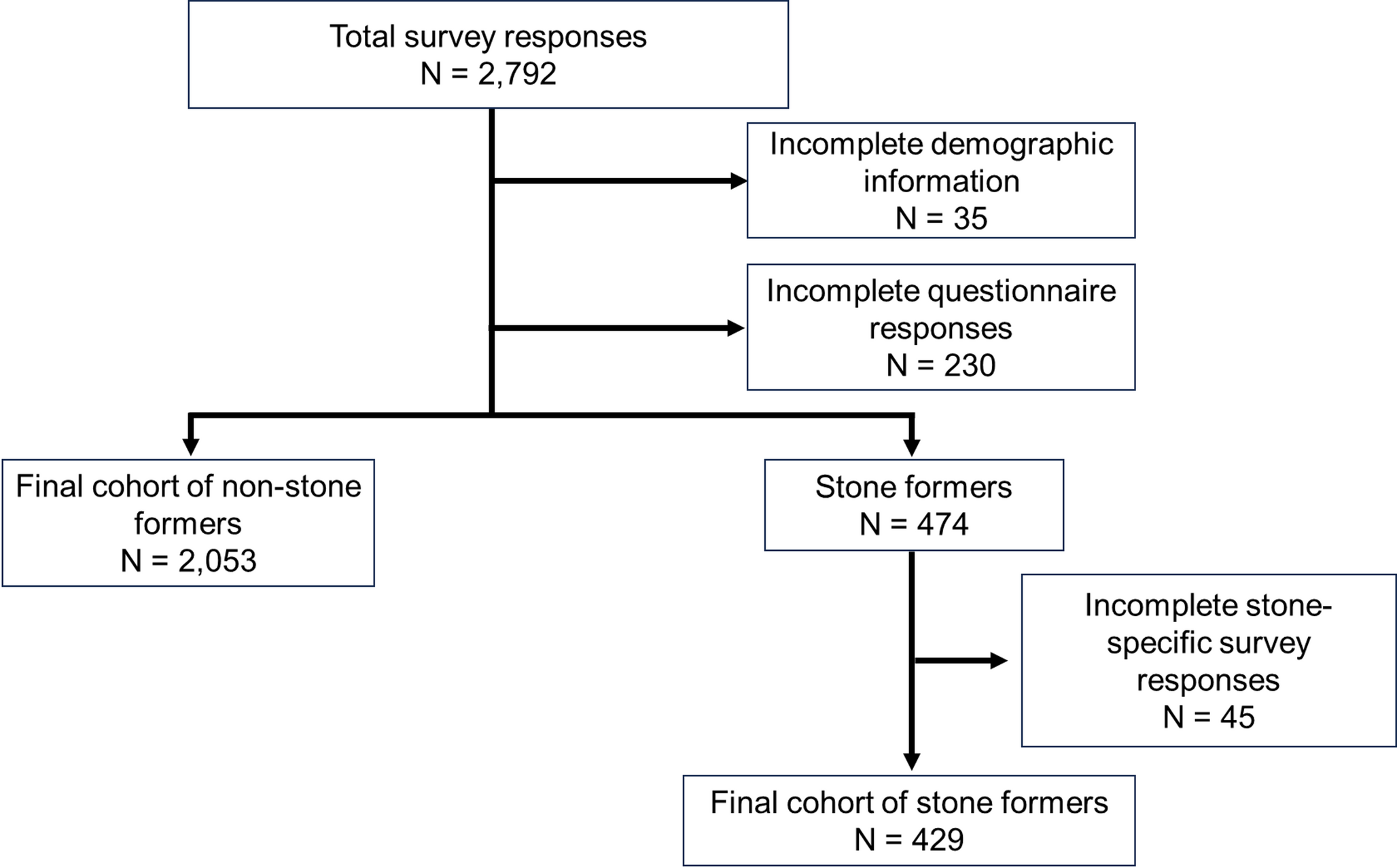
Nonetheless, this study is the largest reported in the literature with over 2400 respondents sampled from across the nation and incorporated assessment of disease-specific quality of life using a validated survey [16]. The overall low accuracy rate for both non-stone formers and stone formers on oxalate-specific questions in particular suggests this may be a high yield target for future intervention. While adherence rates to dietary therapy are commonly reported below 50% [25, 26], strategies for improving patient adherence have included incorporating Registered Dietitian Nutritionists into practice [27] and group appointments for stone patients [28]. The rise of smart or digital health technology [29,30] may improve patient adherence with smart containers to monitor fluid intake, wearable technology with sensor capability or applications to send automated electronic reminders. Ultimately, enabling stone patients to better understand their own disease should lead to improved participation in and adherence to primary prevention thereby leading to decreased recurrent stone events and improve quality of life.



Comments (0)