GA-SPARF: Genetic algorithm-tuned random forest for sleep position monitoring using accelerometer
Objective
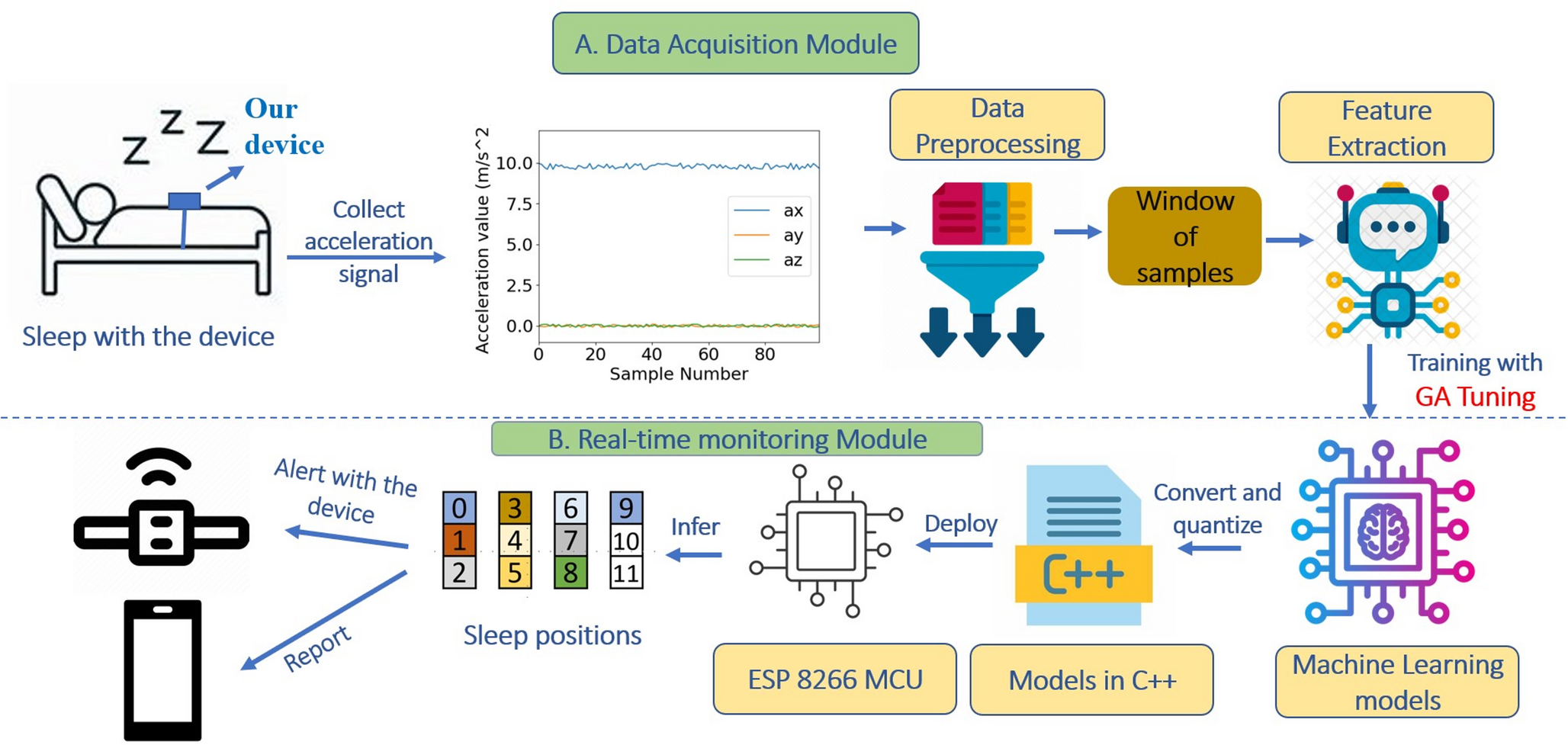
This study presents GA-SPARF, a wearable Internet of Things (IoT) system for real-time sleep posture monitoring aimed at supporting Gastroesophageal Reflux Disease (GERD) management. Unlike prior studies that typically classify a limited number of sleep postures (e.g., 4–5 classes), GA-SPARF enables real-time classification across 12 distinct sleep positions with high accuracy and low power consumption, thereby enhancing its clinical applicability and scalability for long-term home-based monitoring.
Methods
The system integrates a single ADXL345 accelerometer positioned on the abdomen, an ESP8266 microcontroller, and Wi-Fi connectivity for real-time data transmission. Data were collected from 20 participants in a controlled environment across 12 labeled postures. Preprocessing involved noise filtering, missing value imputation, and extraction of statistical and kinematic features. A Random Forest (RF) model was optimized using a Genetic Algorithm (GA) and benchmarked against Decision Tree (DT), Gradient-Boosted Decision Trees (GBDT), Support Vector Machine (SVM), and K-Nearest Neighbors (KNN) classifiers using 5-fold cross-validation.
Results
The GA-optimized RF model achieved an average accuracy and F1-score of 99.79 ± 0.02%, outperforming all baseline models. Inference time was 3 ms per prediction, with minimal power consumption. Clinically significant postures—supine (D), right lateral (R), and left lateral (DL)—were classified with 100% sensitivity, positive predictive value (PPV), and negative predictive value (NPV), underscoring the system’s clinical relevance. Despite minor confusion between adjacent postures, the overall classification performance remained consistently high.
Conclusion
GA-SPARF demonstrates state-of-the-art performance in sleep posture classification using a compact and low-cost setup. Unlike previous studies, it supports a broader set of postures and enables real-time deployment on constrained hardware. This work offers a practical tool for GERD care and lays the groundwork for future innovations in wearable health monitoring.

Comments (0)