
Remember me
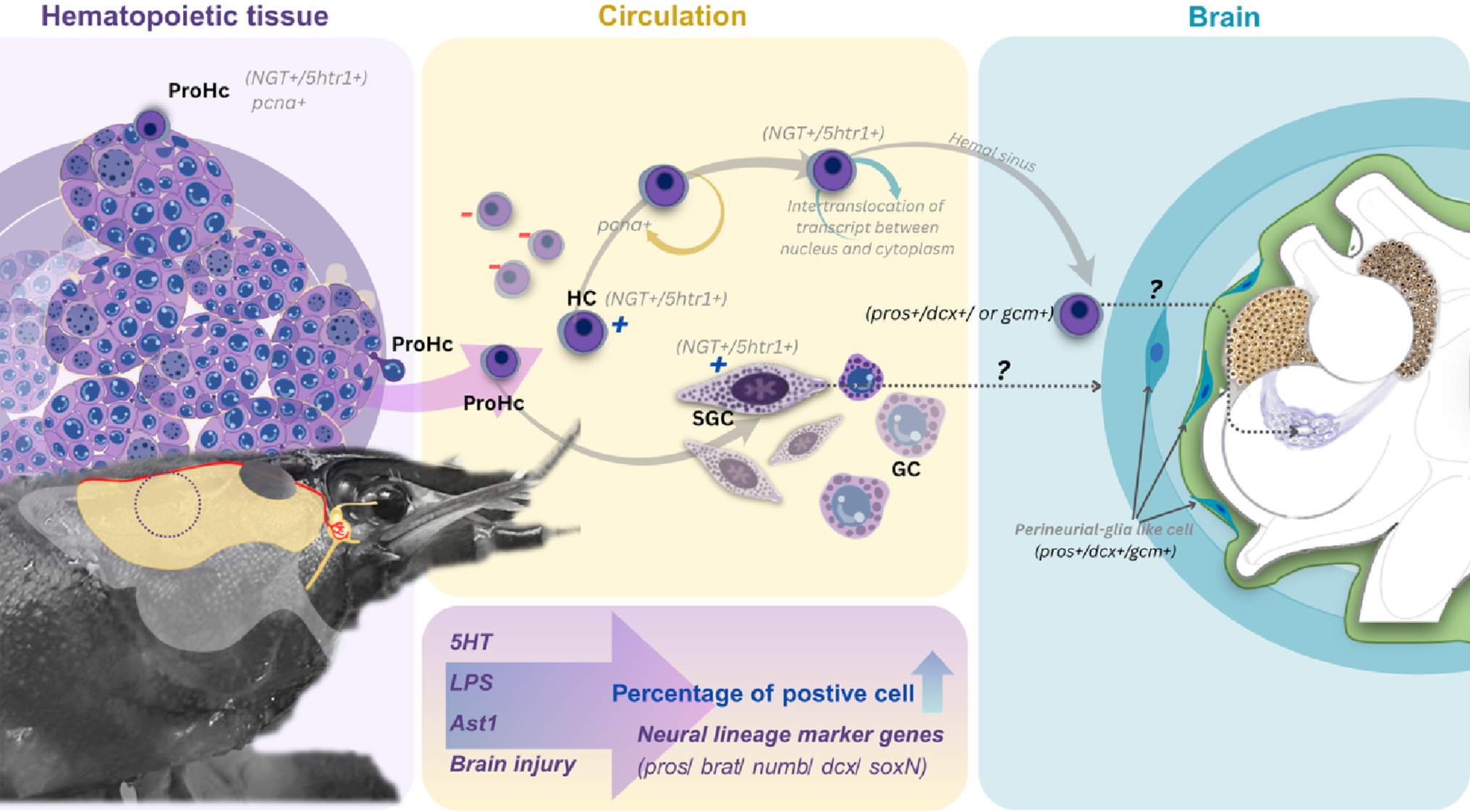
Previous experiments have indicated that neural progenitors are present in the circulation of freshwater crayfish, and that these are recruited to the neurogenic niche to form neurons in the brain area containing neurons innervating the olfactory lobe of the crayfish’s brain (Benton et al. 2022). Figure 1 shows a schematic illustration of the proposed mechanism of adult neurogenesis, in which hemocytes released from the hematopoietic tissue (HPT) and the anterior proliferation center (APC) are the sources of neural precursors. These precursor cells form mature neurons in the brain through a developmental process in the neurogenic niche, as shown in several earlier reports (Fig. 1) (Benton et al. 2011, 2013, 2014, 2022; Chaves-da-Silva et al. 2013). In order to find crustacean neurogenic specific marker transcripts in vivo, we searched in the P. leniusculus transcriptome from hemocytes and the HPT (Accession: PRJNA259594) for some candidate genes related to the formation of new neurons, including prospero (pros), brain tumor suppressor (brat), Notch signaling repressor (numb), doublecortin (dcx), and sox-neuro (soxN). Accordingly, the circulating hemocytes were examined for these transcripts using multiplex RNA-FISH.
Fig. 1
How adult-born neurons can originate from the immune system. Schematic illustration presenting the proposed mechanism of new neuron formation and integration in the brain of adult decapod crustaceans, which is modified from Benton et al. 2022. Previous experiments indicate that the immune and nervous systems interact to generate neurons in the adult brain of crayfish, and that the neural precursors responsible for producing these adult-born neurons originate from the hematopoietic tissue (HPT) and that they travel to the neurogenic niche via the circulatory system
As shown in Fig. 2A, we first used specific RNA probes to visualize the expression of the neural lineage-specific markers numb, brat, and pros in combination with the hemocyte-specific marker transcript Hml. Surprisingly, we found that these three putative neural lineage-specific markers were co-expressed in very few, but in the same hemocytes, and most importantly, not together with Hml expression (Fig. 2A–A″ and Supplementary Fig. 1A). Next, Fig. 2B shows another combination of probes, and the expression of brat, dcx, and pros was detected in the cytoplasm of the cell, but also here all transcripts were present in the same cell. This suggests that these are mature mRNAs localized in some specific circulating hemocytes (2B arrows, and Supplementary Fig. 1A, B).
Fig. 2
A low number of hemocytes expresses markers for neuronal precursor cells. Circulating cells are stained using different combinations of RNA probes specific for neurogenic transcripts by the use of multiple RNA-FISH. A A low-magnification micrograph showing that the putative neurogenic markers (numb in red, brat in yellow, and pros in green) co-localize in the same hemocyte, scale bar = 50 µm (magnified in inserts A’ and A”). However, they do not co-express with hml+ (in pink) in those expressing cells (inserts A’ and A”, scale bar = 10 μm). B In this micrograph one pros/brat+ hemocyte was also positive for the dcx transcript (arrow) scale bar = 20 μm. C A hemocyte expressing 5htr1, dcx and numb (arrow), whereas ast1, (in red) was expressed in several other hemocytes, scale bar = 20 μm. D Hemocytes (arrows) positive for soxN, numb and pros transcripts, scale bar = 20 μm. E and F The observed hemocytes positive for putative neurogenic markers can be classified into two major morphotypes: the hyaline-like (in E, scale bar = 10 μm) and semi-granular-like (in F, scale bar = 5 μm) cells. G Some of these putative neurogenic hemocytes were positive for “glia cell missing (gcm)” mRNA and the proliferation cell marker (pcna) (arrow). Hoe = Hoechst 33342 nuclear staining, scale bar = 20 μm
Since astakine1 (ast1) as well as serotonin (5-HT) have been shown to be associated with adult neurogenesis in Procambarus clarkii (Benton et al. 2022), we accordingly used a probe combination for co-localization of ast1 and a serotonin receptor type 1 (5htr1) expression together with putative neural lineage markers such as numb, pros, soxN and dcx in different combinations (Fig. 2C-D).
Figure 2C shows that numb was expressed in the same cells as dcx and 5htr1, and with a different probe combination as shown in Fig. 2D, numb mRNA was detected in the same cells as pros, and soxN. Figure 2C, and 2E-F show that ast1 and 5htr1 were expressed together with neural lineage markers in some cells, but the ast1 transcript was detected in several different hemocytes, indicating that this gene has a more general function (Fig. 2C, D and Supplementary Fig. 1C, D). When considering the transcript of “numb”, which was used for staining together with different probe combinations we conclude that also pros+ hemocytes could also express the 5htr1 in some cases (Fig. 2C and D).
When the morphology of neural lineage marker positive hemocytes was examined, hyaline (Fig. 2E and Supplementary Fig. 1E) and semi-granular (Fig. 2F and Supplementary Fig. 1F) hemocytes were the dominant cell types, which is consistent with earlier findings and descriptions in the crayfish P. clarkii. As shown in Fig. 2G, we observed expression of the presumed glia-specific gene, glial cell missing (gcm), and the cell proliferation marker gene (pcna) in the hemocytes, and they were co-localized with some of the neural lineage markers (pros and numb).
To assess whether hemocytes that were positive for other neural lineage markers were in a proliferative state, we examined their co-expression with pcna. As shown in Supplementary Fig. 2A–C, we divided the results for the hemocyte population into two sets with different patterns of mRNA expression; (1) pcna+ cells without any neural lineage marker transcripts (white arrow in Supplementary Fig. 2A–C), and (2) co-expression of the pcna+ cells with neural lineage marker transcripts (yellow arrow in Supplementary Fig. 2A–C). However, in the latter group, we were able to find variations in the level of gcm transcript. Some cells had a moderate expression of pcna, high expression of pros/numb, and high expression of gcm (yellow arrow in Supplementary Fig. 2A), while other cells had very low pcna expression, high expression of pros, moderate expression of numb and low expression of gcm (yellow arrow in Supplementary Fig. 2B). There were also some cells characterized by low pcna expression, moderate to low expression of pros, and absence or very low expression of numb/gcm (yellow arrow in Supplementary Fig. 2C). The negative controls, without gene specific probes, had no positive signals in any fluorescent channel (Supplementary Fig. 1H). These results suggests that there is a variation of developmental stages in neural lineage marker positive hemocytes. Therefore, we conclude that there is evidence for the presence of a small population of circulating hemocytes that express neural lineage marker transcripts.
Circulating Neural Progenitor Cells in HemolymphNext, we investigated the abundance of circulating hemocytes expressing neural lineage marker transcripts in naïve animals. As shown in Fig. 3A, we used two different probe combinations. First co-expression of 5htr1 together with soxN/numb/brat or soxN/numb/gcm or soxN/numb/dcx, and secondly, co-expression of pros together with numb and either brat, gcm or dcx (Fig. 3A). The reason for these two different probe combinations was technical limitations, since only four different fluorophores could be used at the same time.
Fig. 3
Circulating hemocytes positive for neural lineage marker transcripts account for approximately 1% of the entire hemocyte population. Violin plots show the percent of neural lineage positive cells per total hemocyte population and their spatial expression patterns of the neural lineage-specific transcripts in the hemocytes and analyzed by multiple RNA-FISH. A A violin plot showing the percentage of cells positive for co-localization of different neural lineage marker transcripts. Upper panel: proportion of 5htr1+ hemocytes co-localized with other neural lineage markers: either soxN/numb/brat, or soxN/numb/gcm, or soxN/numb/dcx. Middle panel: proportion of pros+ hemocytes co-localized with other neural lineage markers: either numb/brat or numb/gcm or numb/dcx; Lower panel: total proportion of hemocytes expressing neural lineage marker transcripts. The percentage of 5htr1 positive cells co-localized with other neurogenic markers (pink color) was 0.5\(\:\pm\:\) 1.03% of the total population, and the percentage of pros positive co-expressed with the other neurogenic markers (purple color), was 1.06\(\:\pm\:\) 1.53% of the total population of hemocytes. The black dots represent the individual values (percent of positive cells per total hemocytes) from each animal. B–B′ Positive signals of neural lineage marker transcripts were observed in the cytoplasm of some hemocytes without (B) and with phase contrast overlay (B′), scale bars = 10 μm. This example shows dcx, 5htr1, numb and Ast1. C–C′ Positive signals of neural lineage marker transcripts were observed within the nucleus of some hemocytes, scale bar C = 10 μm and C’=5 μm. The right panels of Ci–Civ show the different axes of the optical sectioning, as shown in a 3D-generated image of a positive hemocyte obtained by confocal microscopy, which indicates the localization of positive signals within the nucleus (white arrowheads). This example shows SoxN, 5htr1, brat and numb. D Positive signals of gcm transcript were observed, with (white arrow) or without (yellow arrow) co-localization with other neural lineage marker transcripts, scale bar = 10 μm
Figure 3A shows a quantitative analysis as violin plots and the percentage of cells positive for the co-localization of these different neural lineage marker transcripts. The proportion of 5htr1+ hemocytes co-localized with other markers (soxN+, numb+, and brat + or gcm + or dcx+), was approximately 0.5% (Fig. 3A, upper panel). The proportion of pros+ hemocytes co-localized with other neural lineage markers (numb + and brat + or gcm + or dcx+) was approximately 1% (Fig. 3A, middle panel). The proportion of total hemocytes expressing neural lineage marker transcripts was in total around 1%, which indicates that 5htr1 is not expressed in all potential neural precursor cells (Fig. 3A, lower panel, with a yellow highlight).
As shown in Fig. 3B–B′ a cytoplasmic localization of the neurogenic marker transcripts was found in some cells (Fig. 3B–B′, yellow arrowhead), as well as within the nucleus in some (Fig. 3C–C′, white arrowhead). Nuclear localization was confirmed by Z-stacking fluorescent images of the positive hemocyte using confocal microscopy in three-dimensional axes (Fig. 3Ci–Civ).
Figure 3D shows that a few cells were found to express gcm, but without the presence of other neural marker transcripts (Fig. 3D, yellow arrow), and these cells had a more granular morphology as was previously observed in isolated brain cells in the crayfish P. leniusculus by Junkunlo et al. (2020). In summary these results so far indicate that there are about 1% of neural lineage progenitor cells in crayfish hemolymph that express several neural marker transcripts, and in addition a few cells only express gcm which imply that these may be precursors of glial cells.
The Hematopoietic tissue, a Source of Neural Precursor CellsTo further address the origin of the circulating neural progenitors, we examined horizontal and sagittal HPT tissue sections using different sets of neural lineage-specific RNA-probes. We found a few cells expressing these marker genes within the hematopoietic tissue (HPT), and some examples are shown in Fig. 4A (pros+/numb+), and Fig. 4D (5htr1+/dcx+/numb+/brat+). A common characteristic of these cells was their condensed nuclei. Moreover, we found some pros+/numb+/soxN+ HPT cells that appear to have been released from the HPT-lobule into a hemal sinus. One such cell is shown in Fig. 4B (white arrow). A sagittal section of the HPT illustrates two positive cells with different patterns of their mRNA marker expression (Fig. 4C). One cell positive for 5htr1, numb, brat, and soxN was located close to the apical surface of the HPT, (Fig. 4C, yellow arrow), and another cell expressing soxN and 5htr1 but not brat or numb was found close to the basal side (Fig. 4C, white arrow). Most cells positive for any neural lineage marker transcripts shared some common characteristics, i.e., round shape, low amount of cytoplasm, intense nuclear staining and located at the periphery of a lobule and that some were recently released from a lobule. In contrast to the HPT, no positive signals of the specific neural progenitor transcripts were detected in cells of the anterior proliferation center (APC). We could only detect some cells expressing 5htr1, and they were also co-expressing hml This observation points to a role in immunity and this assumption is consistent with some previous reports (Noonin 2018; Tong et al. 2020) (Supplementary Fig. 3).
Fig. 4
Localization of cells expressing neural lineage marker transcripts in the hematopoietic tissues (HPT) analyzed by multiple RNA-FISH. A A horizontal section of the HPT showing co-localization of the neural lineage marker transcripts pros and numb with the proliferation marker pcna and ast1 in a cell that remains inside a HPT lobule (white arrow), scale bars = 20 μm (insert scale bars = 10 μm. B High magnification of another area in the HPT, where a released cell positive for (pros+/numb+/soxN+) was found (white arrow), scale bars = 10 μm. C A sagittal section of HPT tissue showed different cells positive for neural lineage markers. One 5htr1+/soxN+ cell (white arrow) was observed close to the basal margin of the HPT (red arrow heads indicate the basal lamina), and one 5htr1+/soxN+/numb+/brat+ cell (yellow arrow) was observed in the loose organized HPT lobule, where it is located close to the apical surface (indicated by a dashed line) of HPT, scale bars = 20 μm. D A similar pattern could be observed in other areas of the HPT tissue, where a few cells positive for 5htr1+/numb+/ brat+/dcx+ were observed in the apical (dashed line) and basal areas (close to the thin lining of the basal membrane, indicated by red arrowheads) of the HPT section (white arrows). Abbreviation: HS; hemal sinus, scale bars = 20 μm
Neural Progenitor Hemocytes Increase in the Circulation Following Stimuli TreatmentGiven that earlier studies have shown an increase of cells in the neurogenic niche after injection of recombinant astakine1 (rAst1) (Benton et al. 2014, 2022), or treatment with 5-HT (Benton et al. 2022), and that hemocytes with transcripts related to the nervous system were increased after LPS injection in crayfish (Xin and Zhang 2023), we investigated the proportion of circulating neural progenitors after such stimuli. Figure 5A describes the experimental design used to determine the number of neural lineage marker transcript-positive cells among circulating hemocytes, before and after different treatments. As a negative control, injection with crayfish saline (CFS) was used (Fig. 5A). Apart from neural lineage marker transcripts, the expression of 5htr1 was also included in this study since 5-HT has been shown to influence adult neurogenesis in crayfish (Zhang et al. 2011; Benton et al. 2022). We used two different probe combinations with numb as an overlapping probe in order to get as much information as possible for neural lineage marker labelling and quantification (Supplementary Table 2).
Fig. 5
Illustration showing the procedures of the in vivo assays. A Method for collecting circulating hemocytes for RNA-FISH before and after stimulation with the putative stimulating agents, injection of 5-HT (10− 9M 5-HT in CFS), recombinant Ast1 (0.05 mg/g body weight), or LPS (0.01 mg/g body weight), as well as a control using CFS injection. B Method for collecting circulating hemocytes for RNA-FISH before and after brain injury to study the effect of injury on the number of hemocytes positive for neurogenic markers
Figure 6 shows the percentage of positive hemocytes in each individual before and after the different injection treatment. The effect of injection of 100 µL, 5-HT at 10− 9M, is shown in Fig. 6A. The percentage of neural lineage marker transcript-positive cells was below 1% before treatment. One day after the treatment, the percentage of positive hemocytes significantly increased as determined with two different probe combinations. The percentage of hemocytes with neural lineage pros/gcm/numb positive transcripts was 3.35 ± 1.22 (P = 0.0011), and of neural lineage soxN/numb/brat positive transcripts in the hemocytes was 3.13 ± 1.10 (P = 0.0009). In a combination of data with both sets above, the percentage of positive transcripts in the hemocyte was 3.15 ± 0.67 (P = 0.0001) (Fig. 6A in left, middle, and right (framed) panel, respectively).
In Fig. 6B, the effect of LPS injection is shown, and the percentage of pros/numb/brat-positive cells before treatment was variable around 1%, and if dcx was included it was lower. No statistic significant difference was detected one day after injection when experiments probed with dcx/numb and pros/numb/brat neural lineage marker transcripts were analyzed separately. In contrast, a combination of data from the (dcx/numb and pros/numb/brat) positive signals resulted in a significant increase when comparing before and after treatment [1.68 ± 0.82 (P = 0.0270)] (Fig. 6B right framed panel).
Fig. 6
The percentage of hemocytes positive for neural lineage marker transcripts in the circulation “Before” and “After” treatments in the in vivo assays. The percent of hemocytes positive for neural lineage marker transcripts in different probe combinations; A before and after injection of 5-HT (100 µl 10− 9M), n = 6. B before and after injection of LPS (0.01 mg/g BW), n = 4. C before and after injection with CFS (100 ml) as control, n = 4. D before and after injection of Ast1 (0.05 mg/g BW), n = 6. E Co-localization of the 5htr1 + signal with the other neural lineage marker transcripts in 5-HT (right, n = 6) and LPS (left, n = 4) injection assays. Comparison was done between “before” and “after” treatment samples for each individual, and analyzed with “Paired T-test” (two-tailed), and normal (Gaussian) distribution were tested with the “Shapiro-Wilk normality test” and “Q-Q plot. The asterisks (*), (**), (***), (****) refer to statistic significant differences: P\(\:\le\:\)0.05, P\(\:\le\:\)0.01, P\(\:\le\:\)0.001, P\(\:\le\:\)0.0001, respectively, “ns” indicates “no statistic significant difference”
As shown in Fig. 6C, the percentage of positive neural lineage marker transcripts was not significantly different for pros+/gcm+/numb + or soxN+/numb+/brat+, or their combination in the circulating hemocytes before and after CFS control injection (Fig. 6C; P = 0.67, P = 0.18, and P = 0.28, respectively).
In Fig. 6D the effect of injecting 0.05 µg/g body weight recombinant Ast1, it was found that the percentage of positive neural lineage marker transcripts, pros+/numb+/gcm+, was significantly increased (3.26 ± 2.77, P = 0.0344) (Fig. 6D).
As we had noticed that some hemocytes which expressed neural lineage markers at the same time expressed the serotonin receptor 5htr1, we also tested whether the expression of this receptor was affected by 5-HT injection. Thus, we counted positive signals of 5htr1 transcript, co-localized with soxN+/numb+/brat + in hemocytes, before and after 5HT-injection assay, and as shown in Fig. 6E, a large increase in positive hemocytes was found. (Fig. 6E, left panel). This effect was specific for 5-HT injection since LPS injection did not give similar result (Fig. 6E, right panel).
Brain Injury Induced an Increase in Neural Lineage Marker Positive HemocytesNext, we punctured the brain with a thin needle to induce a penetrating traumatic brain injury, in order to evaluate the proportion of neurogenic hemocytes as a result from such injury of the brain. Hemocytes were collected from the same individual before and then 2 days after the injury to the crayfish brain (Fig. 5B). This was followed by experiments using RNA-FISH in circulating hemocytes using two probe combinations.
As shown in Fig. 7 the percentage of neural lineage marker transcript-positive cells before induction was below 1%, and 48 h after brain injury the percentage of neural lineage marker transcript-positive hemocytes increased significantly, both for the probe combination dcx+ (or soxN+), numb+, gcm+ cells (Fig. 7, left panel, P = 0.0143) and for the probe combination pros+, brat+, numb+ cells (Fig. 7, middle panel, P = 0.0205). A combination of the two probe sets revealed that the percentage of neural lineage marker transcript-positive cells after brain injury was significantly higher and constituted 1.89% of the total cells compared to before induction (Fig. 7, right framed panel, P = 0.0005). As shown in Supplementary Fig. 4. the number of circulating hemocytes after brain injury compared to a bleeding control did not change significantly although for some animals there was an increase.
Fig. 7
The percent of hemocytes positive for neural lineage marker transcripts in the circulation “Before” and “After” performing “brain injury induction”. Left panel: percentage of positive hemocyte for dcx+ (or soxN+), numb+, and gcm + in the circulation. Middle panel: percentage of positive hemocyte for pros+, brat+, and numb + in the circulation. Right panel: A summarized inclusion of two probe combination. Comparison was done between “before” and “after” treatment samples for each individual, and analyzed with “Paired T-test” (two-tailed), and normal (Gaussian) distribution were tested with the “Shapiro-Wilk normality test” and “Q-Q plot. The asterisks (*) and (***) refer to statistic significant differences: P\(\:\le\:\)0.05 and P\(\:\le\:\)0.001, respectively, n=9
Crayfish brain, its organization, and Neurogenic Cell IdentificationThe brain histology of P. leniusculus was analyzed in two different anatomical planes as shown in Fig. 8, including horizontal and sagittal views, and then stained with a routine hematoxylin and eosin (H&E). Brains, collected from crayfish that had been injected with Indian ink, were used for histological studies to localize the vascular area associated with the brain tissue.
Fig. 8
Histology of brain tissue sections stained with H&E in horizontal and sagittal planes. A Low magnification of the right hemisphere of the intact brain tissue shows the brain sheath (or perineural sheath) surrounding the brain mass (including the neuropils and cell bodies), scale bar = 250 μm. B High magnification of the part labelled B in panel A, of the brain tissue near the neuronal cluster 10, which shows a loose connective tissue surrounding the brain mass, known as “intracerebral connective tissue,”. This tissue is enwrapped in a thick brain sheath, separating the external and internal environments. The brain sheath is lined internally by some unknown cell types shown by blue arrowheads in the insert, but their organization appears to be similar to that of the “perineural glia” of Drosophila (Hartenstein 2011), scale bar = 75 μm. C, D Parasagittal sections passing through: C at the area of the antennular nerve (An1Nv) entering the brain and terminating in the olfactory lobe (OL), and: D lateral to the area in C as indicated in the small brain pictures (Br) (please see Fig. S4D), scale bar = 250 μm. E A high-magnification area from part of D, a bundle of An1Nv was found at the location of the area between the olfactory lobe (OL) and accessory lobe (AcL), a particular area of interest for observing the neurogenic niche or its migratory stream (yellow area), (blue arrow indicated ink-signal). Abbreviations: PT; protocerebral tract, AMPN and PMPN; anterior and posterior median proto-cerebral neuropils respectively, CB; central body, OGTN; olfactory globular tract neuropil, MAN and LAN; medial and lateral antennular neuropils, AnN; antennular neuropil, ExCCT; external cerebral connective tissue, AV; anterior-ventral, PI; posterior-interior, scale bar = 75 μm
In the following text we used the term glia in the same way as for Drosophila species (Hartenstein 2011), and for brain the terminology of Sandeman et al. (1992). The tissue organization consists of intact structures, aligning from the periphery to the central brain mass. The brain contains neuronal clusters, associated glia, as well as puncta of neuronal fibers and neuropils (Fig. 8A–E). In the periphery, the brain is covered with a thick layer of “brain sheath” (Fig. 8A, B), which separates the connective tissues wrapping the brain into the “external cerebral connective tissue (ExCCT)” and “internal cerebral connective tissue (InCCT)” (Fig. 8B). The adjacent cells lining beneath the brain sheath are called the “perineurial glial-like cells,” which are the most peripheral cells of the brain that have been found (Fig. 8B, arrowheads). Inwardly, a loose connective tissue (InCCT) surrounds the brain mass, which is occupied by “sub-neural glia” (Fig. 8B). The neuropil-associated or ensheathing glia and cortex-associated glia (as in Drosophila) and are situated around neural bodies in the cortex) are the innermost layers that are located and form part of the brain mass (Fig. 8B).
The outer cerebral vascular plexus (OVs) was identified at histological levels (Fig. 8D, E). The sagittal planes show where the antennular nerve (An1Nv) passes through the brain, ventrally (Fig. 8C, D), and Supplementary Fig. 5 shows the ventral morphology of the brain with the section planes for Fig. 8C, D). Ventromedially to the brain, the An1Nv bundle was found, which penetrates the brain sheath before connecting to the olfactory lobe (OL) (Fig. 8C). In another parasagittal section, laterally, a tissue bundle of the An1Nv remains present. At the same time, the neurogenic niche and/or the neurogenic streams were identified underneath that area (Fig. 8D-E).
As shown in Fig. 9 localization of cells that expressed neural lineage marker transcripts was detected in the sagittal tissue sections of the brain and pros+/dcx+/gcm−/numb− cells were located both inside (white arrow in Fig. 9A-B) and outside (yellow arrow in Fig. 9A-B) the brain sheath. The boundary of which is shown in Fig. 8B, and Fig. 9B-C. The positive cells were located outside the brain and situated near the nerve bundle (indicated by the yellow arrow in Fig. 9A). The flattened perineurial-like glial cells inside the brain sheath were pros+/dcx+ (Fig. 9B, green arrows), in addition to some round cells inside the hemal sinus (Fig. 9B, yellow arrow). Interestingly, the pros+/dcx+ cell located near the brain sheath co-expressed gcm in the same cell, while any expression of the numb gene was not detected (Fig. 9B, yellow arrow). Control experiments for any autofluorescence and non-specific signal are shown in Supplementary Fig. 6)
Fig. 9
Cells positive for neural lineage marker transcripts are present in brain tissue sections. A Sagittal brain section at the area of the olfactory (OL) and accessory lobes (AcL) showing pros+/dcx+ positive signals in the perineural glial-like cells (indicated by white arrows), which line inside the brain sheath (red dashed line) and the undefined cells associated with the An1Nv bundle (yellow arrows), scale bar = 200 μm, and magnified are scale bars = 20 μm. B A parasagittal section passing through the outer vascular plexus or vessels (OVs), which is associated with the An1Nv (in the area of white dashed line), showing pros+/dcx+ cells in the perineural glia-like cells (green arrow), and in round-shaped cells, which are located inside the ink-labelled vasculature (yellow arrow). A red dashed line indicates the brain sheath, scale bar = 20 μm. C A round-shaped pros+/dcx+/gcm+ cell (yellow arrow) was found close to the area of the brain sheath (red dashed line). Abbreviations: S; superior, V; ventral, scale bar = 20 μm and magnified are scale bars = 10 μm
Comments (0)