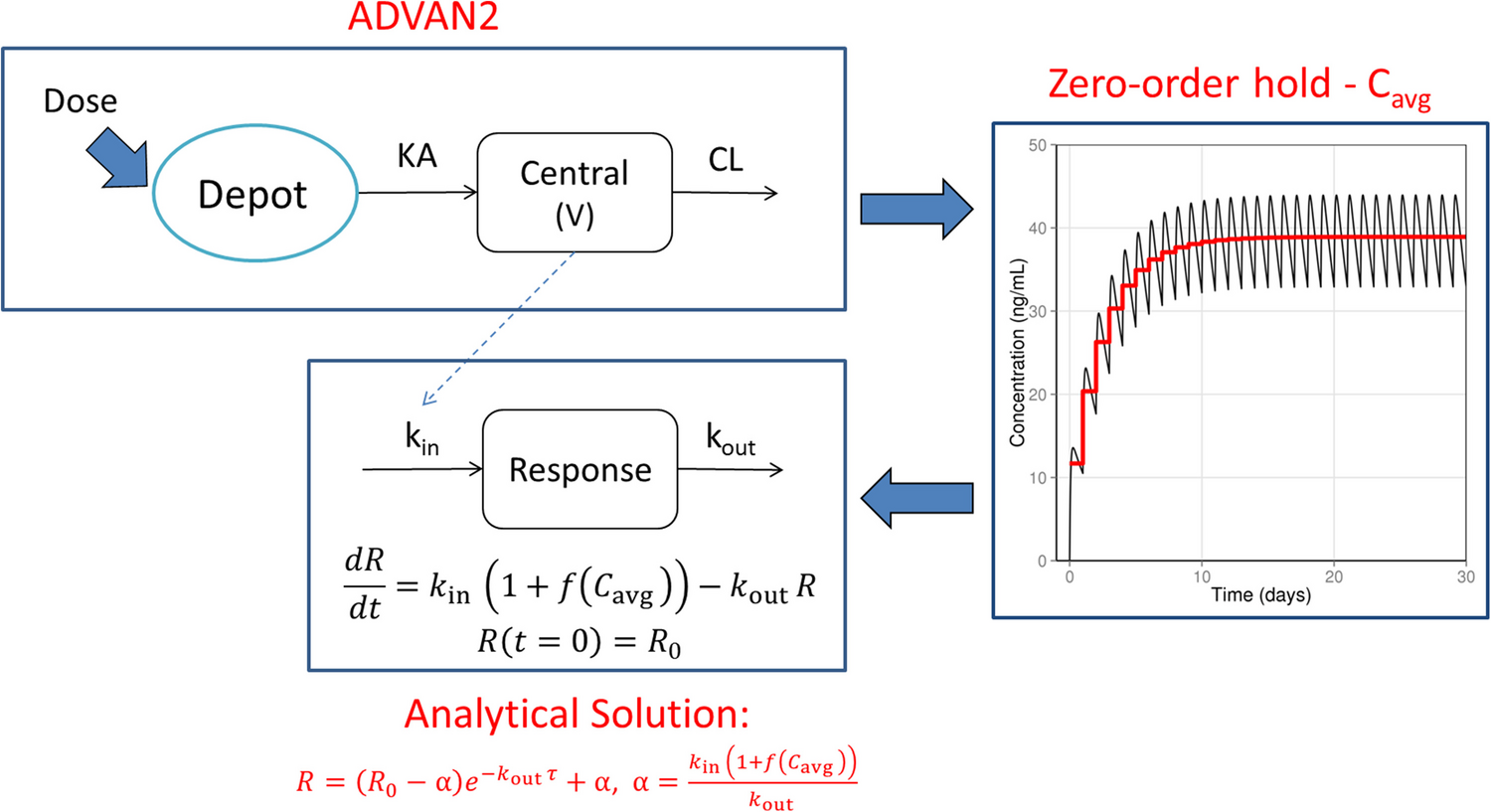
Appendix 1: R code to calculate Cavg
## simulate the PK over the study
rm(list = ls()) # clear the environment
graphics.off()
options(stringsAsFactors=FALSE)
library(ggplot2)
library(dplyr)
library(mrgsolve)
library(magrittr)
select <- dplyr::select
plot.me <- TRUE
set.seed(-1)
auc.f = function(xIn, yIn)
## set up the 1-compartment model
code <- '$PARAM TVCL = 1.6, TVV=28, TVKA=0.6, DOSE=-1
$PKMODEL ncmt=1, depot=TRUE
$CMT GUT CENT
$SET req="GUT CENT"
$GLOBAL
$MAIN
double KA = TVKA;
double CL = TVCL*exp(IIVCL);
double V = TVV*exp(IIVV);
$OMEGA @annotated
IIVCL: 0.1 : CL
IIVV: 0.1 : V
$TABLE
double IPRED = CENT/V*1e3;//convert mg/L to ng/mL
double DV = IPRED;//DV is ng/mL
double DAY = floor(TIME/24)+1;
$CAPTURE IPRED DV DAY KA CL V DOSE'
## load the PK model
mod <- mcode("pk_1cmt", code)
## generate a PK data set
tbl.sim <- expand.ev(amt=c(0,10,30,100),id=1:10,addl=27,ii=24) %>% mutate(DOSE=amt)
## here is the time grid to 30 days
des <- tgrid(0,24*30-1e-10,0.1)
## simulate the PK model
out <- mod %>% mrgsim(data=tbl.sim,tgrid=des)
## calculate PK metrics by day
tbl.pk <- out %>%
as.data.frame %>%
group_by(ID,DAY,DOSE) %>%
summarise(
AUC = auc.f(xIn=time, yIn=IPRED),
CMAX = max(IPRED),
CMIN = min(IPRED)
) %>%
mutate(CAVG=AUC/24)

Comments (0)