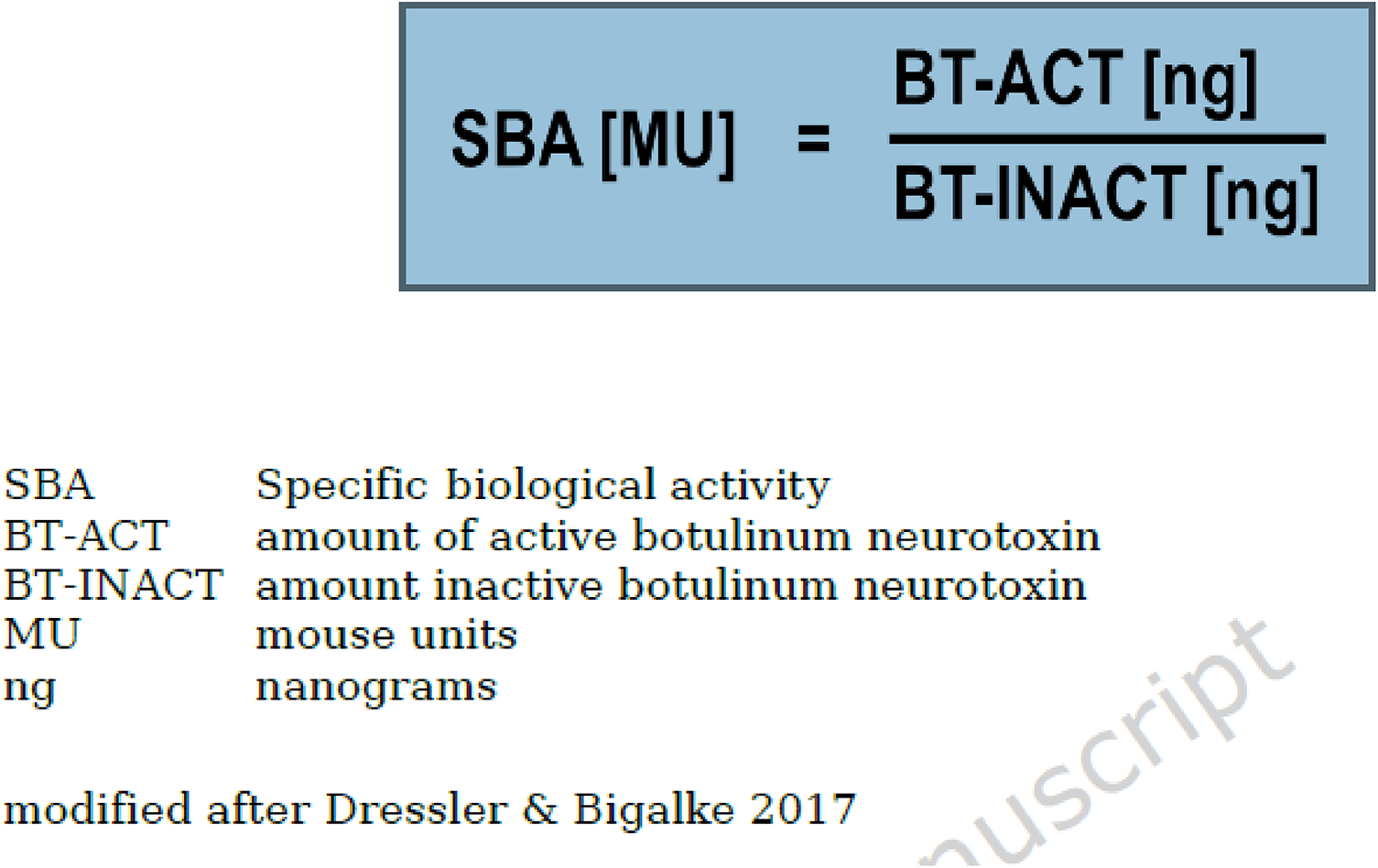
Potency is the most important critical quality attribute (CQA) of BT drugs. Potency describes the biological activity of a BT drug. Uncertainties about potency bear substantial risks for BT’s clinical use. They also make comparative studies on efficacy, safety and costs impossible.
Potency of BT drugs is best measured in biological models, typically in lethality assays based on dose-effect curves monitoring mouse lethality. For potency measurements of BT drugs, a standard mouse lethality assay has been described in much detail in various pharmacopoieae with potencies given in LD50 units or mouse units (MU). Although these lethality assays are standardised, clinical practise shows, that the MU determined by them are not identical. As a consequence of this, the FDA has explicitly warned, that the potency labelling of BT drugs are not directly comparable.
Whereas MU of Allergan, Merz and Lanzhou are identical (Dressler 2010; Dressler et al. 2012, 2014, 2018; Pan et al. 2019), Ipsen’s MU are clearly different and a conversion factor needs to be applied. However, there is - so far - no agreement as to which conversion factor might be appropriate (Scaglione 2016). Suggested conversion factors range from 1:1 (Wohlfahrt et al. 1997) to 1:11 (Marchetti et al. 2005). Supernus MU are also idiosyncratic and have to be converted by using a conversion factor of 1:40 to become comparable to MU of ONA, INCO and LAN (Dressler and Eleopra 2006).
The idiosyncrasy of Ipsen’s and Supernus’ potency labelling became only apparent after the registration and after more wide-spread clinical experience was gathered.
For the development of new BT drugs an unambiguous potency labelling is critical. Basing the potency labelling on an external industry standard would have solved this problem. However, manufacturers did not agree on this and still use their internal potency reference standards. As long as internal potency reference standards are applied, conversion factors should be provided by the manufacturers to allow comparisons on efficacy, safety and costs. Reference to the potency labelling of ONA, INCO and LAN would be preferable, whereas idiosyncratic potency labelling will hinder the clinical use and the positioning of a new BT drug in the market.
Therapeutic profiles of BT types and BT subtypes
Therapeutic profiles describe the efficacy and safety of BT drugs. For efficacy, the onset latency and duration of the therapeutic effect are described and for safety, the kind of adverse effects. They are directly related to BT’s molecular structure. They are also a CQA of BT drugs.
BT is a di-chain protein produced by Clostridium botulinum (Dressler and Foster 2018). BT’s mode of action includes three steps. In the binding step, in which BT binds with its heavy chain to ganglioside acceptors on the neuronal cell surface and co-binds to the specific BT receptors synaptotagmin or synaptic vesicle protein 2 (SV2) depending on the BT type (Dressler and Foster 2018). In the translocation step, BT is internalised into the nerve terminal cytosol. In the cleavage step, BT’s light chain cleaves one or two of the SNARE proteins SNAP25, VAMP (Synaptobrevin) and Syntaxin, again depending on the BT type. This blocks the secretion of acetylcholine into the synaptic cleft (Pantano and Montecucco 2014).
Although the protein structure of the BT types and BT subtypes is similar, differences do exist. All of those molecular differences may affect all three elements of BT’s mode of action including binding, translocation and SNARE protein cleavage and - with this- may directly affect BT’s therapeutic profile.
For BT type A (BT-A), the therapeutic profile is well established by animal studies and by extensive clinical use covering numerous indications, large patient populations and its prolonged clinical use.
BT type B (BT-B) was initially developed as an alternative to BT-A. As predicted from animal experiments, its efficacy is similar to BT-A with similar onset latency and similar duration of action. Its safety, however, differs substantially from that of BT-A (Dressler and Benecke 2003): whereas BT-A has a relatively strong effect on neuromuscular cholinergic synapses, BT-B has a relatively strong effect on autonomic cholinergic synapses. This means, in order to produce sufficient muscular efficacy, strong autonomic adverse effects have to be accepted. In animal studies, these safety differences were not detected and neither the manufacturer nor the FDA anticipated them, so that they were not monitored in the registration studies. These autonomic adverse effects only became apparent, when larger patient populations were treated and independent and unbiased observations became possible after the drug became widely available in the market (Dressler and Benecke 2003).
BT type E (BT-E) (trenibotulinumtoxinE, TRENI, Allergan-Abbvie) is currently under clinical investigation. Animal studies and clinical data suggest a special therapeutic profile with rapid onset and short duration of action (Yoelin et al. 2018; news.abbvie 2023). The complete safety profile, however, is not yet available, so that potential autonomic adverse effects cannot be evaluated.
For other non-A- and non-B-BT types, animal data only describe some aspects of their efficacy usually durations of action and onset latencies. Human experience is restricted to few experimental BT applications only (Dressler et al. 2019; Eleopra et al. 2020; Chen et al. 1998; Greene and Fahn 1993; Sheean and Lees 1995).
For BT subtypes such as BT subtype A6 (BT-A6) (Moritz et al. 2018; Whitemarsh et al. 2013) only preliminary animal data on efficacy dynamics are available. A current BT-subtype A2 (BT-A2) drug development project provides some preliminary clinical data in addition to animal efficacy dynamics data (Takeuchi et al. 2021).
For BT drug developmen, this means, that animal studies are not sufficient enough to predict therapeutic profiles, neither with respect to efficacy nor with respect to safety. Whereas differences between BT types may be substantial, differences amongst BT subtypes may be minor. Obviously, this bears substantial risks for BT drug development: favourable therapeutic effects predicted by animal experiments may not be confirmed in human applications and adverse effects not detected in animal experiments may occur in human use.
Pilot studies in humans would help to predict therapeutic profiles in patients. Unfortunately, they have become increasingly difficult to perform, as BT study material now has to be drug grade and has to be manufactured according to FDA-GMP standards.


Comments (0)