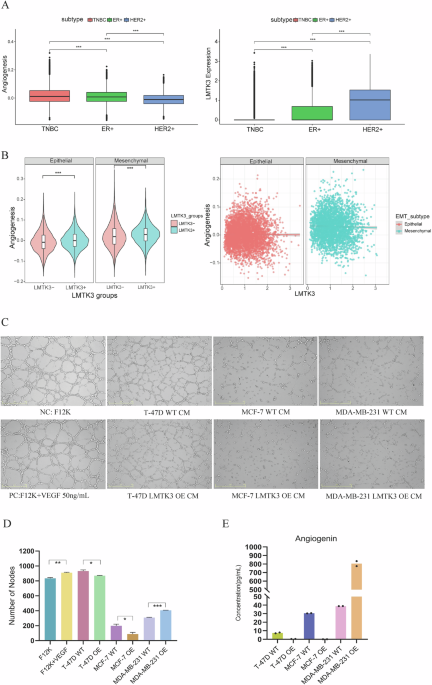
This study resolves prior contradictions regarding LMTK3’s role in angiogenesis by identifying it as a principal upstream driver of MET in BC, providing a biological explanation for the observed “Simpson’s paradox” phenomenon. We demonstrate that LMTK3 does not directly transcriptionally regulate angiogenic genes but instead functions as a central regulator of cellular plasticity, thereby shaping the secretory profile of tumor cells in a context-dependent manner.
We propose a hierarchical model wherein the pre-existing EMT state of the tumor cell dictates the angiogenic outcome of LMTK3 activity (Fig. 3). In mesenchymal TNBC, LMTK3-driven MET induces a highly plastic, pro-angiogenic p-EMT state, aligning with evidence that such hybrid states confer heightened tumorigenic and metastatic potential compared to fully mesenchymalized or fully epithelialized cells [11,12,13,14]. Conversely, in epithelial luminal BC cells, LMTK3 reinforces a rigid hyperepithelialized state, constraining plasticity and suppressing MAPK/ERK-driven pro-angiogenic factor secretion, potentially influencing less invasive metastatic trajectories. Thus, LMTK3 operates as a contextual angiogenic switch—promoting vascularization in TNBC while suppressing it in luminal subtypes. This mechanism perfectly explains why, despite the overall low expression of LMTK3 in TNBC, its expression level still correlates positively with angiogenesis scores.
Notably, despite LMTK3-OE persistently driving the MET program, functional reversal by the C28 inhibitor exhibits complexity across different cell lines. Unlike gene knockdown, C28 is an ATP-competitive inhibitor. Given the multi-target pharmacology typical of kinase inhibitors, C28 may exert off-target effects on other kinases regulating the EMT/MET spectrum. This may explain why C28 treatment did not reverse the LMTK3-OE phenotype across all molecular markers. Specifically, the incomplete reversal of E-cadherin or p-ERK suggests that LMTK3 may also function through scaffold protein interactions independent of its catalytic activity, or that C28-mediated inhibition triggered compensatory signaling pathways within the angiogenic microenvironment. Ultimately, in order to delineate the mechanistic involvement of LMTK3 in MET, subsequent investigations should employ genetic perturbation via siRNA-mediated knockdown and/or CRISPR-Cas9 knockout.
From a translational perspective, LMTK3 inhibition represents a promising therapeutic strategy in TNBC that extends beyond direct cytotoxicity. However, this context-dependent nature presents a therapeutic paradox for luminal BC. While LMTK3 inhibition benefits targeting the ERα signaling pathway and cell proliferation, our data suggest that such inhibition could theoretically inadvertently release the “super-epithelial” inhibition of angiogenesis, thereby promoting vascular remodeling. This suggests that in luminal subtypes, optimal efficacy may require combination therapy with anti-angiogenic agents (e.g., bevacizumab) to counteract this potential side effect. By blocking the MET driver, such inhibition could force tumor cells to exit the pro-angiogenic p-EMT state, thereby suppressing neovascularization or promoting tumor vascular normalization.
Future research should validate this “vascular normalization” hypothesis in TNBC-derived patient-derived xenograft models. Specifically, the efficacy of combining the LMTK3 inhibitors with standard chemotherapy (e.g., paclitaxel) should be evaluated to determine whether LMTK3 inhibition can improve tumor perfusion, alleviate hypoxia, and enhance chemotherapeutic delivery.

Comments (0)